 This seems quite apt after my recent dig at the Frogs!! (http://pauljamesog.blogspot.com/2009/10/complete-military-history-of-france.html)
Friday, 30 October 2009
French Military Victories
This seems quite apt after my recent dig at the Frogs!! (http://pauljamesog.blogspot.com/2009/10/complete-military-history-of-france.html)


Tuesday, 27 October 2009
HMS Rocket
Another YIAWWS Exclusive - by Vanvlak Industries!
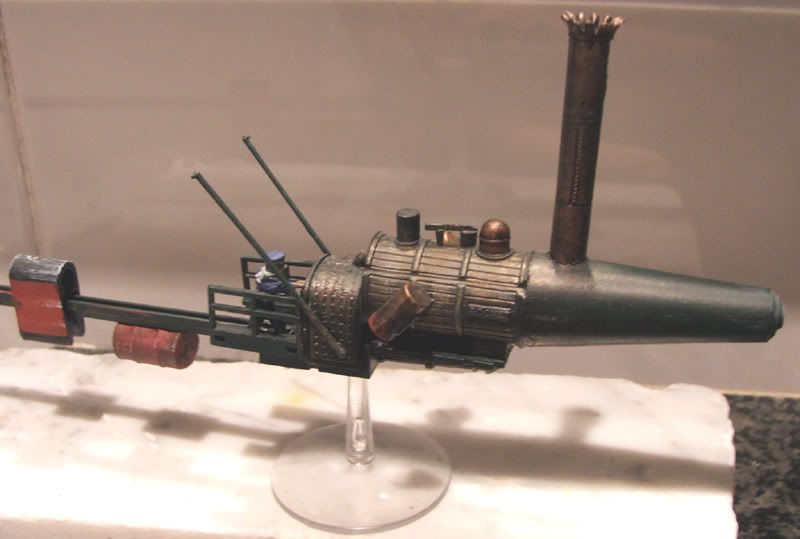
HMS 'Rocket' is the lead ship of the MkII Airborne Steam Shunt (A.S.S.) class of unarmed vessel, a short range flyer used to shuffle cargo around docks. The long rail at the rear is used to attach cargo onto. The MkIIa is similar but has a redesigned aft section and is a dedicated dirigible and aeronef tug, although the MkII itself is sometimes put to the same use. The MkIIb is identical to the MkII but has an enclosed cockpit for space use.
'Rocket' is currently attached to the Mediterranean fleet, and has seen service in Malta and Graham Island.*
*http://en.wikipedia.org/wiki/Ferdinandea
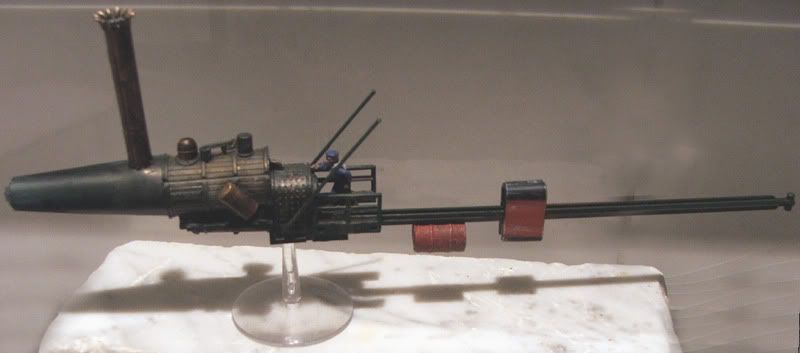
It's the first model in a new collection of vehicles I intend to build (no bets on whether I'll actually get them done...). They will be a loose assortment of Victoriana, mostly vehicles with some troops, all in 15mm scale. I'm currently working on the second vehicle, a Mk I Conveyancer. The vessels will be part of a joint British (Imperial)/Venetian force. I still have no idea what they are up to in the Mediterranean, or who their enemies would be (Barbary Coast Pirates? The Russian Navy?).
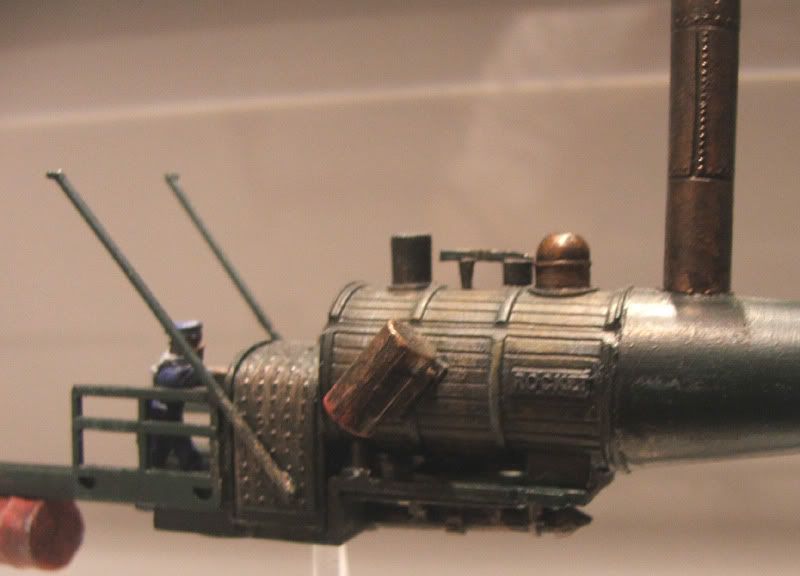
Peter Pig sailor at the helm.
Bravo old Boy - we've missed your unique style and great skills around here!
HMS 'Rocket' is the lead ship of the MkII Airborne Steam Shunt (A.S.S.) class of unarmed vessel, a short range flyer used to shuffle cargo around docks. The long rail at the rear is used to attach cargo onto. The MkIIa is similar but has a redesigned aft section and is a dedicated dirigible and aeronef tug, although the MkII itself is sometimes put to the same use. The MkIIb is identical to the MkII but has an enclosed cockpit for space use.
'Rocket' is currently attached to the Mediterranean fleet, and has seen service in Malta and Graham Island.*
*http://en.wikipedia.org/wiki/Ferdinandea
It's the first model in a new collection of vehicles I intend to build (no bets on whether I'll actually get them done...). They will be a loose assortment of Victoriana, mostly vehicles with some troops, all in 15mm scale. I'm currently working on the second vehicle, a Mk I Conveyancer. The vessels will be part of a joint British (Imperial)/Venetian force. I still have no idea what they are up to in the Mediterranean, or who their enemies would be (Barbary Coast Pirates? The Russian Navy?).
Peter Pig sailor at the helm.
Bravo old Boy - we've missed your unique style and great skills around here!
Sunday, 25 October 2009
Attack on Melbourne
Interesting details of a colonial harbour defense plan (minus the aerostats and aquanefs of course!)
http://www.awm.gov.au/journal/j35/kitson.asp

http://www.awm.gov.au/journal/j35/kitson.asp
Tuesday, 20 October 2009
Old School Balkan Dirigibles
Gentlemen,

A Turkish cruiser squadron on patrol, no doubt searching the Greeks or Bulgarians.


Finally the Bulgarians - the large model in the centre has some outrigger launching rails for fixed wing aircraft although sadly I never got around to adding them.
Below are a selection of the scratch built Dirigibles I made for the Balkan Air Fleets some 4 years ago - certainly the Turks pre date Brigades models. They are now residing in the collection of Steve Blease and are rumoured to be appearing in the 2nd edition of Aeronef when it is published. These wee very simple to build - consisting of spare aircraft bombs and drop tanks with various pieces of scrap plastic and sprue added to taste. The Turkish Carrier started life as the Revell Hindenburg kit with much chopping about. I really must get around to making some more of these as the basic technique I used has improved with practise and the fact that Brigade produce a load of usable bits to add to the resultant model.
The Turkish carrier Messudieh - note the wing turret type rails for launching fixed wing fliers.
A Turkish cruiser squadron on patrol, no doubt searching the Greeks or Bulgarians.
The Greek Coastal defence Dirigibles Psara, Hydra and Spetsai.
A Greek escort squadron of small destroyer sized dirigibles.
Finally the Bulgarians - the large model in the centre has some outrigger launching rails for fixed wing aircraft although sadly I never got around to adding them.

It was great fun making these and I am sure the next lot will be even better.
I hope you enjoy this piece of Aeronef history as much as I did digging them out!
Wednesday, 14 October 2009
Zeppelin to America

From Our Correspondent: Lakehurst, New Jersey, 15th October 1924
Zeppelin Missing!
"Hopes are fading for a successful conclusion to the fantastic exercise of a trans-Atlantic crossing from Friedrichshafen, Germany, to here in New Jersey today. In one of the most incredible adventures yet seen in the world of aviation, the German Zeppelin, LZ-126, no longer the monstrous terror-bomber of the late European War, was to have been flown by its co-creator, Dr Hugo Eckener across the stormy waters of the North Atlantic to take her place amongst the burgeoning ranks of our own glorious Air Corps.
As our readers will know, this terrible symbol of Prussian aggression was to have been offered to our government as part of War Reparations, and would have been converted to civilian use.
The Hydrogen-filled monster was last seen crossing the Irish coast in cloudy weather, escorted by fighters that appeared as mere moths against her giant bulk; (See photograph above) her expert crew confident that they would make landfall on American shores within two days.
President Calvin Coolidge's Office has denied reports that her disappearance may have some connection to the recent activity of Air Pirates in the vicinity of the Newfoundland Coast, and have stated that all efforts are being made to trace the gaseous leviathan......"
An interesting anniversary today, the fifteenth of October, which saw the successful conclusion of a transatlantic flight some three years before the exploits of Lindbergh and the Spirit of St. Louis, which have somewhat claimed the limelight ever since. Dr Hugo Eckener, co-developer of Germany's dirigible airships, convinced the Allies post WWWI that it would be better to support the fledgling aviation industry by allowing the construction of civilian airships, rather than seeing them dismantled. Although controversial, this decision saw the transfer of LZ-126 from Germany to the U.S. Air Force to become the ZR3, later the Los Angeles.
Once her Hydrogen had been replaced by Helium, she served on as a training ship, and had the distinction of being the only U.S. Airship not to be destroyed in an accident, making over three hundred flights in an eight year period.
Excellent information on this unusual footnote in history, and other early dirigibles can be found here:
Plenty of stuff to inspire scenarios, I think; was the LZ-126 intercepted by Air Pirates, or did Dr Eckener have more sinister motives for taking charge of the Zeppelin on her maiden voyage?....
(Photo shows Revell Minikit Hindenburg accompanied by flight of Irregular Miniatures 2mm IKGW6, generic biplane)
Tuesday, 13 October 2009
Welcome Captain Shrike!
Another convert to the madness of VSF!
 http://captainshrike.blogspot.com/
Welcome to the fray Sir.. and with tid-bits like your new 'Air Station Zebra' (pictured here) we can clearly expect big things from you!
http://captainshrike.blogspot.com/Monday, 12 October 2009
The Complete Military History of France
Intriguing facts from a recent lecture at the Imperial War College, delivered by Colonel Rowley Birkin, retired (you may recall him from here: http://pauljamesog.blogspot.com/2006/12/happy-new-year.html)

Gallic Wars - Lost. In a war whose ending foreshadows the next 2000 years of French history, France is conquered by of all things, an Italian.
Hundred Years War - Mostly lost, saved at last moment by schizophrenic teenaged girl, who inadvertently creates The First Rule of French Warfare; "France's armies are victorious only when not led by a Frenchman."
Italian Wars - Lost. France becomes the first and only country to ever lose two wars when fighting Italians.
Wars of Religion - France goes 0-5-4 against the Huguenots.
Thirty Years War - France is technically not a participant, but manages to get invaded anyway. Claims a tie on the basis that eventually the other participants started ignoring her.
War of Devolution - Tied. Frenchmen take to wearing red flowerpots as chapeaux.
The Dutch War - Tied
War of the Augsburg League/King William's War/French and Indian War - Lost, but claimed as a tie. Three ties in a row induces deluded Frogophiles the world over to label the period as the height of French military power.
War of the Spanish Succession - Lost. The War also gave the French their first taste of a Marlborough, which they have loved every since.
American Revolution - In a move that will become quite familiar to future Americans, France claims a win even though the English colonists saw far more action. This is later known as "de Gaulle Syndrome", and leads to the Second Rule of French Warfare; "France only wins when America does most of the fighting."
French Revolution - Won, primarily due the fact that the opponent was also French.
The Napoleonic Wars - Lost. Temporary victories (remember the First Rule!) due to leadership of a Corsican, who ended up being no match for a British footwear designer.
The Franco-Prussian War - Lost. Germany plays the role of drunk Frat boy to France's ugly girl home alone on a Saturday night.
World War I - Tied and on the way to losing, France is saved by the United States (According to them - eh?) Thousands of French women find out what it's like to not only sleep with a winner, but one who doesn't call her "Fraulein." (Yes, indeed lots of colonials served in France as well as giving old Johnny Turk a good fight at gallipolli!) Sadly, widespread use of condoms forestalls any improvement in the French bloodline.
World War II - Lost. Conquered French liberated by the United States and Britain (supported once again by stout colonial chaps!) just as they finish learning the Horst Wessel Song.
War in Indochina - Lost. French forces plead sickness, take to bed with the Dien Bien Flu.
Algerian Rebellion - Lost. Loss marks the first defeat of a western army by a Non-Turkic Muslim force since the Crusades, and produces the First Rule of Muslim Warfare; "We can always beat the French." This rule is identical to the First Rules of the Italians, Russians, Germans, English, Dutch, Spanish, Vietnamese and Esquimaux.
War on Terrorism - France, keeping in mind its recent history, surrenders to Germans and Muslims just to be safe. Attempts to surrender to Vietnamese ambassador fail after he takes refuge in a McDonald's.
The question for any country silly enough to count on the French should not be "Can we count on the French?" but rather "How long until France collapses?"
All in good fun of course Chaps, what ho!
Gallic Wars - Lost. In a war whose ending foreshadows the next 2000 years of French history, France is conquered by of all things, an Italian.
Hundred Years War - Mostly lost, saved at last moment by schizophrenic teenaged girl, who inadvertently creates The First Rule of French Warfare; "France's armies are victorious only when not led by a Frenchman."
Italian Wars - Lost. France becomes the first and only country to ever lose two wars when fighting Italians.
Wars of Religion - France goes 0-5-4 against the Huguenots.
Thirty Years War - France is technically not a participant, but manages to get invaded anyway. Claims a tie on the basis that eventually the other participants started ignoring her.
War of Devolution - Tied. Frenchmen take to wearing red flowerpots as chapeaux.
The Dutch War - Tied
War of the Augsburg League/King William's War/French and Indian War - Lost, but claimed as a tie. Three ties in a row induces deluded Frogophiles the world over to label the period as the height of French military power.
War of the Spanish Succession - Lost. The War also gave the French their first taste of a Marlborough, which they have loved every since.
American Revolution - In a move that will become quite familiar to future Americans, France claims a win even though the English colonists saw far more action. This is later known as "de Gaulle Syndrome", and leads to the Second Rule of French Warfare; "France only wins when America does most of the fighting."
French Revolution - Won, primarily due the fact that the opponent was also French.
The Napoleonic Wars - Lost. Temporary victories (remember the First Rule!) due to leadership of a Corsican, who ended up being no match for a British footwear designer.
The Franco-Prussian War - Lost. Germany plays the role of drunk Frat boy to France's ugly girl home alone on a Saturday night.
World War I - Tied and on the way to losing, France is saved by the United States (According to them - eh?) Thousands of French women find out what it's like to not only sleep with a winner, but one who doesn't call her "Fraulein." (Yes, indeed lots of colonials served in France as well as giving old Johnny Turk a good fight at gallipolli!) Sadly, widespread use of condoms forestalls any improvement in the French bloodline.
World War II - Lost. Conquered French liberated by the United States and Britain (supported once again by stout colonial chaps!) just as they finish learning the Horst Wessel Song.
War in Indochina - Lost. French forces plead sickness, take to bed with the Dien Bien Flu.
Algerian Rebellion - Lost. Loss marks the first defeat of a western army by a Non-Turkic Muslim force since the Crusades, and produces the First Rule of Muslim Warfare; "We can always beat the French." This rule is identical to the First Rules of the Italians, Russians, Germans, English, Dutch, Spanish, Vietnamese and Esquimaux.
War on Terrorism - France, keeping in mind its recent history, surrenders to Germans and Muslims just to be safe. Attempts to surrender to Vietnamese ambassador fail after he takes refuge in a McDonald's.
The question for any country silly enough to count on the French should not be "Can we count on the French?" but rather "How long until France collapses?"
All in good fun of course Chaps, what ho!
Friday, 9 October 2009
Eli's Land Ironclads

Eli (of "I see Lead People" blog fame) brought my attention to his LI army this week.
I like the twin turreted beasts with triangular treads in particular - well done Sir!
http://leadpeople.blogspot.com/2008/10/land-ironclads-force-thus-far.html
I like the twin turreted beasts with triangular treads in particular - well done Sir!
http://leadpeople.blogspot.com/2008/10/land-ironclads-force-thus-far.html
Thursday, 8 October 2009
Dreadnought Class Battle Zeppelin
From the forthcoming animated steampunk epic "War of the Worlds: Goliath"

http://www.heavymetal.com/wotw/gallery.html
http://www.heavymetal.com/wotw/gallery.html
Wednesday, 7 October 2009
Ragnarok 56 preview

The next SFSFW journal, due out this month:
Issue 56 contains the following:
Allies and Mercenaries In Warhammer 40,000
Fantasy Air Wargaming
Competition: Fantasy Air Wargaming
If Rome Had Not Fallen
Tusk
“Tighten the Line” Scenario
Sub-Loque
Space Vixens: Divine Wind
Space Hrud
The Rules of War - 3rd Edition Space Hulk reviewed
The Melting Pot - Miniature Reviews
http://www.sfsfw.org/rag56.php
Issue 56 contains the following:
Allies and Mercenaries In Warhammer 40,000
Fantasy Air Wargaming
Competition: Fantasy Air Wargaming
If Rome Had Not Fallen
Tusk
“Tighten the Line” Scenario
Sub-Loque
Space Vixens: Divine Wind
Space Hrud
The Rules of War - 3rd Edition Space Hulk reviewed
The Melting Pot - Miniature Reviews
http://www.sfsfw.org/rag56.php
Tuesday, 6 October 2009
Confederate Submarines
Davids, Hunleys, Pioneer II, they are all here in the neat little article... with a conspiracy theory thrown in for good measure!

Sunday, 4 October 2009
HML Leviathan unveiled

Catalyst Games have released this beautiful preview of the completed artwork for HML Leviathan.
http://monstersinthesky.com/2009/10/02/evolution-of-the-british-leviathan_part-3/#more-245
http://monstersinthesky.com/2009/10/02/evolution-of-the-british-leviathan_part-3/#more-245
Saturday, 3 October 2009
Colonial Invasion fiction

Yes, we wrote it here in the Colonies too!
This series of articles was compiled for a Melbourne newspaper, The Argus, in 1887 and reflected the threat posed by the Russian Pacific Squadron.
http://www.cerberus.com.au/dash.pdf
http://www.cerberus.com.au/dash.pdf
This will make a cracking set of scenarios for Aquanef ....with a few digs and submersibles thrown in of course!
Sydney wasn't left out of the Invasion Fiction either:
 |
| The Invasion, by WH Walker, published in Sydney in 1877 |
"This period fiction recounts a fictional attack on Sydney by the Russians. Iron-clad Russian warships were described, standing off the heads as a diversion while a fleet of steamers debouched 6,000 troops at Botany Bay at two in the morning. Battles raged throughout the eastern suburbs and city before heroic efforts finally had the Russian invaders on the run, leaving Sydney ablaze and thousands slaughtered."
Subscribe to:
Posts (Atom)
An exploration of debauchery, vice and other reasons to be a man!
