Tuesday, 9 January 2018

VSF One Man Dirigible

This screw powered one man dirigible is a VSF delight to battle foes in the Back of Beyond, over the Red Planet or as some sort of diesel punk version of the Gyro Captain from Mad Max 2! I found this kit in the depths of the Man Cave where had lurked since purchase. The Flight bonus round gave me the impetus to give it the attention it so richly deserves.
The model is a resin and metal casting from Tobsen Miniatures in Germany, who do some fantastically crazy and wacky stuff: https://shop.tobsen77.com/en/  (https://www.facebook.com/Tobsen77.de/) He also sells the characterful pilot figure and the customer service is excellent (including overseas postage & handling). Maxim gun and the backpack/ammo pouches are from my spares box.
The countersunk magnet in the base made for a very neat connection

I spent an overly long time trying to be clever by magnetising the base for easier storage, to reduce damage and so I can use the flying base for a multitude of other models.  I had mixed results but at least it is serviceable and (mostly) stable.  Probably a good height for lighter plastic models but I'll make some shorter tubing for metal contraptions like this one.

So lots of fun and this model is highly recommended!

Sunday, 24 December 2017

Sunday, 17 December 2017

The Fighting Retreat to Dusters' Drift

Our Colonial game this week was a LOT of fun!  It saw a British Column, led by the 3rd Foot & Mouth Regiment (Major Backsight commanding) conducting a fighting retreat to the small logistics base at Dusters' Drift. Opposing them were the Impis of Zulu noble Oomagooglies (the Zulu King's cousin twice removed, on his mother' side).

  I've done something a bit different and stitched together a video of the after action dispatches!
 

Thursday, 30 November 2017

"We come on the orders of the Great White Queen!"

My Imperial Force
As promised, here is the British and Boer forces for the Zulu war.  The British Cavalry bore the worst of the damage to their lances and swords but otherwise this whole thing is a testament to the wonderful Testors' dullcoat - and always use two coats! The lad helped me build this - my first wargaming video. Its a but self indulgent but it was fun to make For those who prefer stills, here are the key ones.
24th Foot: The Thin Red Line
The 60th Rifles
Stout lads of the Naval Brigade - with Gatling Gun!
Fire support of the Royal Artillery
Breach loading 9pdr - note the VC on the right most figure (painted on during a game in which this gun, down to the last man, held off and then broke the last Zulu Regiment to claim the day!)
British Cavalry - 17th Lancers and Hussars
Boer Irregulars
Hoping to get them onto a table for some action shortly!
Lord Chelmsford and the senior staff

Monday, 27 November 2017

"Zulus Sah! Fousands of 'em!"

Massed warriors (around 350 of them)- how a Zulu Impi should look!
This is a post some 24 years in the making. Some time ago I quite enjoyed Colonial gaming and the Zulu War was my conflict of choice.  Some mates and I put together armies in 15mm and had a great time.  Early in 1994 I had a major life change and the figs were packed away.  I've since moved house some 18 times and the figs have remained unopened; the awful noises that came from the box made me shy away.  Then last week when there was interest at the club about doing some Colonial gaming and I realised I (might) have all the figures.  Depending on how they fared at least. Here is what greeted me once I plucked up the courage to open the Zulu Box...
The Horror... The Horror...
And after 23 years this was the sum total of damage - other than bent spears and knoberries which needed reshaping
The vast majority of these figs, if not all, are from Essex 15mm colonial range
Usuthu!!!
I love the warrior in the bottom right corner wearing a captured British flag as a trophy!
And if one of going to cross the Buffalo River into Zululand, you need some terrain to fight over right?
Semblance of a small veldt hamlet named after an Irishman
British tentage and a Kraal
Next Up: The British and their Boer allies.

Thursday, 13 July 2017

Nemo's War 2nd Ed Arrives!

A year without a post here at the blog? Goodness me, what was I thinking? Entombed in a submersible vehicle with a mysterious Captain of unknown origin I was. Lucky I have now resurfaced with the arrival of Nemo's War 2nd Edition - and worth waiting for it was too!

I'll do a full review in due course but first impressions are: WoW! The opponents are fantastic and this game has gotten the warranted lavish attention it deserves. Its clear from the multiple victory conditions, difficulty levels, upgrade options, counter mix and large card deck that this game has lots of replayability too.  Games are reported to last 1 to 1.5 hrs in length.

Non KS backers will appreciate that the vast majority of rewards were realised in upgrades to the core game, so with the loss of only two token bags you get everything else. One particularly nice addition is the plastic Nautilus model instead of a counter.  Pics of some very nicely painted ones are appearing at BGG and with only the one model to do it wont take as long as your other wargaming forces!

And finally, I really liked the attention put into the ship counter mix.  The Warships are all historical with accurate silhouettes etc, building a greater level of enjoyment than generic Frigate/Cruiser etc. And I was thrilled to see a certain Victorian Monitor make an appearance!

And finally, this new edition has a co-op version allowing it be be expended from solo play up to 4 players. Haven't tried it yet but it sounds interesting - I love coop games.

So first impressions are: Well worth the wait! And there are already rumours of booster packs being developed by the authors with additional cards, motivations and crew counters...

EDIT: A rumour no longer - play testing has already commenced!
https://www.victorypointgames.com/news/nemo-booster-packs-playtesting/

Tuesday, 14 June 2016

Attack on the Williamstown Batteries

THE MONITOR CERBERUS ATTACKING THE WILLIAMSTOWN BATTERIES AND H.M.S. NELSON

Source: The Illustrated Australian News, 23 April 1872
The Attack by the Cerberus
The Williamstown division of the Naval Reserve went on board the Black Eagle at half-past nine a.m., and proceeded to the Sandridge Town River, where they joined the rest of the brigade.


The full strength of men and officers was 178, of whom 112 were detached to the Nelson, under the command of Captain Fullarton, while 70 men under the Lieuts. Steel, Elder and Surgeon Curtis joined the Cerberus, the crew of which numbered 129 all told, but there were on Monday, in addition, several of the Nelson boys on board. So soon as the men were at their posts the vessel left her moorings and proceeded under easy steam down the bay, all the men being kept under cover, and Captain Panter, who was in command, being stationed in the commander's box, so that not a soul was visible as the ship left the harbour. After proceeding some little distance the Cerberus went at full speed, which however did not exceed seven knots an hour, the two masts were struck, and were converted for the nonce into an apparatus for catching torpedoes, they being set out in front of the ship, and connected together by a spar 45 feet long, to which half a dozen grapnels were attached. By the time this work had been executed, the ship had gone some twelve miles from the lightship, in the direction of Portarlington. The men went to dinner, and the Cerberus commenced to retrace her course, her head being directed to the mouth of the Koroit Creek, about three miles west of the Williamstown lighthouse. Refreshments over, both with officers and men, preparations were made for action. The various coverings were fastened down, and the turrets were manned by the Naval Reserve, Lieut.Elder, with the Williamstown division, forming the crew of the fore, and Lieut, Steele with the Sandridge men, that of the after. Each cupola requires in addition to the captain of the turret who directs the gun, and the captain of each gun who is responsible for the elevation, a crew of ten, five to each gun. There were, therefore, besides the lieutenant in charge, thirteen men in each turret. Twelve were, in addition, required at each to work the guns in and out, eight for the magazine, and two powder monkeys. In actual warfare eight additional men would engage in serving shell.
CONDITION OF SHIP
On her trip down the bay the Cerberus had, owing to the foulness of her bottom, steered very badly, and Captain Panter therefore decided upon working his ship from the hurricane deck in order to avoid any risk of getting aground. In addition the commander, six men who were engaged in steering, were men exposed to the enemy's fire. One gun had become disabled during the drill on the previous Saturday owing to a trifling injury to one of the cogs in the wheels of the carriage. So that it had to be sponged from the outside. With these and some minor exceptions, the Cerberus was in the same condition that she would be in actual service. All the railings around the ship were let go, and everything made as snug as possible.
COMMENCEMENT OF ACTION
A few minutes before three o'clock, the Cerberus having gone as close in shore as she could with safety, two men being kept all the time in the chains heaving the lead, she steamed from the mouth of the Kororoit Creek towards Williamstown. At 3 p.m., a shot was fired from one of the Williamstown batteries, and immediately afterwards the Cerberus commenced to take the right centre, and lighthouse fortifications in flank. The enormous weight of her metal, her guns carrying 4 cwt. shell, and requiring 30lb of powder, enabled her to shell the shore defences with little or no risk to herself. Since none of them could do execution at more than 2000 yards, while the guns of the Cerberus could carry double that distance: beside which the embrasures of the Williamstown batteries did not cover the attacking ship, which had kept so far to the westward as to be completely outside the strip of sea commanded by the fortifications. After firing several shots, and then a broadside, the Cerberus steamed out of the reach of the fire from the Williamstown right and centre batteries, and then went up again to attack the Nelson. While doing this she was exposed to the fire of the Williamstown lighthouse battery, which kept up the ball manfully. The great feature of defence was, however, the Nelson; which, after firing at long distances the large one hundred and fifty pounders from her forecastle, kept up a very heavy discharge from her three decks, the gallant old ship being warped in such a manner as to keep her broadside to the Cerberus. She, on her part, went close in, raked her adversary fore and aft, and then steamed towards Sandridge shores, where she engaged the western battery, which has latterly been erected in the direction of Fisherman's Bend. This defence, and the three others on the same shore, viz, the lagoon, the central and the St Kilda right, blazed away at the Cerberus, which did not go close enough in to run much risk. At no time was she within 1500 yards from any Sandridge batteries, while to the western she was never nearer than 2000 yards. The Nelson, however, was not idle, for notwithstanding the heavy fire she had been sustaining for so long, she kept up a brisk discharge at the Cerberus long after that ship had gone clear away from Williamstown and was on the Sandridge side of the Bay.
FIRING RATE
At 3.30 p.m., after having fired 114 shots, 100 with 30 lb, of powder, and 14 with 40, the Cerberus went out of action and returned to her moorings, it not being thought prudent to go near the batteries in the direction of Emerald-hill, in consequence of the shoal water. There was no means of ascertaining what damage has been done to the defending force, but the attacking vessel had not gone through the engagement scathless, The concussion of the enormous guns had not only broken every pane of glass in the ship, but had actually started the iron work around the armor (sic) plating. A piece of iron 2½ inches, which fastened one of the boats' davits to the deck had been moved several inches by the wind of a gun, and the covering to the wardroom ventilator had been carried away, debris going on to the mess table, and demolishing the remains of the luncheon. Everything moveable had been completely destroyed, and all that in nautical parlance is styled gingerbread work had been shaken to atoms. The chart house had suffered very severely, the shutters were strewn on the deck, and the contents of the erection were everywhere but in their right place. The noise when the guns were fired was almost deafening, and, but for the precaution that some of the visitors had adopted at the suggestion of Dr. Curtis, of stopping their ears with cotton wool, their (sic) might have been permanent injury to there (sic) tympana. A man named John Gray, of the Williamstown division, while engaged to the fore battery sustained a contusion of the thigh while the guns were being run out, and one or two others received trifling injuries which did not necessitate the interference of the surgeon. The gunnary (sic) was remarkably well managed. It would be impossible to ascertain how the guns were served so far as direction and elevation were concerned, but there is no doubt of the rapidity of the fire. At one time during the engagement there was a shot from each cannon every minute and a half, and the men were working with great activity and smartness. Indeed, considering the comparatively rare occasions that they have of being drilled on board the Cerberus their proficiency was both creditable and remarkable. The ship stood the concussion very well indeed, her guns had never before fired over the bow and stern, so that her raking the Nelson as a parting shot was rather experimental, but no injury was done to any portion of her framework. The great advantage she has over the batteries, and even almost any other vessel afloat, is the ease with which she is manoeuvred - she turns in a little more than her length, almost as if she were on a pivot - and the distance at which her enormous guns will do deadly execution. After mooring the Cerberus the Black Eagle came off with the men who had been on board the Nelson, and the officers and men left the Cerberus with three cheers for Captain Panter.
THE NELSON
Captain Fullarton, together with Sub-Lieutenants Bland and Blomb, Surgeon McLean, and 110 men proceeded on board the Nelson shortly after 10 a.m. and, after exercising the crew at the main deck guns and getting their dinner, they ran out heavy warps and anchored so as to move the ship into such a position as to be able to fire a broadside into the Cerberus when she approached, and afterwards to shift position so as to continue the fire after the attacking ship had passed and was proceeding towards Sandridge. While the Cerberus was engaging the Williamstown batteries the Nelson fired her 150 pounders, and so soon as the Monitor got within range the 32 pounders on the main deck were manned, and a heavy fire was kept up, not only while the Cerberus was coming up, but long afterwards. While just abeam broadside were fired both from the main and lower decks 64 pounders. The total number of shots fired was 700. The guns were all manned by the Naval Reserve, the ship's boys being employed as powder-monkeys, and the ship's company kept hard at work in the magazine. Had he Nelson got under way the general effect would have been much heightened, and the old ship would have shown what she really could do. The men behaved admirably throughout, and the rapidity of their firing was beyond praise.
SANDRIDGE AND WILLIAMSTOWN
The steamer Gem, was busy all the forenoon in ferrying spectators over to Williamstown, where the attack would commence. Sandridge, like St Kilda and the whole intervening beach, was even more active than if the invasions had been actual Crowds assembled on the Railway and Town Piers, the vessel at the seaward ends being quite black with people, with hundreds of men and boys swarming up the masts and out along the bowsprits. Young Australians evinced their pluck by climbing right to the top masts and spreading on the highest yards. At little more than five minutes after two o'clock the first puff of white smoke was seen to rise from the other side of Williamstown and a boom came across the waters, indicating that the invading Cerberus was at hand. The cannonade thenceforward became brisk, as the Cerberus ran the gauntlet of the three Williamstown batteries, returning the fire of each. Then the old Nelson joined in, and altogether there was tremendous hurly burly of firing, so completely enveloping Williamstown in smoke as to render it invisible from Sandridge. The Gem, on her way across, had to steer for a time by bearings, for no Williamstown was in sight. Her voyagers smelt powder, for once in their lives, as strongly as if they were in the midst of a naval engagement. It was just like a fog all around , and the general opinion expressed was that powder smelt just like fog too. In a minute or two the shore batteries at Sandridge and Fisherman's Bend, towards the mouth of the Yarra, set to work. What the last named battery was blazing at formed a puzzle to everybody, unless it was the Russian man-of-war Isamroud, which lay beautifully in its line of fire, with the great white national flag, crossed by St Andrew's cross in blue flapping lazily at her mizen. Anyhow, the gunners could be seen as active as ants, hopping about round their cannons in the scrub, and every now and again sending out a puff. No doubt it was excellent practice. When the Cerberus had rounded the breakwater at Williamstown it was, of course, futile for the batteries there to waste any more powder, but the Nelson peppered away to the last, firing parting shots after the monater as it proceeded grimly on its way to silence the Sandridge battery. Hundreds of country folk were at Sandridge and Williamstown, who never saw the Cerberus before. Some called it the "building", others the "animal" but few could bring themselves to regard it as a ship. The Cerberus, by the way, has been new painted lately. She is now of a grey color all over, including the funnel. It was a fine spectacle to see her exchanging shots with the Sandridge battery. The explosions from her big guns are terrible, and the manner in which the smoke goes circling rapidly upon the surface of the ocean, as if unwinding itself, shows the force with which the charge is expelled. The sightseers had their fill truly.

Saturday, 4 June 2016

Naval Hotchkiss revolving cannon


I have previously posted about the Hotchkiss Revolving Cannon (here) design along with pics of a nice museum piece.  Yesterday I came across a nice example of a Naval version on a pedestal mounting at the Royal Australian Navy's Heritage Collection at the Garden Island naval base, in Sydney.


Friday, 27 May 2016

Sail Trek

In the spirit of Steam Trek (here) - well worth a giggle!


Monday, 28 March 2016

Melbourne's Sea Forts that never were

Proposed but never built, based on the Channel forts off Portsmouth, UK. 
Would have made fascinating additions to the Victorian defensive network.

From: http://www.mhhv.org.au/?p=1741

In 1859 (and with the "Russian Scare" of the Crimean War still fresh in the minds of the Australian colonies), Britain was swept with an anti-French fever whipped up by the Press as a result of the construction of the French warship La Gloire, the first armoured steam warship to be built.

In the same year the Palmerston government was forced by public opinion to set up a Royal Commission to review the defences of the United Kingdom. When the Commission reported in 1860 it recommended sweeping improvements to the defences of the Royal Dockyards at the enormous cost, in those days, of £11 million.
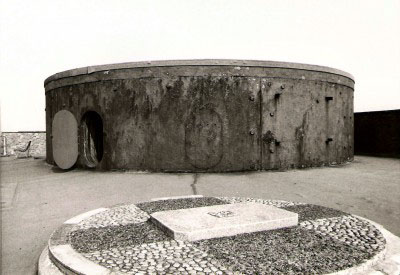
One result of the recommendations of the Commission was the construction of four sea forts to defend the Solent, the stretch of water between the Isle of Wight and Portsmouth. These were large circular forts, one sited on a spit of land off the Isle of Wight and the other three on shoal banks in the Solent. All were built of stone and partly clad with iron and all mounted some of the largest rifled muzzle-loading (RML) guns, 12.5-in 38 ton guns. At the same time a further fort was approved for the defence of Plymouth harbour. Known as the Breakwater Fort it was slightly smaller than the Solent forts and a revised, though abortive, design in 1866 included a pair of two-gun turrets on the roof of the fort.
The concept of mounting guns in turrets on coast defence forts was a very new one in the 1860s. Captain Cowper Coles RN had patented an iron revolving turret for two ‘heavy’ RML guns in 1859 and proposed the design of a number of turret ships for the Royal Navy. It was, therefore, a logical progression for British military engineers to suggest the mounting of turrets on coast defence forts.
These five forts were the only sea forts to be constructed by British military engineers. However, what is not generally known is that two similar sea forts and a tower with a turret for two guns were proposed for the defence of Melbourne in the 1860s though these were never constructed.
The turret for two 16-in RML guns mounted on the Admiralty Pier at Dover
Melbourne Sea Forts
The Crimean War and the construction of the French armoured steam warship La Gloire produced war scares not only in Britain but also in the Australian colonies. The defences of Melbourne were rudimentary at this time with the main defences being an earth battery for nine 68-pounder smooth-bore guns at Williamstown and a battery of  six guns at Sandridge.
In 1859 the Victoria government requested advice on the fortification of Melbourne from the War Office in London and in August 1860 Captain Peter Scratchley arrived with the specific task of reviewing the existing defences and advising on what additional defences were required. Scratchley’s recommendations included four batteries at the Heads at the entrance to Port Phillip Bay. In addition, he recommended the construction of five batteries at Sandridge and Williamstown to be reinforced by a floating battery and a wooden sea fort raised on piles in Hobson’s Bay. Despite a scare of war with the United States in 1861 only Scratchley’s proposals for the batteries for the close defence of Melbourne in Hobson’s Bay were completed in 1863 together with a battery at Shortland’s Bluff to defend the entrance to Port Phillip Bay.
Captain Scratchley returned to England in 1863 but plans for improving the defences of Melbourne and Port Phillip Bay continued with proposals in 1865 for the construction of towers at Point Nepean and Point Lonsdale to support HMVS Cerberus, the construction of which had recently been authorised. The Point Nepean tower was designed to carry a turret for two 23 ton RML guns (12-in Mk I). The cost of the tower was estimated at £10,000 with a further £10,000 for the turret and £8,000 for the armament making a grand total of £28,000 for the completed tower. (1). It is, perhaps, not surprising, therefore, that the construction of these towers was never authorised by the government of Victoria.
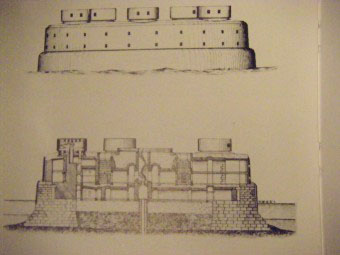
A design for a sea fort mounting five turrets
In London in 1867 the Defence Committee, under the chairmanship of Admiral Grey together with Rear Admiral Cooper Key and Lieutenant Colonel Jervois, reviewed further proposals for the defence of Melbourne and concurred with a report of the Fortifications Committee that two sea forts should be built for the defence of Port Phillip Bay. The forts were to be constructed in the water on a line between Point Gellibrand and Point Ormond, a distance of approximately 6,000 yards (5,538 metres), in order to provide a line of defence that was sufficiently advanced to protect  Melbourne and its shipping from long-range guns. These forts were to be similar in design to the Breakwater Fort in Plymouth harbour but smaller in size.
One fort was to be sited on a shoal 500 yards (460 metres) from Point Gellibrand and this was to be an iron casemated fort mounting 10 x 9-in 12 ton RML guns in two tiers of casemates with 2 x 10-in 18 ton RML guns in a single turret. The second fort was to be sited in 4 ½ fathoms of water 2,000 yards (1,846 metres) from the Point Gellibrand fort. The second fort was to be more heavily armed mounting 12 x 9-in 12 ton RML guns in two tiers of casemates and 4 x 10-in 18 ton RML guns in two turrets.
The cost of the fort off Point Gellibrand was estimated at £75,000 for the foundations and iron casemates; £10,000 for the turret; £25,000 for the 9-in guns; and £7,000 for the 10-in guns. The total cost coming to £117,000. The cost of the deep-water fort was even more with an estimate of £145,000 for the foundations and iron casemates; £20,000 for the two turrets; £30,000 for the 9-in guns; and £14,000 for the 10-in guns. The total cost coming to the astronomical sum, for that time, of £209,000. (2.)
The proposals for the construction of the two sea forts came at a time when Britain was reviewing its Imperial defence policy and instituting a requirement that the dominions and colonies should contribute towards their own defence. At this time Britain was also considering the withdrawal of the Imperial garrisons from Canada and the Australian colonies and had passed an act of Parliament permitting the creation of official naval forces in the colonies. Having just authorised the construction of HMVS Cerberus the government of Victoria was not inclined to fund the construction of these expensive fortifications and so the project lapsed.
- See more at: http://www.mhhv.org.au/?p=1741#sthash.RgFMlBw3.dpuf

Tuesday, 2 February 2016

Fort Philip, Sydney

Standing high on Windmill Hill above The Rocks, Fort Phillip was one of the initial fortifications built to defend the colony.  It was named after the founding Governor of the Colony, Admiral Arthur Phillip.

The hexagonal Fort Phillip on Windmill Hill c1891-1921 (NSW State Library)


Construction began in 1804 (after the Dawes battery was completed, see previous post) in a hexagonal design to protect from threats coming from the ocean to the east, and the hinterland to the west.  The walls were made of locally quarried sandstone several feet thick.  However, with 3 walls completed, construction ceased and the fort was never finished.


The original Fort Phillip design


The Fort repurposed to a Signal Station c1842 (NSW State Library)

Though the guns remained there until the 1820s after which it languished.  In 1840 the land was considered more useful as a signal and telegraph station so the Fort was mostly demolished and repurposed. One wall, which still stands today, was converted to serve as the semaphore station's platform and the rest was levelled in the 1850s for the construction of Sydney Observatory which remains there today.

The redesign of the Fort area to become the Observatory and Signalling station

The fields of observation from Windmill hill are excellent, but the range for 19th century ordinance would have been challenging (Note this is a Krupp cannon captured from the Boers, part of a South African War Monument on the site)
The remodelled Signal Station, incorporating part of the original outer walls

The outer wall of the Signal Station - original from Fort Phillip

Outer North Wall - original sandstone revetment 

The excavated magazine entrance inside the original Fort


Excavation work in 2011- this view shows the use of the original wall as part of the semaphore station, and the entrance to the magazine.

The Observatory (with Timeball Tower atop for synchronising marine chronometers)

A relatively minor site, but one that the lad and I enjoyed visiting on a sunny summer day.

References:
http://www.smh.com.au/news/national/the-colonial-fort-that-never-was/2008/10/20/1224351155229.html

http://www.dayofarchaeology.com/sydney-observatory-and-fort-phillip/

http://dictionaryofsydney.org/building/fort_phillip

An exploration of debauchery, vice and other reasons to be a man!

An exploration of debauchery, vice and other reasons to be a man!