Tuesday, 10 November 2020

The French On Mars (Space 1889 Background)

by James L. Cambias

Originally published in issue 7 of Transactions of the Royal Martian Geographical Society, now available here http://www.heliograph.com/trmgs/trmgs2/frenchmars.shtml

----

The French have always considered their nation to be the fountainhead of civilization in Europe. During the colonial period, they believed that France had a mission to spread that civilization across the Earth. In the world of Space: 1889, the French would inevitably feel it necessary to bring civilization to Mars, whether the Martians want it or not.

Idaeus Fons

The center of French influence on the Red Planet is the city-state of Idaeus Fons, located in the highlands west of the Mare Acidalium.

Idaeus's population is about 80,000 Martians, with a resident Terran population of 4000. Ninety percent of the Terrans in Idaeus are French citizens (the remainder are mostly Americans and Italians). The city is located on the Grand Canal which links the Mare Acidalium with the Coprates Valley. The area around the city is arid and rough. Even along the canals the farmland is marginal. The climate is generally cool, similar to that of the Canadian Rockies.

Despite the terrain and climate, the city is prosperous. Its economy is based on the canal trade and on metal production. The rugged hills surrounding Idaeus hold some of the richest deposits of copper and lead on Mars. For thousands of years the smithies of Idaeus have produced copper pots and bowls, bronze tools, and cannon for export to the Acidalium cities and the Coprates Valley.

Slavery was common in Idaeus until the arrival of the French. Slaves worked the metal mines and rowed the canal boats. The French abolished the slave trade and decreed that the children of slaves would be free, but did not liberate those who were already enslaved. Nowadays, the slave population in Idaeus is dwindling, and mostly consists of household servants.

The language of Idaeus Fons is Thark, but a substantial proportion of the population especially the upper classes speak Na-Gaaryani. The most common Terran language is French.

The Surrounding Region

The rugged area surrounding Idaeus Fons is sparsely settled. A few farms exist along the canals, but the chief occupation is herding.

The mines of Idaeus have been worked for millennia. The hills and mountains of the region are honeycombed with ancient tunnels and galleries. Many of these ancient mines have not been mapped in recent memory. Brigands and fugitives often seek refuge in the mines, and tales tell of horrible creatures dwelling underground.

The area around Idaeus is home to the Drukhma plant, an extremely dangerous carnivorous plant armed with poisonous thorns. From time to time Martians have been killed by this plant, but Terrans usually suffer only a painful allergic reaction to the toxin.

French Control In Idaeus

The French presence in the Idaeus region dates back to 1873. The first French scientific expedition to Mars, led by Dr. Claude Massigny, landed near the city and established friendly relations with King Lotmar, the ruler of Idaeus Fons.

More scientists followed, accompanied by merchants, missionaries, and explorers. By 1875 nearly four hundred Frenchmen were living in Idaeus. But anti-Terran sentiment was already growing in the population, particularly among the nobility and the priests.

Riots broke out in July of 1877, when a mob of Martians attacked a Bastille Day celebration. Six Frenchmen died in the fighting, and much property was damaged. The French Consul demanded a full apology and reparations from the King. When he refused, the French declared war. Five regiments landed in November of 1877, and shattered the city's army in three battles.

The French compelled King Lotmar to step down in favor of his nephew Akvan. Several nobles were imprisoned, and their lands were turned over to the French government as compensation. In 1878 King Akvan signed a treaty accepting French military protection and guidance in foreign affairs. Separate courts for French citizens were set up, and a reduced tariff was set for goods brought in on French ether flyers.

Ambitious French officers seeking victories as the quickest route to promotion conducted extensive campaigns on the frontier. Independent towns were forced to recognize the sovereignty of Idaeus, and Hill Martian tribes were subjugated or forced out. French columns pushed as far as the rim of the Mare Acidalium in the east, the Tempe mountains to the north, and several hundred miles across the deserts to in the south and west.

The inhabitants of Idaeus Fons have an ambivalent attitude toward the French. On one hand, the memories of the war of 1877 and the humiliating treaty are bitter, and recent immigrants from the Coprates tell horrifying tales. On the other hand, the city has prospered economically due to trade with the French, the bureaucracy has been purged of corruption, and patrols have nearly eliminated banditry in the surrounding hills. The priests and what remains of the aristocracy are more fervently anti-Terran than ever, but the merchants and the military leaders have a growing respect for the aliens.

The French In Idaeus Today

Since 1877, the French presence in Idaeus Fons has grown dramatically. French firms hold important business concessions a French company now runs a steamship line to Nilokeras, and another owns the largest lead mine in the area.

The scientific endeavors that initiated French involvement on Mars are still going on. The Republic has established an Institut Martien des Sciences in Idaeus Fons. The Institut occupies a large building, formerly the palace of a noble family. Laboratories study Martian weather, animals, plants, and minerals; as well as the culture and prehistory of the Martians. The Institut sends expeditions ranging far over the surface of Mars, and is generous in its sponsorship of independent explorers.

Where Frenchmen go, wine follows. Ten years ago a group of vintners purchased a tract of land in the hills south of the city, and began trying to raise grapes. After a few years spent experimenting with various root stocks and fertilizers, the first bottles of Maison Zoraad became commercially available. The wine has become quite popular in Idaeus and elsewhere on Mars. Some other wineries have begun operation in recent years, to keep up with the demand.

Government

Technically, the city of Idaeus Fons is still an independent state, ruled by King Akvan. The only formal tie with France is a treaty of alliance and a guarantee of protection for French citizens. In practice, though, the city is run by General Pierre Saint-Honoré, the commander of the French garrison. In addition to his French military rank, Saint-Honoré also holds the title of "High Warlord" of Idaeus, making him second in command after the King.

King Akvan is thoroughly under the General's thumb, and all his edicts are drafted in Saint-Honoré's office. The various government ministries of Idaeus Fons have all been stocked with French officials, who answer to the General. The offices function honestly (though with the usual French bureaucratic fussiness and sloth). The only part of the government free from French influence is the law-courts. The Martian judges have complete jurisdiction over all the Martian inhabitants of Idaeus Fons, and the French do not interfere with them. A separate French court decides cases involving Terrans.

Military Forces


The French currently have eight regiments based in Idaeus Fons, plus the city's own army, which is effectively under French command. The French units are the 2nd Foreign Legion Infantry, the 3rd Marine Infantry, the 79th, 81st and 114th Infantry Regiments, the 1st Foreign Legion Cavalry, the 6th Hussars, the Composite Regiment of Spahis, and five artillery batteries (one horse artillery battery armed with 9-pounders, two mountain batteries armed with 6-pounders, a field battery with 15-pounders, and a heavy battery with 6" howitzers).

The Idaeus Army is of Poor quality, and has thirteen bands of infantry armed with muskets, eight bands of cavalry, and twenty cannon. General Saint-Honoré has organized one Good-quality infantry regiment along European lines, with 180 men armed with modern rifles and four field guns. All the officers are French.

The Marines, the 79th Infantry, and the 81st Infantry are based in the city, along with the modern-style Martian regiment and six infantry bands. The remaining French units and the rest of the Idaeus army are based in frontier posts. The French regiments are broken up into separate battalions, and are paired with one or two Martian bands. No Martian units are free of Terran supervision.

Despite their impressive force of ground troops, the French have been handicapped by a lack of aerial vessels. Although the mountains north of Idaeus Fons have plentiful liftwood groves, the city has no shipyard. All of the city's cloudships were bought from Acidalia or Niliacus. At one point, funds were allocated to have a pair of Harpon-class aerial gunboats constructed at Syrtis Major, but since the outbreak of the Oenotrian War, the British have been using the Syrtis yards at full capacity for their own fleet.

Currently, the French operate the old Idaeus Fons cloudship fleet, and have rearmed a few vessels with modern guns. The King still has the Royal Yacht (an unarmed Clearsight screw galley). The fleet consists of two Hullcutter screw galleys, a Whisperdeath kite, a Sky Runner galley armed with a 3" gun and two 6-pounder Hotchkiss cannons, a Bloodrunner kite armed with 6-pounder HRCs, and two Swiftwood kites, one of which has been rearmed with a 4" short gun and two 3-pounder HRCs. The fleet is Trained quality. All marines are drawn from the French 3rd Marine Infantry; they are Experienced troops armed with modern rifles.



French Influence Outside Idaeus

While Idaeus Fons is the only city under French political contril, most of the surrounding cities have small groups of French merchants. Many have signed treaties of friendship with France, and the rulers take great pains to avoid outbreaks of anti-Terran violence that might provoke a military response.

Acidalia: The French presence in Acidalia is growing. There are numerous French merchants, and plans are afoot to have officers in the army trained by the French. Both the government and the inhabitants of Acidalia are friendly towards France.

Chryse: Prince Tarkrakar of Chryse has tried to steer a course that will enrich himself and his city. He has welcomed French assistance in building a highly efficient army, and dreams of conquering Niliacus with French help. He is trying to balance the French against the Tossians and so retain his autonomy. Tarkrakar has worked on developing his military, and in doing so has neglected the administration and economy of his city.

Nilokeras: Osuuva, the Potentate of Nilokeras, is decadent and incompetent. Under his rule the city's economy, government, and military have all declined to an abysmal level. French influence here is strong, and the terrible state of the city's military has made it a virtual French protectorate. The government is very unstable only French subsidies and support keep it afloat.

Niliacus: Prince Dardag of Niliacus is a weak ruler dominated by the priests of the city. High Priest Aaverdigon recently became Prime Minister. Niliacus has the nearest and largest shipyard available to Idaeus Fons, and the French have worked very hard to woo the prince. The priests are very intolerant of dissent and heresy, and require all human visitors to remain in the Foreign Quarter of the city at all times.

There is a small French presence in Niliacus, which the government tolerates only due to fear of possible intervention. A small faction of military and mercantile interests wish to see the city modernized, but they are still very much a minority.

Relations With Other Colonial Powers

The Belgians: The French attitude toward the Belgians on Mars is compounded equally of patronization, envy, and exasperation. The French have always viewed Belgium as a kind of detached province of France, and so tend to view Belgian colonial activities as an extension of their own. Certainly Frenchmen make up the largest contingent of foreigners in the Coprates.

At the same time, French commanders and officials on Mars are terribly jealous of the support given to Belgian colonial activities by the government on Earth. They compare it with the unhelpful attitude of their own government. French forces on Mars dwarf the Belgian army in the Coprates, and with enough backing they could have annexed the entire Mare Acidalium by now.

Finally, the French are profoundly irritated by the clumsy and barbaric methods used by the Belgian Coprates Company. (It isn't the barbarity itself that annoys them so much as unnecessary barbarism). The Belgians make all the other Terrans look bad. The thought has occasionally been expressed that the Coprates might be run better by some other power... France, perhaps.

The Americans: Growing American influence centered at Thymiamata has led to conflicts between French and American commercial interests in Chryse and Niliacus. This is not very serious, however, since the eyes of the French are mostly turned towards the Mare Acidalium region, while the Americans are more interested in the Tossian Empire. Relations between the two nations are good, and this is reflected by cooperation among French and American officials on Mars, especially concerning the extradition of criminals, suppression of piracy, and efforts to control anti-Terran agitation.

The Germans: Since 1871 French relations with Germany have been uniformly bad. On Mars, what little contact the two nations have has been chilly, but officially polite. Both sides have set up spy networks in the other's sphere of influence, and both work to undermine the other's colonial efforts. Several times the French have sent anonymous tips to the British about German operations in the Boreosyrtis cities. The Germans have been quietly expanding their presence in the Mare Acidalium, and have made friendly overtures towards cities that might have cause to fear the French.

The British: French relations with Britain are currently at their lowest ebb since Waterloo. This is curious, since both countries are concerned about growing German power. But colonial rivalries in Africa and Southeast Asia have caused a deep rift between the two governments, and centuries of habit are hard to break.

On Mars, French and British interests do not directly compete, since their respective spheres of influence are far apart. But there is still no love lost between them. French arms merchants have been active in Shastapsh, and there has been talk of French-made rifles being found in Oenotrian hands.

The French government depends heavily on the British heliograph system for rapid communication, and cannot build any gunboats on Mars without British cooperation all of which is intolerable to French pride.

Conflict between the two is mostly at the level of continual minor annoyances on both sides. The fact is that there is really a great deal of common interest in their colonial activities, but a potentially fruitful cooperation has been poisoned by bad feeling.

Idaeus Fons: The Tricolor Over Mars

By Michael Sangemino

James L. Cambias' article "The French on Mars" is an informative description of France's colonial presence on Mars. This article provides additional detail about the major city of the French colony, Idaeus Fons.

The seat of the French power on Mars rests in the city-state of Idaeus Fons. At one time an isolated provincial town, Idaeus Fons is now touched by the civilizing mission of France. The city streets smell of French bread and wine,  Idaeus Fons has become the center of European culture on Mars, and a vacation site of many homesick Terran colonists.

City Statistics

Population: 80,000 (plus 4,000 humans)


Government: Weak Prince
Corruption: Honest
Economy: Mercantile
Vitality: Wealthy
Army: Poor*
Army Size: 21
Fleet Quality: Trained
Fleet Size: 320,000 pounds
Attitude: Indifferent
Colonial Army: Good
Colonial Army Size: 1Colonial Army Loyalty: Indifferent


Important Sections Of The City

<>Refer to the Idaeus Fons Map to locate the areas discussed below.

The French Quarter: The French who reside in Idaeus Fons live within the French Quarter. Lying just outside outside the city-state's walls, the French Quarter streets are lined with architecture resembling the very finest of Paris. It has an atmosphere of refinement and Gallic snobbery.

The land upon which the Quarter is located was originally land owned by nobles who opposed French control and reluctantly turned it over as compensation for their opposition. Surrounding the Quarter are beautiful vineyards growing grapes for the popular Maison Zoraad wine. The Quarter is home to most of the high French military and administrative officials. It is also home to French businessman and ambassadors from the other colonial powers.

The Quarter is divided by the Rue de Paris which is lined by fine restaurants specializing in French Cuisine and taverns serving Terran spirits. The heart of the Quarter is the Palace de Republique, a beautiful theater and home to the many touring companies of Can-Can dancers and ballet dancers from France.

The Quarter is considered the focal point for human culture on the Mars. Many a day one can stroll along the canal and see painters creating beautiful depiction's of everyday colonial life. Most government officials dream be sent to Idaeus Fons to sample the local charm and the French wine! The Quarter is considered off limits to Martians with the exception of domestic workers.

Palace: The Palace is a walled area within the city. Before the French established control of Idaeus Fons, this area was home to the city-state's noble family and the seat of government. The buildings within the Palace sector rise above the rest of the city. The large Palace of Kazan was the home of King Lotmar. After the signing of the Treaty of Idaeus Fons in 1877, the newly installed King Akvan was moved from the large palace and is presently residing in the smaller residence originally designated for servants.

The Kazan Palace has been turned over to the Institut Martian des Sciences. The Palace is now filled with laboratories dedicated to the study of the Mars.

The Church of St. Michele can also be found within the Palace sector. Formerly a Temple dedicated to the goddess Marhardroxx, the Church is now the home to the Roman Catholic Bishop Mailard. The Bishop sees Mars as a new opportunity to convert polythestic Martians and has sent missionaries throughout Mars.

The most important building in the area is the old military headquarters of Idaeus Fons. It is now the home to General Saint-Honore who officially is adviser to the King but in reality is the ruler of the colony.

The military presence in the Palace sector is the Royal Guard, which is housed in the new palace and protects the King. They are generally experienced troops. Also occupying the Palace sector is a battalion of French soldiers from the 79th Infantry Regiment.

Old City: This is a dense populated area known for its filth and crime. Visitors to Idaeus Fons are warned against venturing into the Old City. The section is filled with brothels and gambling halls. The Old City is a good area to buy illegal goods, and is a breeding ground for anti-human resentment.

The military presence in this area is primarily the responsibility of the newly formed Colonial troops.

Landing Field: This is the only facility for aerial traffic. It serves as the base of the French-operated Idaeus Fons cloudship fleet. Within the landing area there is usually a company of the French 3rd Marine Infantry. Adjoining the Landing Field is Fort Defence which overlooks the French Quarter and houses the French 3rd Marine Infantry.

Bazaar: The Bazaar is the hub of commercial activity in the city. Usually open seven days a week, the French have recently prodded King Akvan to close the bazaar on Sundays out of respect of Terran religious beliefs. This has angered many Martians who feel furthered humiliated by their human rulers. This humiliation is alleviated by the presence of more and cheaper material goods due to the France's effective administration and protection.

Business District: North of the Bazaar is the Business District. The Business District is the home to most of the offices of French companies, and also the embassies of foreign powers. In particular, this section houses the office of The Societe de Ether which is one of the primary concessions in the city. Societe has exclusive control of all interplanetary travel between France and Idaeus Fons. It also runs a steamship line that transports goods to Acidalium.

The Business District is home to a number of French Schools and many of the city's Nobles send their children there. Overlooking the Business District is the Fort Republique which houses the 79th infantry and a heavy battery of 6" howitzers.

High Docks: This large open area of the city is busy day and night with sailing and steam ships transporting goods in and out of Acidalium. The port facilities are controlled by French concessions. Nearby, the Customs House, which looms over the docks, protects French interests by taxing heavily all non-French concerns therefore insuring French economic hegemony over the city.

Also nearby is Fort France, which houses the city prison. Many nobles and priests who opposed French control in 1877 are now imprisoned here. The 81st infantry controls this area.


Personalities

General Saint-Honore

The head of all French forces on Mars, General Saint-Honore is convinced of the importance of the civilizing mission of France. Therefore, in his opinion, France must have colonies! Unfortunately, many in France disagree with him. Saint-Honore is a veteran infantry officer of the Tunisian campaign. A masterful military tactician and a skilled politician, Saint-Honore must deal with a uninterested Parliament, recalcitrant Quai d' Orsay and a stingy Ministry of Marine. French troops have conquered a large amount of territory in the region but Saint-Honore still begs France for more troops and money.

The General's dealings with King Akvan are mostly cordial. However, the General is suspicions of the King and at times will diplomatically inform his majesty of who is in charge. Saint-Honore demands discipline from his officers and troops. He will, however, look the other way if he suspects an ambitious young officer is attempting to spread French influence in another region of Mars.

Presently, Saint-Honore sees himself as France's only hope to thwart German and British designs upon the entire planet. Relations between the General and the King have become tense because of Saint-Honore desire to use Royal troops as part of an expansion into Acidalium. In Saint- Honore's mind, as the importance of liftwood increases, France will become more interested in her colony on Mars.

King Akvan

Installed as King of Idaeus Fons after the Treaty of 1877, replacing his defeated Uncle King Lotmar, King Akvan is seen by the general populace as merely a puppet controlled by the French. For the most part this is true, but Akvan reflects much of the ambivalence that the people share toward their new rulers. On one hand, he is humiliated at how the French have taken control of the city's economy and are attempting to impose their religion upon the populace. On the other hand, King Akvan is spoiled by the increased wealth brought by French protection. He is known to spend many hours drinking and entertaining with many of the court's beautiful maidens, but in reality this is a facade. Akvad spends much of his time trying to gain greater independence from the French while not raising their ire.

Recently, things have become increasingly strained, due to General Saint-Honore's desire to use Royal troops on a expedition into Acidalium. Rumor has it that King Akvan's cousin Prince Gorgaxx has converted to Christianity and is a likely candidate to replace the King. King Akvan need only visit the tomb of his dead uncle King Lothar to see the results of disagreeing with the French.


Friday, 6 November 2020

Et Voila! Mon Armee de'Mars!

Mesdames et Messieurs, en presentat ma premier Armee de Mars!

Tirailleurs Martiens;

La Legion Etrangere:


Ready for an expeditionary operation in the Ideaus Fons basin where the Nomadic Hill tribes have been ambushing caravans from the northern valley viticulture district.

Very happy with these- finishing off four units in 4 weeks in some kind of record for me. After about of decade of mulling and planning, it's great to be off and running. I do work well to a deadline it seems!

Modelling notes re basing: Wood filler basecoated in GW Doombull Brown, heavy drybrush GW Jokaero Orange, final drybrush GW Lugganath Orange

Wednesday, 28 October 2020

French Armee d'Martien progress Pt 3

Four posts in one month? Inconceivable!

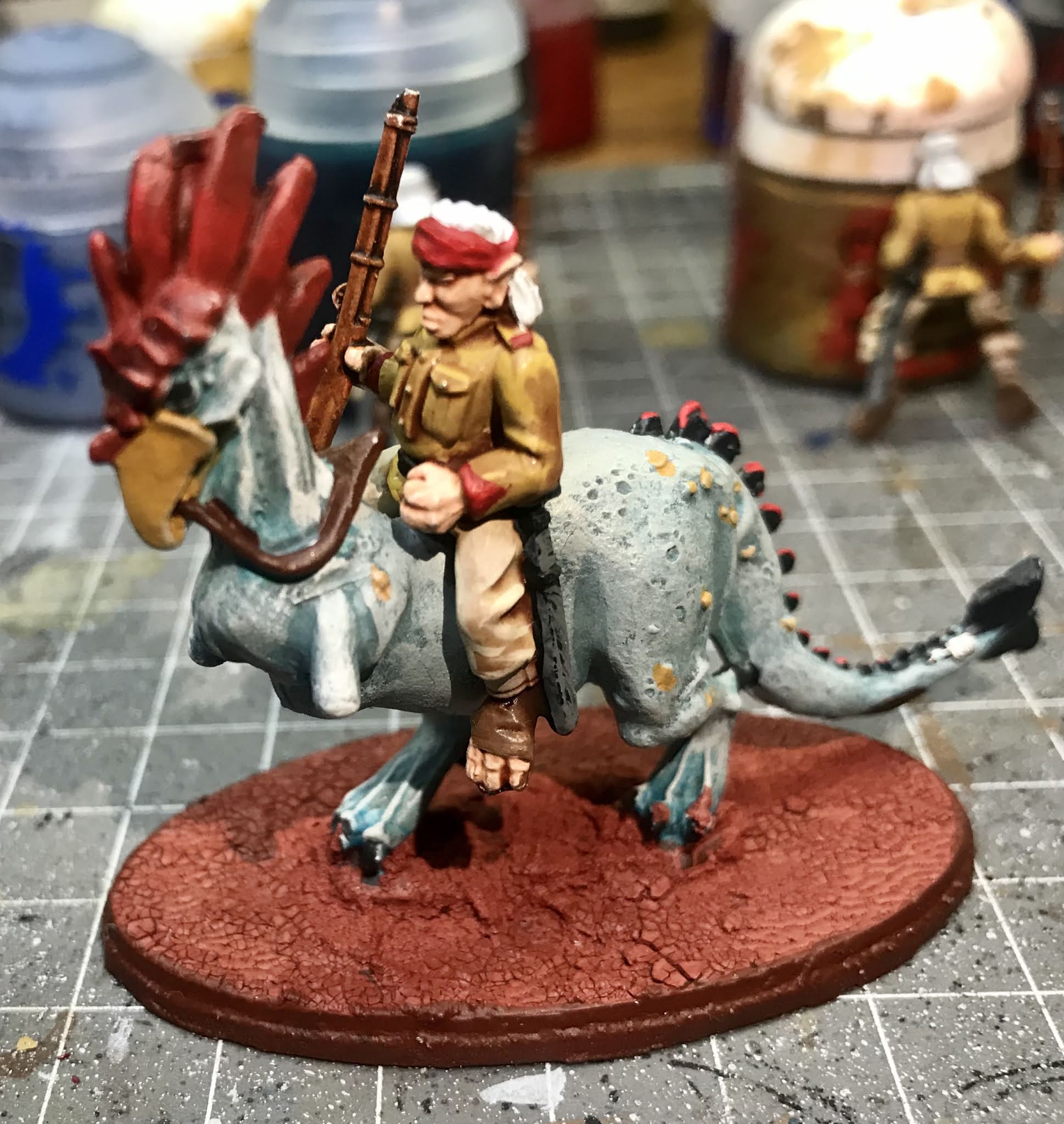
Spahi test fig (mounted on a loaned gashant)
The Infantry are all painted now (2 units of Legion Etrangere, 2 units of Tirallieurs) as are the canal Martian Spahis.  Time to get basing while I move onto the Chasseur d'Mars and all of the gahsant mounts.  

Really happy with the way these are coming along - on track for our game in early December

I've painted all of these in the past four weeks - amazing progress for me!


Mon Capitan 'Lefty' - a great Foundry fig that a mate gave me


Sunday, 25 October 2020

Tirailleurs progress

 Second unit of Tirailleurs completed - now onto some gashant mounted Spahis and Chasseur d'Mars!

Not the best image but you get the idea!

Wednesday, 21 October 2020

Tirailleurs Martien

My first unit of Canal Martians is painted! Not based yet but I'm excited to have gotten a start on the project. These Tirailleurs Martiens are furnished with modern rifles and a European “Adviser” officer. They are based in the Canal city of Ideus Fons, the French seat of power on Mars.

The Canal Martians are from the RAFM Space 1889 line, while the French Officer is an Artizan figure. The 12 figure unit is sized for Osprey's The Men Who Would Be Kings rules


Thats 4 units done (3 French, 1 Martian) - one more of Tirailleurs and I’ll start the basing en mass. Then its time for the Gashant Cavalry!

Friday, 9 October 2020

The French Foreign Legion on Mars

 by R. H. Cartwright, as told to Brian Kendall

from http://www.heliograph.com/trmgs/trmgs2/ffl.shtml


It was spring of last year when I had the privilege to make the acquaintance of some unique soldiers of France. I was on a hunting trip when, during a sudden stampede of a huge herd of Ruumet Breehr, I became separated from my party. After wandering the Martian deserts for a week with no food or water, my trusty gashant "Cromwell" finally gave out, but I staggered on. Time seemed to stand still, interrupted only by several hallucinations (I rather enjoyed the one that included a large reptile named "Herbie" manning a fish and chips wagon), and I finally fell upon the baked Martian soil to die. Slowly my eyes closed, and I said good-bye (or so I thought) to the world.

"I think he must be English," said a voice in the darkness in, of all languages, French.

"Why?" asked another voice

"Because only an Englishmen would be alone in the middle of this god-forsaken desert."

I remember first thinking "My god, how rude, disturbing my eternal rest like this." Then almost immediately my thoughts switched to, "Oh no! I'm in Hell, for surely if there is a language of Hell, it would have to be French!"

I opened my eyes, expecting to see the horned head of Satan himself laughing at me, but to my surprise (and relief) I saw ten soldiers standing around me.
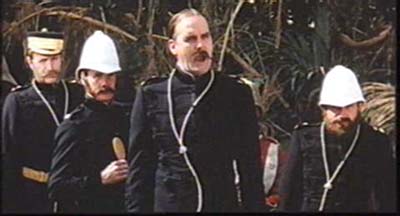
"Would you like some water?" said the young officer leaning over me. "Bloody right, mate" was the only words my parched lips could get out.

So having meet young Sous-Lieutenant Henri Dagino, we started off back to his posting, at a place called Fort Zinderneuf. I was surprised to find out that my saviors were members of the 2nd Bataillion de Marche, drawn from the world-famous French Foreign Legion. What had started out as being polite interest soon became fascination as I began to grill the young officer on his unit as any good newspaper man would.

It seems that on March 9th, 1831, King Louis-Philippe waved his kingly scepter and created a Foreign Legion to serve outside of France. Since then the Legion has grown and shrunk. It has served in every hemisphere and was even called upon to violate its charter and serve in France during the Franco-Prussian War. In all its battles the legion has maintained itself with the highest standards of bravery and honor.

The soldiers of the Legion on Mars are mostly veterans of the Sudan and Tonkin. Their experiences serve them well on Mars. Most of the soldiers know how to ride and have been trained to serve as mounted infantry; however, the current lack of mounts hampers their ability to function in this capacity.

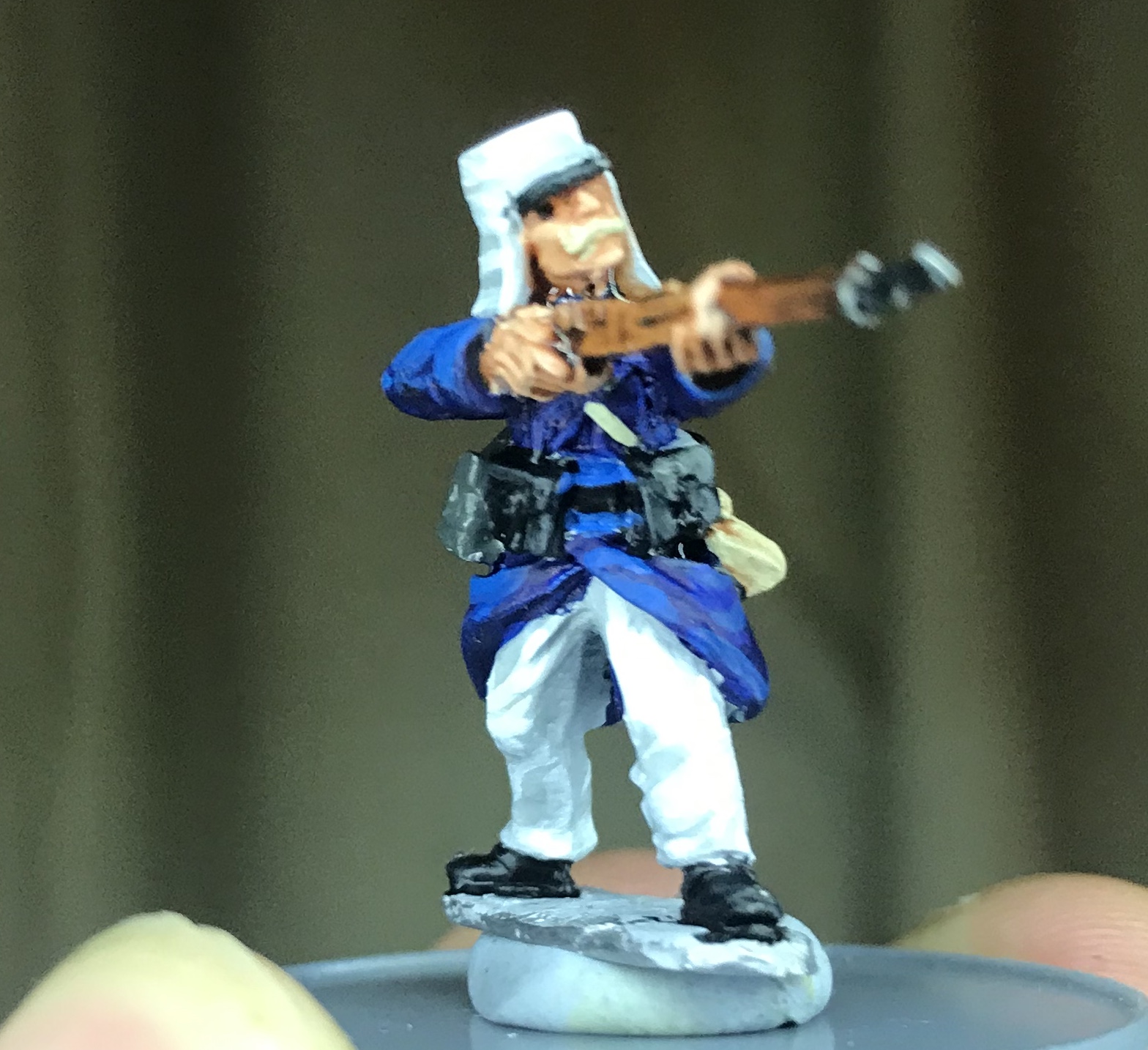
As for their uniforms on Mars, the standard field dress is white cotton linen shirt and trousers. Most men have been issued the new khaki colonial coat which has a small collar. For the most part the men wear sun helmets, although most officers and NCOs wear a kepi covered by a havelock (a white cloth that covers the neck).

One of the most surprising things to me was the way the men were armed. It seems once the Legion arrived on Mars they received the new Modele 1886 rifle or the "Lebel" as the men call it. Its most unusual feature is its 8-round tubular magazine, but "being a hell of a lot better" than their old Gras rifles, you'll hear no one complaining about this 8mm weapon. To carry more ammo for these weapons, many legionnaires have taken to wearing homemade cloth ammo pouches that are worn across the chest. No two are alike, and quite frankly it takes away from their soldierly appearance.

Unlike English garrisons, however, the Legion has troops trained to man their fort's small howitzers and Maxim guns. This in a way is a strong point because it cuts down on chain of command problems. I'm told for the types of duties the Legion carries out it is effective.

The main weakness of the Legion on Mars as I see it is distance. Each company is given a huge area to patrol. This makes it quite impossible for them to consolidate and present a formidable defense like our grand British columns.

After being in the company of young Dagino for three days I departed with a new respect for these troops of France (words I thought I would never put to print). As the song La Boudin fills the air and the French tricolor is hoisted high into the morning air, my mind swims with the romantic legacy of the Régiment Étranger. So to these forgotten sons of the world, it is to you I dedicate this story Long Live The Legion!

Tuesday, 6 October 2020

First Frenchman for Mars

After years in planning and another unpardonably long absence from this blog, I have finally commenced my French on Mars project. Well a test figure anyway!

It’s a long way to Idaeus Fons Messieur...

We are using a Space 1889 setting with Osprey’s The Men Who Would Be Kings as our tactical rules, so I will be focusing on 12 figure units for Regular and Colonial Infantry, and 8 figure Cavalry units.

My initial French force plan is:
    2 units of Legion Etrangere infantry
    1 unit Chaseur D’Mars (mounted on Gashants)
    2 units of French trained and equipped Canal Martians Ideaues Fons
    1 units of Colonial Mounted Infantry (on Gashants)
    2 Artillery Pieces 
    1 Mitrailleuse

This is my first test fig, which is from Artizan’s March or Die range. I’m going for something simple so I can churn them out quickly. A mate is working on his British Force with the aim of us having a game in December.

Mars pour le Francias!    Mort au Prussien!

Sunday, 24 March 2019

HMVS Cerberus

Updated online history section at the Royal Australian Navy website here:
http://www.navy.gov.au/hmas-cerberus-hmvs

HMAS
 
Cerberus
 
(HMVS)

Type
Coastal Defence Turret Ship/Ironclad Breastwork Monitor
Builder
Palmer Shipbuilding & Iron Co
Laid Down
1 September 1867
Launched
1 December 1869
Commissioned
April 1871
Decommissioned
April 1921
Fate
Sold April 1924 and scuttled as a breakwater at Black Rock, Victoria 2 September 1926
Dimensions & Displacement
Displacement3340 tons 
Performance
Speed9 knots 
Complement
Crew82 (normal) up to 155 
Propulsion
Machinery2 x Maudsley, Son & Field steam engines 
Horsepower250 
Armament
Guns
  • 4 x 10-inch Armstrong Rifle Muzzle-loading guns
  • 2 x 6-pounders
  • 4 x Gatling guns
  • 4 x 1-inch four-barrelled Nordenfelt guns
The passing of the Colonial Naval Defence Act, 1865empowered the Australian colonies to officially acquire warships and to raise and maintain seamen to serve in such vessels.
Of all the Australian colonies, Victoria put the most effort into her naval defences and in 1866 its colonial government applied to the British Government for assistance in establishing a naval force under the provisions of the 1865 Act. In reply to the request the Imperial Government agreed to assist with a grant of £100,000 towards the cost of a monitor turret ship and to donate, as a training ship, the old wooden man-o-war Nelson. The maintenance and manning of the new turret ship would be the responsibility of the Victorian Government, with assistance from the Royal Navy; however, she was to be placed at the disposal of the Commanding Officer of the Royal Navy’s Australia Station in the event of a war.
A general arrangement plan showing the layout of the monitor and her armament
A general arrangement plan showing the layout of the monitor and her armament.
The ship’s design was comparatively new, the first of its type having emerged just five years earlier during the American Civil War in the form of USS Monitor, and was especially suited to the conditions likely to be encountered in Port Phillip Bay. She would be clad in iron armour up to eight inches thick and, by flooding her ballast tanks with up to 500 tons of water; the ship could lower herself three feet into the water so that only the breastwork and turrets remained on the surface. The design also featured a broad flat bottom, which did nothing to increase her sea-keeping capabilities.
Construction commenced on 1 September 1867 at the Palmer Shipbuilding & Iron Company shipyards at Jarrow-on-Tyne near Newcastle, England, and was completed two years later. The ship commissioned as Her Majesty’s Victorian Ship (HMVS) Cerberus, named after the three-headed hound in Greek and Roman mythology which guarded the gates to the Underworld.
Cerberus was steam powered and although not designed to have masts or sails, these were temporarily fitted to help conserve her coal supply on her maiden voyage to Australia. In her normal configuration, without the mass of rigging required for sails, her guns enjoyed a wide, unhampered firing arc.
Cerberus sailed from Chatham on 29 October 1870 under the Red Ensign and was manned by a crew of twenty-five merchant seamen under the command of Lieutenant William Henry Panter, RN. Panter had been serving in Australia aboard HMVS Nelson and had arrived in his native England in June to take command of the new monitor.
Captain W H Panter, RN the first commanding officer of HMVS Cerberus (State Library of Victoria Collection)
Captain WH Panter, RN the first commanding officer of HMVS Cerberus (State Library of Victoria Collection).
At the beginning of her long delivery voyage to Australia, Cerberus encountered heavy weather as she departed Chatham and was forced to seek shelter at Spithead, between Portsmouth and the Isle of Wight, before continuing on to Plymouth, where most of the crew deserted. With a new crew of sixty-five embarked, the voyage resumed on 7 November. She encountered more heavy weather in the Bay of Biscay but made Gibraltar safely where still more of her crew deserted.  Between Gibraltar and Malta Cerberus encountered more favourable weather, and then endured searing heat as she steamed through the Red Sea. On 3 January 1871, the engineer recorded temperatures of 53ºC in the engine room and 61ºC in the stokehold.
After stopping at Aden for coal she continued on to Ceylon and Batavia before encountering cyclonic weather and strong headwinds. She coaled again at Fremantle during the final leg of the voyage where:
...the vessel created a great sensation, and every possible civility was offered by the Government. Governor Weld himself came on board and inspected the ship.
A stay of eight days in King George’s Sound, Albany, was spent taking on additional coal, cleaning and painting in preparation for the passage across the Great Australian Bight and her ultimate arrival at Melbourne.
On Sunday 9 April 1871, having spent 123 days en route, Cerberus arrived in Port Philip Bay. The Melbourne Age recorded:
…the circumstances of her voyage of five months and nine days have been watched with the deepest interest on both sides of the world. Captain Panter expected that it would be the end of April before the ardently hoped-for moment would come when he would drop his ‘mud hook’ off Williamstown; but his skill, together with comparatively favourable weather, has thus materially shortened the voyage.
She was first sighted off Cape Northumberland on Good Friday, but the telegraph offices were closed and it was not till Saturday that the public heard of a ‘turreted ship’ being seen off our coast. Later in that afternoon came the welcome news that the Cerberus had signalled the Cape Otway lighthouse, and yesterday morning she entered the Heads and steamed to her anchorage, which was the berth lately vacated by HM Corvette Blanche.
Cerberus following her arrival in Port Phillip Bay.
Cerberus following her arrival in Port Phillip Bay. (State Library of Victoria Collection)
As she came up she excited the greatest possible interest. As might be expected, she was not regarded as a handsome ship by any means. She appeared, as in great measure she is, a huge, long, square box, cut down straight at both ends, and surmounted by stunted masts, the tops of her turrets and her funnel. This is not the shape she will be when she is stripped of her surroundings. Then she will be a monitor, whose deck line will be 3 feet above the water, save in the centre, where the outline is broken by a breastwork of immense strength, above which are two cupolas and a pilot house, covered with the strongest armour plate. But now, this has been built over with iron bulwarks and a temporary upper deck to enable her to stand the voyage, and her outline is consequently of the ugliest.
The bay seemed all-alive as she entered Hobson’s Bay, and she was the centre of observation. The Russian man-of-war the Haydamackdipped ensign to her and Captain Koltovsky hurried on board Cerberus to pay his compliments to her commander. The boys of HMVS Nelson crowded into the rigging of their ship, and made the air ring again with peals of boyish cheers; and nearly every vessel in the bay hastened to pay the compliment of dipping colours.
Precisely at 1 o’clock the long-wished for moment arrived, and Captain Panter dropped his ‘mud hook’, and the event was immediately celebrated with the frothing of champagne by him and the few friends already onboard, amongst whom was Captain Payne, the chief harbour-master, who had boarded the Cerberus long before.
In the meantime a great multitude of boats, crowded with passengers, had put off from shore in hope of their being allowed on board. In this respect, Captain Panter did not think it right to disappoint the curious public, although the ship was not fit to be seen. He gave the required leave, and then started off to pay his respects to the Governor. During the whole of the afternoon the crowd of visitors increased greatly, and several thousands of visitors must have come on board and endeavoured to understand her construction and the working of the turrets.
Soon after her arrival, Cerberus was docked in the Alfred Graving Dock where her ocean-passage configuration was removed and her conversion to a monitor completed.
Cerberus in the Alfred Graving Dock. (State Library of Victoria)
The arrival of Cerberus in the Victorian colony saw it briefly possess the most powerful warship on the Australasian station and naturally enough the Victorians were keen to show off their new acquisition. With her merchant crew discharged and with a new crew of naval reservists embarked she began her first trials on Port Phillip Bay on 25 August 1871. It was soon discovered that Cerberus’ guns were too powerful to be fired close to shore following a raft of public protests concerning general damage suffered to windows from the percussive effects of her main armament.
Left: Sailors pose on the forward superstructure of Cerberus. Right: Officers gathered on the quarterdeck of Cerberus
Left: Sailors pose on the forward superstructure of Cerberus. Right: Officers gathered on the quarterdeck of Cerberus.
HMVS Cerberus berthed at Williamstown during the late 1800's.
HMVS Cerberus berthed at Williamstown during the late 1800s.
During the 1870s, regular exercises were held with other Victorian naval ships, including the screw battleship, HMVS Nelson, torpedo boats, and the steam sloop Victoria. For more than 50 years, Cerberus was a familiar sight at Williamstown and in Port Phillip Bay where she spent her entire commission.
Cerberus ratings undertaking musket drill on Port Phillip Bay.
On 5 March 1881, Cerberus suffered her only casualties when a mine exploded in the water off Queenscliff during exercises, killing the ship’s gunner and five seamen.
(Courtesy State Library of Victoria)
Left: Engineer Lieutenant W A Forsyth c. 1899 Right: Signalman Andrew Currer of Richmond, Victoria posing with a petty officer of Cerberus crew
Left: Cerberus Engineer Lieutenant W A Forsyth, circa 1899. Right: Signalman Andrew Currer of Richmond, Victoria posing with one of the ship's petty officers, circa 1900.
Following Federation in 1901, the individual colonial navies were combined under one administration and became the Commonwealth Naval Forces, though the former colonial navies and their ships, including Cerberus, remained in their local ports. On 1 July 1911, the Commonwealth Naval Forces was formally granted the title Royal Australian Navy (RAN) and the Navy’s commissioned ships henceforth carried the prefix ‘HMAS’.
Throughout her commission Cerberus was confined to the waters of Port Phillip Bay.
A fine profile of Cerberus in her heyday.
At the outbreak of war in August 1914, HMAS Cerberus assumed the role of Port Guard Ship for the Port of Melbourne acting as a base for the naval dock guards and small craft patrolling the harbour.  She became a store for ammunition and explosives in the later stages of the war.
In 1921, Cerberus was moved from Williamstown to Geelong where, for the next two years, she acted as a submarine depot ship for the RAN’s flotilla of six J-class submarines. On 1 April 1921, her name was changed to HMAS Platypus (II).
In April 1924 she was sold as scrap to the Melbourne Salvage Co Pty Ltd, for the sum of £409, and she was towed back to Williamstown where she was stripped of all her valuable metals and useful fittings.
Cerberus being dismantled at Williamstown prior to be scuttled as a breakwater at Black Rock
Cerberus being dismantled at Williamstown prior to be scuttled as a breakwater at Black Rock.
In 1926, the hull was purchased by the Sandringham Municipal Council, filled with concrete and, on 2 September of that year, was towed across Port Phillip Bay to be sunk at Black Rock, where she remains as a breakwater.

SUNK AT BLACKROCK. BREAKWATER FOR SMALL CRAFT.

The Argus September 3 1926

Yesterday morning the hulk of the old iron-clad Cerberus was towed from her berth at the Williamstown pier, where everything of value had been removed from her, and sunk off the Black Rock jetty to form a breakwater for the yachts and fishing boats. Although the ultimate fate of the Cerberus was decided some time ago, when the Black Rock Yacht Club purchased it for £150 and resold it for the same amount to the muncipal council under agreement that it should be used as a breakwater. the date of the final move was indefinite. This was because the vice-president of the Marine Board (Mr George Kermode), under whose direction the vessel was sunk, did not wish to carry out the somewhat difficult task until the opportunity afforded by the perfect weather conditions presented itself. For this reason the sight of the strange flotilla that appeared off Half Moon Bay shortly after 9 o'clock took residents somewhat by surprise. The word, however, was passed around swiftly, and soon the cliffs were thronged by interested spectators, who saw approaching the grey, squat hull, towed by the tugs Agnes and Minah, and preceded by the Plover and motor-boat to mark the mooring. By 10 o'clock what was left of the Cerberus had been towed and coaxed by the tugs to within 400 yards off the jetty, where her bow was made fast to the existing breakwater, and the stern was slowly swung into position and secured to a temporary mooring. The operation had been timed for high water, when there is a depth of 15ft on the bank selected for the breakwater, and it was estimated that the Cerberus was drawing nearly 14ft. Immediately the hull was made fast three seacocks were opened, and the flooding of the vessel began. Dingys put off from the jetty, and the harbour master's motor-boat took off a large crowd of small boys who swarmed over the decks and down below to watch the rising water. The Cerberus sank almost imperceptibly, going down slightly by the stern. There was a large amount of scrap iron and odds and ends of useless gear, and visitors took away weighty bolts and nuts as souvenirs, after peeping into the turrets to inspect the heavy rusting guns.
The once proud Cerberus resting on the seabed at Black Rock. (http://foodinfocusblog.com/Food_in_Focus/Blog/Entries/2012/1/27_Melbourne_Sea_Planes_files/P1010063)
The once proud Cerberus resting on the seabed at Black Rock. (http://foodinfocusblog.com/Food_in_Focus/Blog/Entries/2012/1/27_Melbourn...)
The name Cerberus is perpetuated in the RAN’s premier training establishment, HMAS Cerberus, situated at Westernport, Victoria. The present Cerberushas in its museum several heritage items from Cerberus (I) including the binnacle, ship's bell, helm and searchlight.
The bell, binacle and ship's helm from Cerberus, now on display in the HMAS Cerberus Museum, Westernport, Victoria
The bell, binnacle and ship's helm from Cerberus, now on display in the HMAS Cerberus Museum, Westernport, Victoria.
Victorian naval ratings onboard Cerberus c.1895.
Victorian naval ratings onboard Cerberus, circa 1895.

Thursday, 21 March 2019

Beehive Casemate, Middle Head, Sydney

Beehive Casemate is a Colonial era fortification at Obelisk Bay, a small inslet within Sydney Harbour.  Construction was part of the wider defensive network and took place from 1871-1874.  The underground Casemate was one of the first to be locally designed and built after the withdrawal of British troops in 1870 as part of the Cardwell Reforms (under these reforms the  Australian and NZ colonies became responsible for their own land defence and small British army garrisons were replaced with locally raised units)

Three 3.7m by 2.1m high gunports in the cliff face

The fortification is built into the natural cliff face and contains three domed chambers that were used as gun emplacements, each chamber having a gunport with fields of fire to fire towards Sydney heads. They were intended to fire on enemy ships as they navigated the passages around Sow & Pigs Reef, within the entrance to Sydney Harbour. The underground chambers are of brick and mortar and were built into the excavated cavities in the sandstone bedrock.


Excellent fields of fire towards the entrance to Sydney Harbour

The Beehive Casemate was reinforced by another fortification above and adjacent to it, which would have added plunging fire to the direct waterline fire from the three Beehive guns.


Tuesday, 12 February 2019

Back to Mars!

Good God man - has it really been a year since a dispatch was last posted?  We were adrift in the Aether you know while dispatched on Her Majesty's service, but have now returned. Indeed a new VSF project beckons but I'll keep Mum for now as it develops - wouldn't want the Kaiser or the Tsar to get word of it.   But it does involve Mars, Airships and gashants with a few of those new fellows down at the club providing some inspiration and opposing forces...

In the meantime, some news regarding that mysterious and boreboding planet:

The Coming of the Martians

The Coming of the Martians is our full-cast faithful audio dramatisation of H. G. Wells’ original 1897 martian invasion story The War of the Worlds.
Since it was first novelised in 1898 there have been numerous adaptations in various media formats. However, none of these derivative works have been truly faithful to the original story or the tone that Wells established.
Our adaptation, presented as an audio drama in surround sound, retains the dark and often horrific nature of events and faithfully recreates scenes as closely as possible without the need to alter the original story. We retain the late 19th Century period and the southern England setting and give the story a fantastic cast of actors wonderfully directed in a production that sounds incredibly realistic!
https://www.sherwoodsoundstudios.com/the-war-of-the-worlds/

BBC is making a Victorian-era War of the Worlds TV series

Earlier today, the BBC announced a number of new shows, including a three-part series based on H.G. Wells’ novel The War of the Worlds. The show is scheduled to go into production next spring, and it appears that, unlike most modern adaptations, it will be set in the Victorian era.
The series will be written by screenwriter Peter Harness, who adapted Susanna Clarke’s Victorian-era fantasy novel Jonathan Strange and Mr Norrell for the network, as well as a handful of Doctor Who episodes. The North-West Evening Mail has some additional details, quoting Mammoth Studios Managing Director of Productions Damien Timmer as saying that while the film has been adapted many times, “no one has ever attempted to follow Wells and locate the story in Dorking at the turn of the last century.” The project was first announced in 2015, and today’s confirmation of production comes only months after the book entered the public domain. 
The novel follows an unnamed narrator as he watches a series of shooting stars, which turn out to be vast metal cylinders containing Martian invaders. The aliens attack the assembled humans and begin a conquest of the planet, only to succumb to human diseases. 
The War of the Worlds is one of the more important works of science fiction out there, and its period setting is important to the original story, as it’s part of an entire movement of fiction dubbed “invasion literature,” in which England is gallantly defended against hostile outsiders. It will be interesting to see how and if the series addresses the politics of the novel’s era, and how they relate to the politics of England and Europe today.Since the novel’s release in 1898, there have been a number of film, television, and radio adaptations, but with only one exception, most productions updated the novel to contemporary times and settings. The 1953 film took place in Southern California, while the 2005 Steven Spielberg adaptation was set in New York. Even the famous 1938 radio play by Orson Welles shifted the location to the United States. Only a direct-to-video adaptation called H.G. Wells’ The War of the Worlds retained the period setting. 
https://www.theverge.com/2017/5/4/15551306/bbc-the-war-of-the-worlds-tv-series-peter-hartness

An exploration of debauchery, vice and other reasons to be a man!

An exploration of debauchery, vice and other reasons to be a man!