THE MONITOR CERBERUS ATTACKING THE WILLIAMSTOWN BATTERIES AND H.M.S. NELSON
Source: The Illustrated Australian News, 23 April 1872
The Attack by the Cerberus
The Williamstown division of the Naval Reserve went on board the Black Eagle at half-past nine a.m., and proceeded to the Sandridge Town River, where they joined the rest of the brigade.
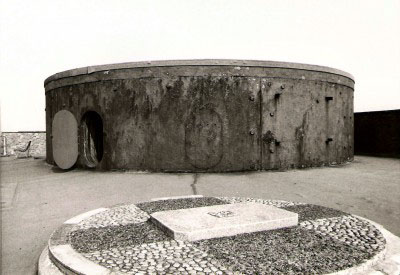
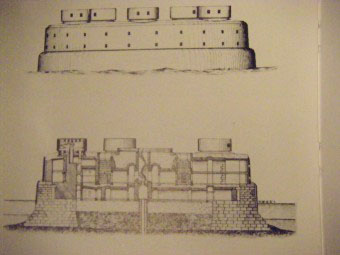
The full strength of men and officers was 178, of whom 112 were detached to the Nelson, under the command of Captain Fullarton, while 70 men under the Lieuts. Steel, Elder and Surgeon Curtis joined the Cerberus, the crew of which numbered 129 all told, but there were on Monday, in addition, several of the Nelson boys on board. So soon as the men were at their posts the vessel left her moorings and proceeded under easy steam down the bay, all the men being kept under cover, and Captain Panter, who was in command, being stationed in the commander's box, so that not a soul was visible as the ship left the harbour. After proceeding some little distance the Cerberus went at full speed, which however did not exceed seven knots an hour, the two masts were struck, and were converted for the nonce into an apparatus for catching torpedoes, they being set out in front of the ship, and connected together by a spar 45 feet long, to which half a dozen grapnels were attached. By the time this work had been executed, the ship had gone some twelve miles from the lightship, in the direction of Portarlington. The men went to dinner, and the Cerberus commenced to retrace her course, her head being directed to the mouth of the Koroit Creek, about three miles west of the Williamstown lighthouse. Refreshments over, both with officers and men, preparations were made for action. The various coverings were fastened down, and the turrets were manned by the Naval Reserve, Lieut.Elder, with the Williamstown division, forming the crew of the fore, and Lieut, Steele with the Sandridge men, that of the after. Each cupola requires in addition to the captain of the turret who directs the gun, and the captain of each gun who is responsible for the elevation, a crew of ten, five to each gun. There were, therefore, besides the lieutenant in charge, thirteen men in each turret. Twelve were, in addition, required at each to work the guns in and out, eight for the magazine, and two powder monkeys. In actual warfare eight additional men would engage in serving shell.
On her trip down the bay the Cerberus had, owing to the foulness of her bottom, steered very badly, and Captain Panter therefore decided upon working his ship from the hurricane deck in order to avoid any risk of getting aground. In addition the commander, six men who were engaged in steering, were men exposed to the enemy's fire. One gun had become disabled during the drill on the previous Saturday owing to a trifling injury to one of the cogs in the wheels of the carriage. So that it had to be sponged from the outside. With these and some minor exceptions, the Cerberus was in the same condition that she would be in actual service. All the railings around the ship were let go, and everything made as snug as possible.
A few minutes before three o'clock, the Cerberus having gone as close in shore as she could with safety, two men being kept all the time in the chains heaving the lead, she steamed from the mouth of the Kororoit Creek towards Williamstown. At 3 p.m., a shot was fired from one of the Williamstown batteries, and immediately afterwards the Cerberus commenced to take the right centre, and lighthouse fortifications in flank. The enormous weight of her metal, her guns carrying 4 cwt. shell, and requiring 30lb of powder, enabled her to shell the shore defences with little or no risk to herself. Since none of them could do execution at more than 2000 yards, while the guns of the Cerberus could carry double that distance: beside which the embrasures of the Williamstown batteries did not cover the attacking ship, which had kept so far to the westward as to be completely outside the strip of sea commanded by the fortifications. After firing several shots, and then a broadside, the Cerberus steamed out of the reach of the fire from the Williamstown right and centre batteries, and then went up again to attack the Nelson. While doing this she was exposed to the fire of the Williamstown lighthouse battery, which kept up the ball manfully. The great feature of defence was, however, the Nelson; which, after firing at long distances the large one hundred and fifty pounders from her forecastle, kept up a very heavy discharge from her three decks, the gallant old ship being warped in such a manner as to keep her broadside to the Cerberus. She, on her part, went close in, raked her adversary fore and aft, and then steamed towards Sandridge shores, where she engaged the western battery, which has latterly been erected in the direction of Fisherman's Bend. This defence, and the three others on the same shore, viz, the lagoon, the central and the St Kilda right, blazed away at the Cerberus, which did not go close enough in to run much risk. At no time was she within 1500 yards from any Sandridge batteries, while to the western she was never nearer than 2000 yards. The Nelson, however, was not idle, for notwithstanding the heavy fire she had been sustaining for so long, she kept up a brisk discharge at the Cerberus long after that ship had gone clear away from Williamstown and was on the Sandridge side of the Bay.
At 3.30 p.m., after having fired 114 shots, 100 with 30 lb, of powder, and 14 with 40, the Cerberus went out of action and returned to her moorings, it not being thought prudent to go near the batteries in the direction of Emerald-hill, in consequence of the shoal water. There was no means of ascertaining what damage has been done to the defending force, but the attacking vessel had not gone through the engagement scathless, The concussion of the enormous guns had not only broken every pane of glass in the ship, but had actually started the iron work around the armor (sic) plating. A piece of iron 2½ inches, which fastened one of the boats' davits to the deck had been moved several inches by the wind of a gun, and the covering to the wardroom ventilator had been carried away, debris going on to the mess table, and demolishing the remains of the luncheon. Everything moveable had been completely destroyed, and all that in nautical parlance is styled gingerbread work had been shaken to atoms. The chart house had suffered very severely, the shutters were strewn on the deck, and the contents of the erection were everywhere but in their right place. The noise when the guns were fired was almost deafening, and, but for the precaution that some of the visitors had adopted at the suggestion of Dr. Curtis, of stopping their ears with cotton wool, their (sic) might have been permanent injury to there (sic) tympana. A man named John Gray, of the Williamstown division, while engaged to the fore battery sustained a contusion of the thigh while the guns were being run out, and one or two others received trifling injuries which did not necessitate the interference of the surgeon. The gunnary (sic) was remarkably well managed. It would be impossible to ascertain how the guns were served so far as direction and elevation were concerned, but there is no doubt of the rapidity of the fire. At one time during the engagement there was a shot from each cannon every minute and a half, and the men were working with great activity and smartness. Indeed, considering the comparatively rare occasions that they have of being drilled on board the Cerberus their proficiency was both creditable and remarkable. The ship stood the concussion very well indeed, her guns had never before fired over the bow and stern, so that her raking the Nelson as a parting shot was rather experimental, but no injury was done to any portion of her framework. The great advantage she has over the batteries, and even almost any other vessel afloat, is the ease with which she is manoeuvred - she turns in a little more than her length, almost as if she were on a pivot - and the distance at which her enormous guns will do deadly execution. After mooring the Cerberus the Black Eagle came off with the men who had been on board the Nelson, and the officers and men left the Cerberus with three cheers for Captain Panter.
THE NELSON
Captain Fullarton, together with Sub-Lieutenants Bland and Blomb, Surgeon McLean, and 110 men proceeded on board the Nelson shortly after 10 a.m. and, after exercising the crew at the main deck guns and getting their dinner, they ran out heavy warps and anchored so as to move the ship into such a position as to be able to fire a broadside into the Cerberus when she approached, and afterwards to shift position so as to continue the fire after the attacking ship had passed and was proceeding towards Sandridge. While the Cerberus was engaging the Williamstown batteries the Nelson fired her 150 pounders, and so soon as the Monitor got within range the 32 pounders on the main deck were manned, and a heavy fire was kept up, not only while the Cerberus was coming up, but long afterwards. While just abeam broadside were fired both from the main and lower decks 64 pounders. The total number of shots fired was 700. The guns were all manned by the Naval Reserve, the ship's boys being employed as powder-monkeys, and the ship's company kept hard at work in the magazine. Had he Nelson got under way the general effect would have been much heightened, and the old ship would have shown what she really could do. The men behaved admirably throughout, and the rapidity of their firing was beyond praise.
SANDRIDGE AND WILLIAMSTOWN
The steamer Gem, was busy all the forenoon in ferrying spectators over to Williamstown, where the attack would commence. Sandridge, like St Kilda and the whole intervening beach, was even more active than if the invasions had been actual Crowds assembled on the Railway and Town Piers, the vessel at the seaward ends being quite black with people, with hundreds of men and boys swarming up the masts and out along the bowsprits. Young Australians evinced their pluck by climbing right to the top masts and spreading on the highest yards. At little more than five minutes after two o'clock the first puff of white smoke was seen to rise from the other side of Williamstown and a boom came across the waters, indicating that the invading Cerberus was at hand. The cannonade thenceforward became brisk, as the Cerberus ran the gauntlet of the three Williamstown batteries, returning the fire of each. Then the old Nelson joined in, and altogether there was tremendous hurly burly of firing, so completely enveloping Williamstown in smoke as to render it invisible from Sandridge. The Gem, on her way across, had to steer for a time by bearings, for no Williamstown was in sight. Her voyagers smelt powder, for once in their lives, as strongly as if they were in the midst of a naval engagement. It was just like a fog all around , and the general opinion expressed was that powder smelt just like fog too. In a minute or two the shore batteries at Sandridge and Fisherman's Bend, towards the mouth of the Yarra, set to work. What the last named battery was blazing at formed a puzzle to everybody, unless it was the Russian man-of-war Isamroud, which lay beautifully in its line of fire, with the great white national flag, crossed by St Andrew's cross in blue flapping lazily at her mizen. Anyhow, the gunners could be seen as active as ants, hopping about round their cannons in the scrub, and every now and again sending out a puff. No doubt it was excellent practice. When the Cerberus had rounded the breakwater at Williamstown it was, of course, futile for the batteries there to waste any more powder, but the Nelson peppered away to the last, firing parting shots after the monater as it proceeded grimly on its way to silence the Sandridge battery. Hundreds of country folk were at Sandridge and Williamstown, who never saw the Cerberus before. Some called it the "building", others the "animal" but few could bring themselves to regard it as a ship. The Cerberus, by the way, has been new painted lately. She is now of a grey color all over, including the funnel. It was a fine spectacle to see her exchanging shots with the Sandridge battery. The explosions from her big guns are terrible, and the manner in which the smoke goes circling rapidly upon the surface of the ocean, as if unwinding itself, shows the force with which the charge is expelled. The sightseers had their fill truly.