Showing posts with label Melbourne Defences. Show all posts

Tuesday, 31 March 2026

The Defence of Melbourne, Redux?

Great to catch with a gaming mate recently (lets call him Dave, mostly because thats his name). Of course was showing him my recently completed Crimean Russians, to which he said "put those against my Maori Wars British and we can play the Defence of Melbourne". Mind. Blown. 

Of course we could- we should! We Must!


Real life constraints (such as living in different countries and indeed hemispheres) make this a slower burn project for 18 months or so) but regardless the neurons have been enthusiastically fired, so I'm in research mode now and revisiting this long enjoyed topic topic but with alt-history in mind instead of VSF flavour (at least for now anyway!)

Since I last considered this topic (admittedly a decade or more ago) a local historian has done some fabulous research and self published the outcomes, particularly in these two volumes:


This is interesting to me as I used to live in Hobson's bay and walk past this battery frequently


A review of this latter title here:

https://www.mhhv.org.au/lines-in-the-sand-hobsons-bay-defences-of-williamstown-sandridge-1854-1871-by-keith-quinton/

Both are available from here - unfortunately like many print on demand/low print count the costs for hardcopies are...considerable. However, the author Keith Quinton has kindly made pdf versions available at cup of coffee prices, which I am enjoying now.

https://au.blurb.com/user/keithquinton

Of course I did suggest to Dave that perhaps an assault on the colonial fortification of Fort Scratchley in Newcastle might be a good initial fight. But like me, he grew up in Melbourne and wants to do the big one!

In the meantime, I'll get cracking on the next Russian battalion!

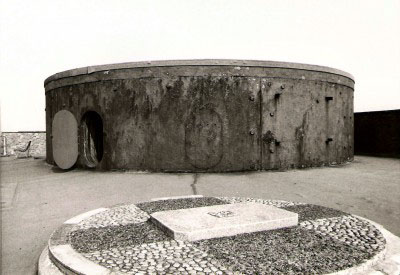
The ‘Right Battery’ at Williamstown, Fort Gellibrand. 

(Image from the Military History and Heritage Victoria website)


And not forgetting this cracking scenario from Space 1889, set exactly at this spot! 

Scenario from GDW's "Ironclad & Ether Flyers" (1990), page 37

Monday, 28 March 2016

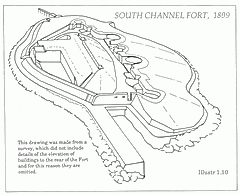
Melbourne's Sea Forts that never were

Proposed but never built, based on the Channel forts off Portsmouth, UK. 
Would have made fascinating additions to the Victorian defensive network.

From: http://www.mhhv.org.au/?p=1741

In 1859 (and with the "Russian Scare" of the Crimean War still fresh in the minds of the Australian colonies), Britain was swept with an anti-French fever whipped up by the Press as a result of the construction of the French warship La Gloire, the first armoured steam warship to be built.

In the same year the Palmerston government was forced by public opinion to set up a Royal Commission to review the defences of the United Kingdom. When the Commission reported in 1860 it recommended sweeping improvements to the defences of the Royal Dockyards at the enormous cost, in those days, of £11 million.
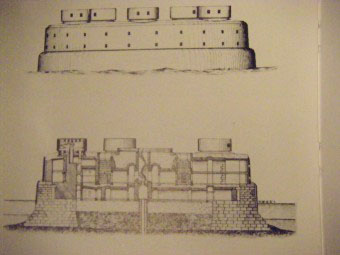
One result of the recommendations of the Commission was the construction of four sea forts to defend the Solent, the stretch of water between the Isle of Wight and Portsmouth. These were large circular forts, one sited on a spit of land off the Isle of Wight and the other three on shoal banks in the Solent. All were built of stone and partly clad with iron and all mounted some of the largest rifled muzzle-loading (RML) guns, 12.5-in 38 ton guns. At the same time a further fort was approved for the defence of Plymouth harbour. Known as the Breakwater Fort it was slightly smaller than the Solent forts and a revised, though abortive, design in 1866 included a pair of two-gun turrets on the roof of the fort.
The concept of mounting guns in turrets on coast defence forts was a very new one in the 1860s. Captain Cowper Coles RN had patented an iron revolving turret for two ‘heavy’ RML guns in 1859 and proposed the design of a number of turret ships for the Royal Navy. It was, therefore, a logical progression for British military engineers to suggest the mounting of turrets on coast defence forts.
These five forts were the only sea forts to be constructed by British military engineers. However, what is not generally known is that two similar sea forts and a tower with a turret for two guns were proposed for the defence of Melbourne in the 1860s though these were never constructed.
The turret for two 16-in RML guns mounted on the Admiralty Pier at Dover
Melbourne Sea Forts
The Crimean War and the construction of the French armoured steam warship La Gloire produced war scares not only in Britain but also in the Australian colonies. The defences of Melbourne were rudimentary at this time with the main defences being an earth battery for nine 68-pounder smooth-bore guns at Williamstown and a battery of  six guns at Sandridge.
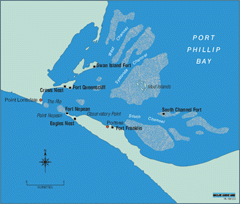
In 1859 the Victoria government requested advice on the fortification of Melbourne from the War Office in London and in August 1860 Captain Peter Scratchley arrived with the specific task of reviewing the existing defences and advising on what additional defences were required. Scratchley’s recommendations included four batteries at the Heads at the entrance to Port Phillip Bay. In addition, he recommended the construction of five batteries at Sandridge and Williamstown to be reinforced by a floating battery and a wooden sea fort raised on piles in Hobson’s Bay. Despite a scare of war with the United States in 1861 only Scratchley’s proposals for the batteries for the close defence of Melbourne in Hobson’s Bay were completed in 1863 together with a battery at Shortland’s Bluff to defend the entrance to Port Phillip Bay.
Captain Scratchley returned to England in 1863 but plans for improving the defences of Melbourne and Port Phillip Bay continued with proposals in 1865 for the construction of towers at Point Nepean and Point Lonsdale to support HMVS Cerberus, the construction of which had recently been authorised. The Point Nepean tower was designed to carry a turret for two 23 ton RML guns (12-in Mk I). The cost of the tower was estimated at £10,000 with a further £10,000 for the turret and £8,000 for the armament making a grand total of £28,000 for the completed tower. (1). It is, perhaps, not surprising, therefore, that the construction of these towers was never authorised by the government of Victoria.
A design for a sea fort mounting five turrets
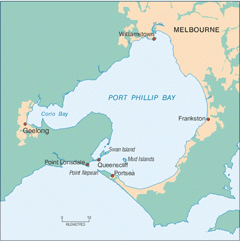
In London in 1867 the Defence Committee, under the chairmanship of Admiral Grey together with Rear Admiral Cooper Key and Lieutenant Colonel Jervois, reviewed further proposals for the defence of Melbourne and concurred with a report of the Fortifications Committee that two sea forts should be built for the defence of Port Phillip Bay. The forts were to be constructed in the water on a line between Point Gellibrand and Point Ormond, a distance of approximately 6,000 yards (5,538 metres), in order to provide a line of defence that was sufficiently advanced to protect  Melbourne and its shipping from long-range guns. These forts were to be similar in design to the Breakwater Fort in Plymouth harbour but smaller in size.
One fort was to be sited on a shoal 500 yards (460 metres) from Point Gellibrand and this was to be an iron casemated fort mounting 10 x 9-in 12 ton RML guns in two tiers of casemates with 2 x 10-in 18 ton RML guns in a single turret. The second fort was to be sited in 4 ½ fathoms of water 2,000 yards (1,846 metres) from the Point Gellibrand fort. The second fort was to be more heavily armed mounting 12 x 9-in 12 ton RML guns in two tiers of casemates and 4 x 10-in 18 ton RML guns in two turrets.
The cost of the fort off Point Gellibrand was estimated at £75,000 for the foundations and iron casemates; £10,000 for the turret; £25,000 for the 9-in guns; and £7,000 for the 10-in guns. The total cost coming to £117,000. The cost of the deep-water fort was even more with an estimate of £145,000 for the foundations and iron casemates; £20,000 for the two turrets; £30,000 for the 9-in guns; and £14,000 for the 10-in guns. The total cost coming to the astronomical sum, for that time, of £209,000. (2.)
The proposals for the construction of the two sea forts came at a time when Britain was reviewing its Imperial defence policy and instituting a requirement that the dominions and colonies should contribute towards their own defence. At this time Britain was also considering the withdrawal of the Imperial garrisons from Canada and the Australian colonies and had passed an act of Parliament permitting the creation of official naval forces in the colonies. Having just authorised the construction of HMVS Cerberus the government of Victoria was not inclined to fund the construction of these expensive fortifications and so the project lapsed.
- See more at: http://www.mhhv.org.au/?p=1741#sthash.RgFMlBw3.dpuf

Thursday, 7 January 2016

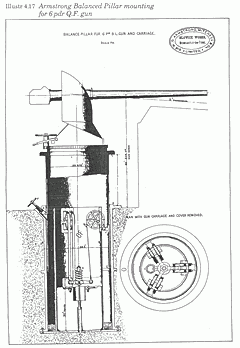
RML 9 inch Armstrong Fortress Guns, Fort Gellibrand, Melbourne


These 9 inch (228mm) Rifled Muzzle Loading guns are 12 ton Armstrong Fortress guns (300 pounder guns - actual weight of shot was 256lb). With a 9 man crew, rate of fire was approx one round every 3 minutes with either solid palliser shot or exploding shell ammunition, cast in water cooled moulds to harden the tip to enhance armour penetration. Effective range approx 5000 metres


This pair are situated in Williamstown (near my parents' house), an inner suburb of Melbourne, and cover the final approaches to the port. These guns (Nos 1679 and 1683) purchased by Sir George Vernon in 1866 to upgrade the existing 32 pounder smoothbore guns at Fort Gellibrand, constructed in 1855 during the Crimean War "Invasion Scare", to cover the southern approaches to the harbour.  


The Point Gellibrand shore batteries were first developed as part of an immediate defensive system for the city and port of Melbourne. The strategy for the defence of the port of Melbourne at this time was based on a number of shore batteries inside Port Phillip Bay. 


From the Military History and Heritage of Victoria website here: http://www.mhhv.org.au/?p=2351
"1869 Sir William Armstrong rifled muzzle-loading fortress gun"
- Military History & Heritage Victoria

This pic appears to be the same location as the one above it - quite unchanged really for well over a century earlier (other than a fence!) 

The first permanent battery was built by penal labour on Gellibrand’s Point in 1855. Convicts from the hulks moored offshore were employed on these works and accommodated in an old military barracks at the Fort. The buried central magazine at the Fort dates from this period. Further gun emplacements were added by private contracts, along the foreshore in the 1860’s."

The importance of the Fort batteries declined from the 1890s with the advent of new technologies allowing enemy ships to stand further out and shell Melbourne at range. Accordingly, they were replaced by new outer harbour defences at Queenscliff and Point Nepean, though they were still used for gunnery practice. Local residents, through the Williamstown Town Council, complained to the Acting Minister for Defence that the concussion from the guns damaged windows, walls and foundations of buildings. 
When the cannons were relegated to garden ornaments

Now deemed not just obsolescent but also a public nuance, the Armstrong Cannons were moved from Fort Gellibrand to the Williamstown Gardens in 1906 as static displays, where they stayed until 1970 when the development of the Esplanade saw them taken to their current position.

"Williamstown cannons being fired in 1988" (assumed for the Australian Bicentenary celebrators).
This was the last time the guns were fired


In addition to coastal fortifications, this type of gun was also typically fitted to smaller British ironclads and as the secondary broadside armament on larger battleships. The primary ammunition was solid Palliser shot, primarily employed for Armour Piercing work. Initial design was 1865 and 3 successive upgrades were implemented.

Two additional Armstrong guns, also originally emplaced at Fort Gellibrand, are displayed in another nearby Melbourne suburb where they were relocated in 1910.


https://historicalragbag.com/2024/07/

https://www.gleneira.vic.gov.au/our-city/history-and-heritage/our-monuments-and-sites/cannons-in-hopetoun-gardens

Saturday, 20 November 2010

The Defence of Melbourne

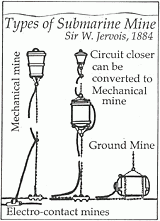
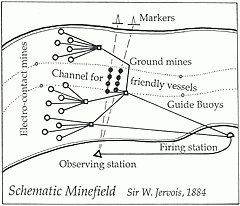
Real documentation for the defensive plans for the colony of Melbourne (against those dastardly Russians most likely!), including the layered use of shore batteries, coastal forts, minefields and the local flotilla (including the HMVS Cerberus).

http://www.awm.gov.au/journal/j35/kitson.asp

Note too the potential use of scouting dirigibles!

Sunday, 25 October 2009

Attack on Melbourne

Interesting details of a colonial harbour defense plan (minus the aerostats and aquanefs of course!)

http://www.awm.gov.au/journal/j35/kitson.asp

Saturday, 19 September 2009

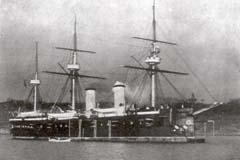
HMVS CERBERUS

I just picked up a lovely monograph on this wonderful piece of colonial naval history:
'HMVS Cerberus: Battleship to Breakwater.'

Built at the cost of 125,000 pounds (of which the British Government donated 100,000 pounds). She was laid down in 1867, completed in 1870 and delivered (after a perilous journey) the following year. She was ordered to protect Melbourne, one of the Empire's richest colonies at the time due to the gold rush, from the Russian threat. Not an inconsequential threat it turns out, as Russia was allied to the United States during the civil war and the Russian Pacific Fleet commander had sealed orders to bombard Sydney, Melbourne and Hobart should hostilities break out between the US and Great Britain.

The monitor was the first British armoured ship to fully dispense with sail and be powered purely by steam. She was also first vessel with a central superstructure with gun turrets at the ends, and the first design to have breastwork protection and low freeboard. She had two sister ships, Abyssinia and Magdala, built for service in India though they were completed later.


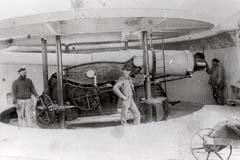
Gunnery drills on the uppder-deck: 2 quad barrelled Nordenfeldts and a QF 4pdr


HMS Devastation (1871), built 3 years after Cerberus, incorporated many lessons learnt from Cerberus can rightly claim credit as being the first ocean going modern battleship. (Whereas Cerberus was specifically designed for Harbour defence)

"Indeed Devastation itself was an enlarged version of the coast defence Breastwork Monitor Cerberus, whose construction marked the beginning of practical turret ship design" Birth of the Battleship, John Beeler, US Naval Institute Press, 2001

"Between the harbour defence ship and the sea-going battleship was a matter of degree - the Devastation was to develop out of Cerberus in due course." British Battleships, Oscar Parkes, Seeley Service & Co., London, 1957

She was a powerful warship equipped with two twin 10 inch gun turrets (muzzle loading, rifled Armstrong guns), 4 quad barreled Nordenfeldt machine guns and 2 six pounder guns (added in 1892/93). Armour plate ranged from 6 inches on the sides to 10 inches on the turrets. She was not initially provided with any protection against torpedoes, but outriggers and nets were later fitted for this purpose.


The local press commented upon her arrival that "Victorians can sleep peacefully upon their pillows, with the consciousness that Cerberus is in every way fit to fight their battles and to fight them in modern style".

Cerberus enjoyed a period of 53 years service in which she never fired a shot in anger. Ironic then that her guns caused such general collateral damage to windows that public protest effectively negated the conduct of firing practices close to shore!


A free 1/250 scale card model of Cerberus as she appeared in the 1890s (with mast modification and torpedo booms fitted) is available here:

http://www.cerberus.com.au/store/model_paper.html

In the meantime, I'm working on my lovely 1/1200 scale Cerberus from Brigade Models: pics soon!

Thursday, 16 April 2009

The Defence of Melbourne

I have been meaning to get around to posting about this excellent emo game put on at CANCON 09, yet sadly haven't found the time. But now, I've found this excellent Blog by the guys themselves:


It was a great game using 25mm figs and modified TSATF rules. And as you can see, the scratchbuilt models and terrain are just stunning!


I'll try to clean up the pics I took and add them too

An exploration of debauchery, vice and other reasons to be a man!

An exploration of debauchery, vice and other reasons to be a man!