 This seems quite apt after my recent dig at the Frogs!! (http://pauljamesog.blogspot.com/2009/10/complete-military-history-of-france.html)
Friday, 30 October 2009
French Military Victories
This seems quite apt after my recent dig at the Frogs!! (http://pauljamesog.blogspot.com/2009/10/complete-military-history-of-france.html)


Tuesday, 27 October 2009
HMS Rocket
Another YIAWWS Exclusive - by Vanvlak Industries!
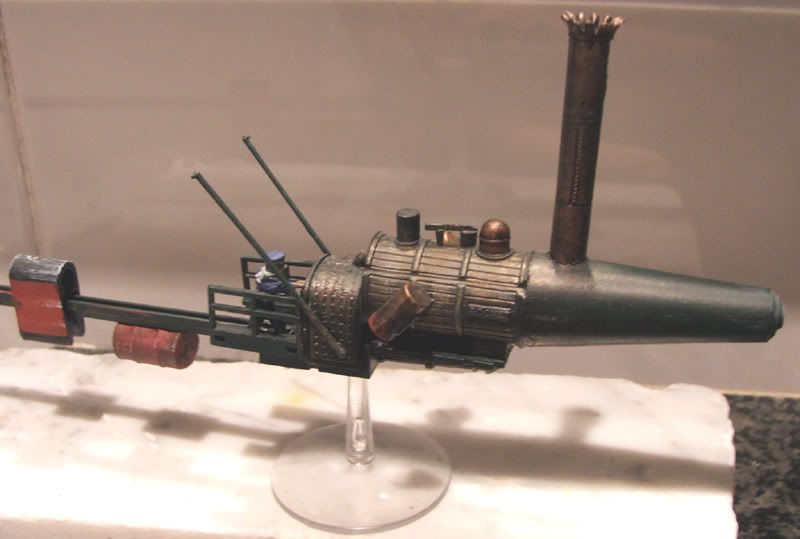
HMS 'Rocket' is the lead ship of the MkII Airborne Steam Shunt (A.S.S.) class of unarmed vessel, a short range flyer used to shuffle cargo around docks. The long rail at the rear is used to attach cargo onto. The MkIIa is similar but has a redesigned aft section and is a dedicated dirigible and aeronef tug, although the MkII itself is sometimes put to the same use. The MkIIb is identical to the MkII but has an enclosed cockpit for space use.
'Rocket' is currently attached to the Mediterranean fleet, and has seen service in Malta and Graham Island.*
*http://en.wikipedia.org/wiki/Ferdinandea
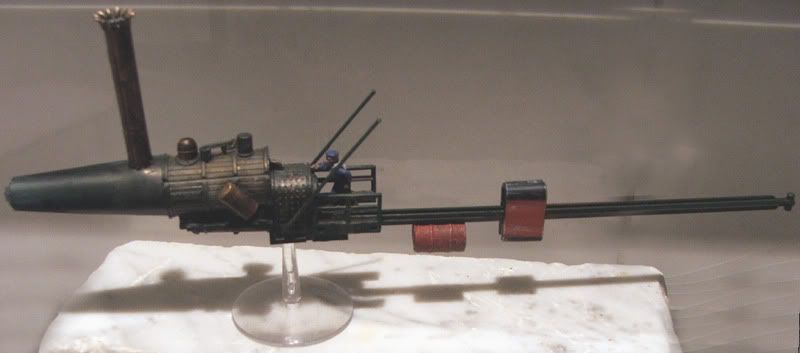
It's the first model in a new collection of vehicles I intend to build (no bets on whether I'll actually get them done...). They will be a loose assortment of Victoriana, mostly vehicles with some troops, all in 15mm scale. I'm currently working on the second vehicle, a Mk I Conveyancer. The vessels will be part of a joint British (Imperial)/Venetian force. I still have no idea what they are up to in the Mediterranean, or who their enemies would be (Barbary Coast Pirates? The Russian Navy?).
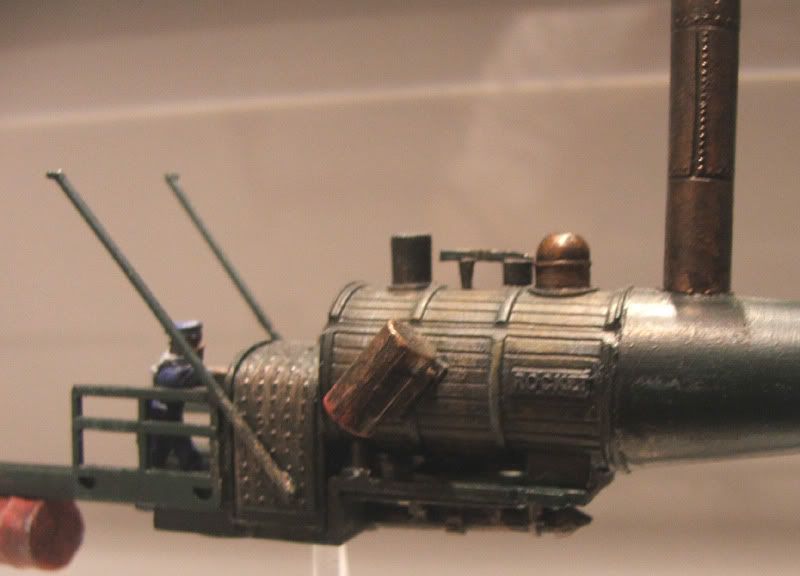
Peter Pig sailor at the helm.
Bravo old Boy - we've missed your unique style and great skills around here!
HMS 'Rocket' is the lead ship of the MkII Airborne Steam Shunt (A.S.S.) class of unarmed vessel, a short range flyer used to shuffle cargo around docks. The long rail at the rear is used to attach cargo onto. The MkIIa is similar but has a redesigned aft section and is a dedicated dirigible and aeronef tug, although the MkII itself is sometimes put to the same use. The MkIIb is identical to the MkII but has an enclosed cockpit for space use.
'Rocket' is currently attached to the Mediterranean fleet, and has seen service in Malta and Graham Island.*
*http://en.wikipedia.org/wiki/Ferdinandea
It's the first model in a new collection of vehicles I intend to build (no bets on whether I'll actually get them done...). They will be a loose assortment of Victoriana, mostly vehicles with some troops, all in 15mm scale. I'm currently working on the second vehicle, a Mk I Conveyancer. The vessels will be part of a joint British (Imperial)/Venetian force. I still have no idea what they are up to in the Mediterranean, or who their enemies would be (Barbary Coast Pirates? The Russian Navy?).
Peter Pig sailor at the helm.
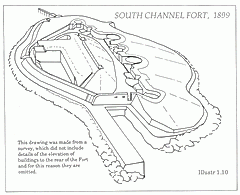
Bravo old Boy - we've missed your unique style and great skills around here!
Sunday, 25 October 2009
Attack on Melbourne
Interesting details of a colonial harbour defense plan (minus the aerostats and aquanefs of course!). Reproduced unaltered from http://www.awm.gov.au/journal/j35/kitson.asp
An attack on Melbourne: a case study of the defence of Australia’s major ports in the early 1890s
Author: Michael Kitson
{1} The casual visitor to a dismantled fort or battery in any of Australia’s numerous coastal defences that predate World War II will usually be impressed by its functional, architectural complexity. On the other hand, on discovering that none of these defensive works were subjected to an attack before 1942, the visitor might wonder whether they were an elaborate and costly extravagance.
{2} As late nineteenth century coastal defences often comprised interdependent but widely dispersed units, it is difficult for a visitor to comprehend (or for a museum to interpret) their purpose. Some visitors – perhaps those with experience of military matters – will be curious to know for what purpose a battery was constructed and what part it served in relation to the whole defence. In short, how was the entire defence conducted? Unfortunately, few defence sites have survived in their entirety. The archaeological evidence that has survived is the product of a process of continuous evolution and superimposition, one in which complexity was replaced by severe simplification after 1909. Furthermore, key components such as submarine minefields, naval and infantry defence provide little in the way of archaeological evidence for interpretation. This is especially significant in the case of submarine mining, which played a vital role in Australian coastal defence from the late1870s until the first decade of the twentieth century. Where it could be employed, it became the foundation on which the whole defence was built; it was, to use the term current then, sine qua non (meaning "without which nothing"). 1
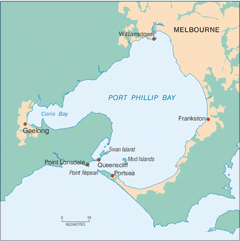
{3} The purpose of this article is to describe the function of Australia’s coastal defences at the stage when they were complete (just before the onset of the financial depression of 1893), using the knowledge obtained from published lectures and reports from the period 1886–91,2 and to reconstruct a reliable account of the defence that was planned in the event of a hypothetical attack against one of these sites. A detailed comparative account for all Australian defended ports would not only be too long and too tedious, but in any case would be found to be basically repetitious. For that reason the scenario of an attack on Port Phillip Bay in 1892 has been selected for examination. This choice is determined by doubts that there is sufficient available archival information to reliably do the same for Sydney in the 1890s, and certainly not enough to attempt Hobart or Brisbane, and the fact that for 1892 there is an exact and detailed record of the armament, ammunition and matériel held in each battery and fort defending Melbourne. 3
{4} During and after the Crimean War, anxiety in Australia that ports and shipping were open to attack is revealed by the regularity with which ‘scare’ articles appeared in the press. The anxiety was justified, because so long as ports and coastal shipping remained inadequately defended (or, worse, lay entirely undefended), even a single cruiser could carry out a destructive raid with a minimum of danger to itself. It was thought that if Britain was involved in a war with other naval powers the "gold colonies were tempting baits and perhaps easy triumphs",4 and also that Australian targets could be taken by surprise. Before the telegraph link with Britain was established in 1872, Britain (and, therefore, her colonies) might well have been at war a month before news was received in Australia. For all these reasons, even good-will visits by friendly foreign warships, or by individual foreign vessels on surveying work, were regarded with suspicion. 5
{5} Two major ‘war scares’ had as profound an effect on the implementation of Australian coastal defence as they did on British imperial defence planning. The first occurred in 1877–78 and the second in 1885; on both occasions Britain came close to declaring war with Russia. Both were a result of Russia’s expansion eastwards, first into the Eastern Mediterranean, which threatened the Suez Canal in Turkish Egypt, and then north of India to Vladivostock and the Sea of Japan.
{6} Once telegraph communication with Europe was established, news from that part of the world was received the following day. This immediacy involved Australians in European ‘scares’ on a day-to-day basis through the press.6 The long build-up to the Anglo-Russian crisis began with Russia’s involvement in the revolutions against the Turks in Bosnia and Bulgaria in April 1877, and was followed avidly by Australians with increasing certainty that Britain would declare war. The crisis came in December when Turkish resistance collapsed at Plevna. Then, fuelled by reports of ‘jingoistic’7 excitement in London, the tension grew with news that a British fleet had forced the Dardanelles in February 1878 to prevent the fall of Constantinople, and of British mobilisation which followed in March. 8
{7} In Sydney and Melbourne during 1876 the effectiveness of the volunteer forces, the local naval defence, and the fortifications built in the previous decade, became the subject of press criticism and public inquiry. The most damning was Victoria’s Royal Commission on the Volunteer Forces, which found the volunteer force ineffective, inadequate and insufficiently trained, and the fixed and naval defences undermanned, outdated and allowed, through neglect, to reach a ruinous condition.9 In December the governors of Australia’s eastern colonies jointly asked the Colonial Secretary in London to appoint an expert military engineer to advise on their defence. As a result, in 1877 Sir William Drummond Jervois and Sir Peter Scratchley drew up defensive schemes for major and outlying ports. The second ‘scare’ of 1885 prompted British moves to protect coaling stations, and also to set up the Colonial Defence Committee which annually reviewed and advised on all imperial defences.10
{8} An overall commonality in the strategic design adopted for Australian coastal defence is not surprising, as after 1885 it became the standard form of coastal defence throughout the British Empire. Between 1885 and 1906, defences for major Australian ports and coaling stations were developed along Jervois’ lines. Despite their evolution over twenty years, during which weaponry rapidly improved, innovation was controlled at first by Scratchley and subsequently by the Colonial Defence Committee. These works comprised an inner defence of a minefield protected by guns and illuminated at night, and also an advanced defence of guns and lights of covering the approaches to the inner system. The scale of attack considered possible, and consequently the power of the defence needed to match it, had been defined by Jervois as an attack, or raid, mounted at long range, by one or more cruisers which made a "descent upon the coast" or operated against commerce. "A squadron intended for such an operation would probably consist of three, or four, vessels, one or two of which might possibly be ironclads."11
{9} Variations in the defensive plan were produced by local factors, such as the availability of sufficient specialized personnel, or differences in topography (such as between Hobart and Sydney). The most marked variations were caused by inequalities between colonies of available funds. Rapid improvements in matériel meant that work which was completed quickly, if funds were unavailable to update it, paradoxically became out of date in comparison with later work.12 Nevertheless, the commonality of strategy and matériel was sufficient for the United Services Institutions of Victoria and New South Wales to usefully address the same issues in their series of monthly lectures. In these forums, papers such as "The Attack of a Protected Harbour" and "The Defence of a Protected Harbour" were delivered by serving imperial and local volunteer officers. While these lectures carefully avoided naming specific harbours, or revealing the exact location of defence features, presumably because of the Secrets Act of 1889, the questions and discussions that followed them leave no doubt they applied specifically to Sydney and Melbourne.
{10} In 1884 (when again Britain’s relations with Russia were strained) the Victorian premier learnt that during the 1878 crisis Russia had actually planned, in the event that war was declared, to raid Australian ports and coastal shipping with "five fast unarmoured cruisers". Some details of this plan had been discovered by chance in Yokohama, Japan, shortly after the crisis passed, by a British marine officer who – after further investigation – produced a report on it.13 In November 1884 the colonies’ defence adviser in London, Major General E. Harding Steward, passed on to Melbourne what was known about the scheme and how it was believed that the Russians had intended to implement it.14
{11} Although a copy of the original report has not been found, there is evidence that the intention of a Russian raid was known in 1881 to the Commander of the Naval squadron in Sydney.15 A close reading of Steward’s memorandum suggests, however, that he had combined information which can be substantiated with material that cannot, with the latter possibly having been obtained from the officer who made the initial report.16 While there is no doubt that Russia had been engaged in building unarmoured fast cruisers for commerce raiding, estimates of the number of vessels Russia maintained on the China Station vary considerably.17 Steward reported that Russia had five cruisers and two ironclads in Chinese and Japanese waters in 1878, and a reliable statement by the Consul General in Japan in 1880 estimated "three ironclads . and twenty six vessels of all kinds, including torpedo vessels and gun-boats."18 There is no doubt the small raiding squadron described in Steward’s memorandum could have been assembled in 1878, especially as France maintained a similar force on the China Station and was expected to form an alliance with Russia if war was declared. This and other statements in Steward’s memorandum provide a useful indication of the form the War Office and Admiralty expected a Russian naval raiding campaign in the Pacific might take.
{12} According to Steward, because Vladivostok was ice-bound during the winter of 1877–78 the Russians had maintained a small squadron in Japanese waters. The Royal Navy conducted a watch on Japanese ports, waiting for the anticipated advice that hostilities had commenced via the only telegraph to Japan. As the cable ran overland through Russian territory to Vladivostock and from there to Japan by a line maintained with Russian capital, it was thus effectively controlled by the Russians. It was therefore possible for Russian ships to receive news of the outbreak of war at least five days before the British did. With this foreknowledge the ships could slip away singly from Yokohama and Tokyo, before assembling in Okinawa where stocks of coal had been ordered from an American company. Not surprisingly, the line to Nagasaki was reported broken by the Commander of the China Station when he arrived there in September 1878, as was the line to Shanghai on his arrival there in October.19
{13} The commander of the Russian squadron in Japan in 1878 had the choice of raiding Singapore and Hong Kong or alternatively the major ports of south-eastern Australia. Coastal defences at all these places were either negligible or entirely lacking. It was possible to capture coal in both Singapore and Newcastle, but Australia was selected as the target because there was less chance of encountering a British fleet during the return voyage to a neutral port on the west coast of the United States. The object of the plan was to destroy as much unprotected coastal shipping as possible, and to raid the ports of Sydney and Melbourne where it was expected that gold bullion worth at least 6 million could be obtained under threat of bombardment.20 In addition, Newcastle would be raided for coal.
{14} Remarkably similar schemes of attack had been reported in 1864 and 1882,21 and would be again just a couple of months after Steward’s report reached Melbourne. On 30 March 1885 Russian troops and Afghan levies exchanged shots at Pendjeh on the Indian frontier, leading to renewed international tension. Again Britain called out her reserves and the Royal Navy in Australian waters put to sea under sealed orders on the 31st. The fear of war was especially marked in outlying colonies such as Singapore, Hong Kong, Cape Town and Australia. In Melbourne the forts at Port Phillip Bay – although still incomplete – were placed on full alert, and rapidly supplemented with temporary works and a submarine minefield.22
{15} After the crisis had passed, and while Australia’s defences were still being brought to completion, two issues raised anxieties about the possibility of a successful attack. The first concerned allegations in the British Press and admissions by the Admiralty, that the Royal Navy could not prevent cruiser raids on ports or commerce, even in home waters.23 The second hinged on the difficulty of maintaining a volunteer force of trained specialists (such as gunners and engineers) to man the new, more complex and technically advanced, defences. In October 1889 Commander George Egerton, RN, described to the United Service Institution in Sydney how he would mount a raid on a major Australian harbour. Following lecturers outlined how such an attack would be met. These discussions provide a means of reconstructing what was expected to occur at Port Phillip Bay in these circumstances, moving the date forward by three years to when we have good information about the extent of the local defences. Throughout this exercise, it should be borne in mind that the task of the defending force was to hold off a marauding squadron until it had to retire (either through exhausting its ammunition or suffering severe damage) or until relief arrived in the form of a British fleet within two or (at the most) three weeks.
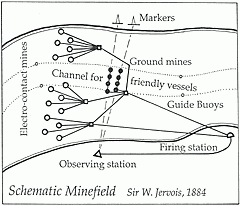
{16} On Admiralty advice, coastal defences in Australia had been planned to resist a force of four cruisers, one of which might be an armoured type. In developing his scenario for a hypothetical attack, however, Egerton decided to employ a squadron of seven ships, four of which would be armoured cruisers of a class similar to his own ship (HMS Orlando); another two cruisers would be equivalent to the Royal Navy’s Marathon class, and he included a transport for stores.24 In making this provision, he was applying the Admiralty maxim that to mount a successful attack on fixed positions required double the number of the defenders’ guns. This at least suggests that the defences were sufficient to hold an attack of the scale against which they had been designed, but also reflected contemporary anxiety about competition in armaments which required that the organisation, strategy and technology of coastal defence constantly kept pace with rapid developments in naval shipbuilding and gunnery.

Marathon
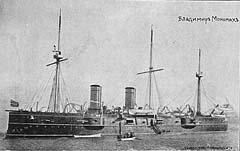
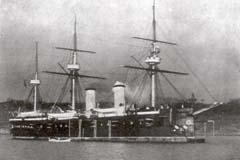
{17} Egerton’s force was by no means unrealistic with regard to either the number or types of ships that the Russians, in alliance with the French, could assemble. Prior to the Colonial Conference in 1887, Major General M.F. Downes, the civil head of the Victorian Department of Defence, provided the Argus newspaper with a list of Russian ships in the Pacific which included three armoured and six unarmoured cruisers.25 Two of the ships listed – Vladimir Monomakh and her sister ship Dimitri Donskoi – were similar to HMS Orlando. They carried four 8-inch and twelve 6-inch breech-loading guns, and were protected by a waterline belt of 6-inch compound armour. Vladimir Monomakh had been on the China Station in 1885 with the powerful and fast Admiral Nakhimoff, which was also certainly there in 1889.26
Dimitri Donskoi
The outer defence
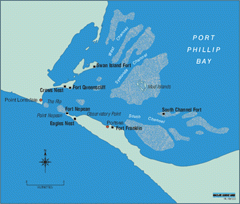
{18} The topography of Port Phillip Bay formed an integral part of its defence. From its narrow mouth at the Rip, on the southern end of the bay, the entrance follows an easterly curve around Point Nepean. Then five kilometres from the Rip, an arc of shoals separates the deep water inside the Heads from the deep water of the bay beyond, with just three navigable channels for shipping. Covering the main entrance were forts on both shores – Fort Nepean and Eagles Nest battery on the eastern side, with Crows Nest battery and nearby Fort Queenscliff on the opposite side – the three locations being able to bring a triangle of fire onto any ships entering or leaving the bay. Inside the Heads, minefields and three forts (Swan Island Fort, South Channel Fort and Fort Franklin) guarded the shipping channels through the shoals and formed a second, inner line of defence. The ships of any attacker had thus to force a way past the first line of defence at the Heads, in particular the guns of Fort Nepean which dominated the long passage around the point, during which vessels presented a continuous large (side-on) target at close range. Once inside, a raider could expect to find the shipping channels closed by minefields and his ships held under the fire of surrounding forts and batteries.
{19} The navigable channels through the shoals into Port Phillip Bay vary in length between five and seven miles (eight and eleven kms). West Channel, the most direct route leading north to Melbourne, was passable for ships of less than 18 ft draught, while Symonds Channel was usable for those of only about 17. South Channel, the longest route, which ran close to the eastern shore, could accept ships to a maximum draught of about 26 ft. As Orlando drew 23 ft of water and the Marathon class 20, their attack could only be made through here.
{20} In wartime a minefield at least 3,000 yds long (2.7 kms) was planned for the South Channel. Even if insufficent warning was received for the whole field to be in position before hostilities began, in only two days enough mines (four groups of four, or sixteen mines) could be laid to close the channel, and work could then be carried on to the rear of the closed section to complete it within four days.27 South Channel Fort (situated five miles from the channel’s western entrance, on its northern side) protected the minefield with gunfire and provided illumination for it at night; it was also from here that the mines could be either electrically detonated under their targets or armed to explode on contact. In addition, ships of the Victorian naval squadron (including three torpedo boats) were assigned to the minefield’s defence.
{21} In his planning for a notional attack on the outer defences, Egerton had two objectives. First, he aimed to reduce the outer forts sufficiently to be able to undertake the risky process of preparing to mount an attack on the minefield, which must be done inside the Heads in sheltered water. Secondly, he wanted to reduce the outer forts effectively enough for his squadron to be able to leave without having to fight its way out. The defence assumed this could not be carried out effectively unless men were landed to spike and dismount guns, and explode magazines, therefore a large force of volunteer infantry, cavalry and field artillery was deployed to defend the forts and batteries, and also to counter any attempt to outflank them.28
{22} The attacking squadron needed to complete its raid and leave before relief in the form of a British naval squadron reached Port Phillip; in Egerton’s words, "delay spelt disaster" for the attack. Also, the amount of ammunition the squadron could expend was finite, even if it included a transport or store ship. Nevertheless, Egerton judged it vital to spend valuable time and ammunition in silencing the outer forts rather than attempting to run past them at speed. In any case, if the minefield of the inner defence was in place then running past the outer forts – which might be done at speed with the tide, perhaps at night and in thick weather – would serve only to bottle up the attacking squadron in a killing ground, held in front of the minefield and surrounded by forts and batteries.
First day of the attack
{23} For these reasons, Egerton envisaged that his attacking ships would appear off the Heads at daybreak, steaming at 15 knots in quarter-line-to-starboard to give the forward guns maximum play. They would open fire at 6,000 yds with 9.2-inch guns, then with 6-inch guns at 5,000 (or 4,000) yds, as positions providing ranges previously calculated from charts were reached. When each ship closed to about 2,000 yds of their target, it would alter course to fire a full broadside (two 9.2-inch and five 6-inch guns), then turn again at the 5-fathom line, under cover of smoke, to bring the stern guns to bear. The process was then repeated as the warships steamed out on a different course. The four Orlando class ships would manage a salvo every two minutes, which meant (at 15 knots) every 1,000 yds.
{24} Unarmoured cruisers were not to close with forts, but would be detached from the squadron and kept about 800 yds (730 m) further out than the Orlandos while attacking outlying batteries (Eagles Nest and Crows Nest). All ships were to mount a rapid fire on these batteries’ parapets with quick-firing guns and machine-guns, aiming not just to damage or destroy them but also to hamper range-finding, cut any telegraph wires above ground, and prevent signalling.
{25} The defence agreed that a slow and careful fire should be opened at the longest effective range possible. What constituted an effective range was considered to depend on a number of variable factors, such as light conditions, range finding, and the size and speed of targets.29 For this reason it was the practice in 1892 for targets to be selected by the commander of each of gun group.30
{26} As soon as the targets were identified, the heavy guns of the coastal defences (10, 9.2 and 8-inch) were capable of longer effective ranges than the squadron. This was because, unlike the warships, they fired from stable platforms and provided only small, widely dispersed, well-protected and hidden targets. They would have begun to fire common iron and shrapnel shells before the leading ships managed their first salvo. Although telephone lines had been laid, fire control by electrical communication was considered uncertain at this date, and was therefore limited to each gun group. Working as independent units, therefore, each group would bring all possible guns to bear onto single targets.
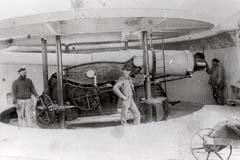
{27} For as long as the armoured cruisers stayed beyond the range at which armour could be penetrated, the object of the defence was to create as much damage as possible to damage or destroy any weapons, such as machine-guns, structures and personnel that were unprotected. When fire was exchanged at these long ranges – so the defence argument ran – the advantage lay with the defence, despite the mobility of warships. One gunner pointed out that an Hp gun position was invisible to the naked eye, even with a telescope, at more than 2,400 yds (2.2 kms). Because these "disappearing" weapons were loaded and stayed below parapet level until ready to be elevated on hydropneumatically-powered arms for firing, their positions could only be seen during the brief time that the gun was actually raised. And, he added, "before the enemy have heard the report of the gun it is down again, safe in the pit."31
Hp gun in lowered (loading) position.
{28} When the squadron came within the range at which armour could be penetrated, the defenders’ heavy guns (6-inch breech-loading and above) would target it. If an armoured warship was not side-on, then its deck armour could be attacked (and very effectively so) by heavy guns at some height above sea level, such as the 10-inch Hp gun at Eagles Nest. The thickness of steel decks (and also the steel overhead cover for the defence’s Hp guns) was calculated to give the same protection at ten degrees as the side armour gave at ninety degrees. Thus, 10-inch guns at 4,500 yds (4.1 kms) could penetrate the side armour and the deck of an Orlando. Against side armour, groups of heavy guns were prepared to fire salvoes of Palliser32 – if possible at the same part of the armoured belt and at right angles to it. Such salvoes produced a shattering effect, and also allowed straddling to be observed and ranges corrected quickly.33 Meanwhile, light and QF (quick-firing) guns were directed against the upper works and ports, firing common shells and shrapnel.
{29} Nevertheless, Egerton was confident his squadron could silence the outer defences in only two running attacks, but decided against landing a party of men to ensure this task was completed because a relieving squadron might suddenly appear. He hoped to complete the reduction of the outer forts during daylight, and then, before dusk, begin preparations for a night attack on the minefields of the inner defence. This assessment seems extremely optimistic, even allowing for the great size of his squadron. Officers of the Defence Forces were confident that (if they were not caught by surprise) it would take several days to penetrate the outer defences, and the whole defence could hold off an attack for at least three weeks.
{30} Major William Bunbury, a Royal Artillery officer acting as military adviser to New South Wales, also considered a raid by two armoured and two unarmoured cruisers on outer defences, and reached very different conclusions to Egerton. In his examination of such an attack, all four ships were crippled sufficiently to force them to withdraw at nightfall after an engagement lasting three hours. His assessment of the damage to the defences in such an engagement was that muzzle-loading barbette batteries were silenced, and a number of their personnel killed by shrapnel fire, but there was no damage to the 6-inch BL (breech-loading) Hp guns, mounted in pits with overhead shields.
{31} Bunbury also wrote an assessment of a longer attack by a larger squadron of eight warships on the inner defences. In this report he again stressed the advantage of Hp mountings, envisaging that two out of four 6-inch BL Hp guns would remain operational until the third day of the attack; one would have failed through mechanical breakdown, and the pit of the other was opened by gunfire on the third day and the gun dismounted.34 Highly successful trials that the War Office conducted in 1885 with this type of gun, under simulated naval attack, had been widely reported. This, and the inaccuracy of naval gunfire at the bombardment of Alexandria three years earlier, may have been foremost in Bunbury’s mind as he drew his conclusions.35
{32} Whereas it might have been possible to silence Fort Nepean, Eagles Nest and Crows Nest from the open sea, without passing through the Heads, it is unlikely that ships of the squadron would have been able – firing at ranges over 4,000 yds – to do serious damage to the guns of Fort Queenscliff, even though its keep and lighthouse provided clearly distinguished features to aid long range bombardment. It would, therefore, seem probable that a second engagement would be necessary to put Fort Queenscliff out of action once the squadron was inside the Heads.
The inner defences
{33} Accepting Commander Egerton’s optimistic claim that the outer defences (including Fort Queenscliff) could be silenced well before dusk on the same day the attack was begun, the squadron’s next objective was to prepare to attack the inner defences. At this time the Royal Navy’s method of clearing a passage through a controlled minefield was by using ships’ boats to lay and explode countermines through it. As this was considered impossible in daylight, if guns protected the minefield, countermining was undertaken only at night. To load and prepare ships’ boats with countermines required sheltered water, where a defence of guard boats and searchlights against torpedo boat attack could be set up, and a secure base established from which to attack the minefield at nightfall.
{34} In this phase of the attack – hove-to with torpedo nets down, and lit – the squadron was most vulnerable. It faced a possible night attack by torpedo boats, which Egerton admitted "all naval men dread"; in relation to Port Phillip, this comment was valid because three such vessels were assigned to protect South Channel. The other main threat was posed by long-range artillery fire from the inner defences (including the 8 and 10-inch guns of the gunboats Victoria and Albert). In fact, none of the water outside the shoals was unprotected by gunfire. Fort Franklin, which had been built specifically to deny the water outside the mouth of South Channel to warships, would have opened fire with its 10-inch BL gun as soon as the squadron completed its passage through the Heads. During its attack on Queenscliff the squadron would also have been under fire from Swan Island Fort, which included 6 and 5-inch BL guns. By the time the squadron closed with Fort Franklin it would also have been well within the effective range of the 8-inch BL guns of South Channel Fort. Thus, before a night attack on South Channel minefield could be prepared, it would be necessary to expend considerably more time and ammunition to silence Fort Franklin, which was also supported (albeit at long range) by South Channel Fort.
Second day of the attack
{35} Most likely, then, the attack would have to be delayed for another day, during which the squadron brought its superior firepower against Fort Franklin to silence it, the edge of the minefield was established, and the artillery defences of South Channel Fort at least tested or softened up. Officers who spoke on defence emphasised that during this phase of the attack, some guns (especially machine-guns and quick-firers) should remain silent – hidden and protected from fire, their crews withdrawn under cover – until the attack on the minefield itself began.
{36} Faced with the delay entailed by having to silence Fort Franklin, an attack at night by a landing party to dismount the guns and destroy the magazines might have been considered a possible option by the attack. The fort’s vulnerability had been recognised by the Defence Committee in 1888, which drew attention to the beaches nearby where landings could be made and noted that the battery could be commanded from the high ground behind it.36 As a result, steps were taken to build a redoubt on the high ground and a five-barrelled Nordenfeldt field gun provided for local defence. Despite the Defence Committee’s anxiety, once the direction of attack was well established and little danger of surprise remained, and with a large Volunteer military force assigned to protect Mornington Peninsula, it seems probable that if a landing were attempted it would have been successfully contested.
Second night of the attack
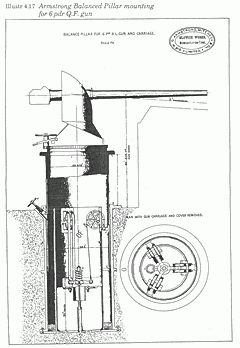
{37} At night, while the ships’ boats were being prepared, an armoured cruiser was to enter the channel. It would lie-off South Channel Fort, outside of armour-piercing range (2,300 yds for the 8-inch guns), with the intention of attempting to blind the gunners with searchlights and keep up a steady fire on the fort. The fort’s main armament (two 8-inch Hp BL and two 5-inch Hp BL) would have probably sustained little damage during the bombardment by ships outside the channel, as these four guns were mounted in pits with overhead shields. During such bombardments, Nordenfeldt machine-guns were to be dismounted, the 6-pdr quick-firers lowered on their "balance pillar" mountings below the parapets, and all gunners not in action withdrawn under cover.37 Thus, despite the fort’s low height, only its 4.7-inch quick-firer (which carried a vertical shield) remained exposed to shell and shrapnel fire. Conversely, to close with the fort the squadron had to enter the channel itself. Here, in the narrow, four-mile long approach to the fort, cruisers in line-ahead lost their advantage of manoeuvrability, the number of guns they could bring to bear was limited, and they presented large targets to the fort’s well-protected guns. Furthermore, within the close range at which they must pass the fort, even their armour (protecting vital machinery and steering gear) could be penetrated.
{38} If South Channel Fort could not be silenced by gunfire or taken by assault, or if an attempt by ships’ boats to grapple for and destroy mine cables was unsuccessful, then after dark the countermine launches would attempt to blast a buoyed channel through the minefield by laying and exploding charges. This was particularly dangerous work, because lines of mines were slung at the sides of the launches and these (as well as the boats and their crews) were entirely unprotected from shrapnel, case shot and machine-gun fire.38 They would have – as Egerton claimed – some measure of cover provided by cruisers making smoke and bombarding the fort, and ships making smoke (as well as smoke from the guns) could negate the effectiveness of defence electric lights.39
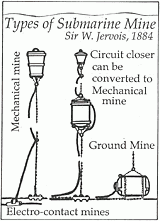
{39} In the British Army, all submarine-mines were electrically controlled and detonated from an observation station. Two types of mines were used: Electro Contact Mines and Electrical Observation Mines. Contact mines were arranged to float below the surface, at a depth that would bring them (or a separate float containing the circuit closer mechanism) into contact with a target vessel. When struck, the circuit closer rang a bell in the fort’s test room and warned the operator of the vessel’s position. On confirmation that the vessel was an enemy, the mine (or usually a group of four mines, each containing 50 or 100 lbs (23 or 45 kg) of guncotton) was detonated. Alternatively, if necessary these mines could be armed from the test room to explode on contact with a vessel. It was essential that the explosion was sufficient to destroy the target but not to so large as to detonate other mines, and it was also vital for mines to be placed close enough to each other to prevent passage between them. Observation mines were constructed with heavy cases to lie on the bottom and carried larger charges scaled to the depth – 250 lbs (114 kg) up to 36 ft (11 m), 500 lbs (227 kg) between 36 and 60 ft (18 m). The position of each mine laid was exactly determined, and when an enemy vessel was seen from the observation station at the fort to be directly over it, the mine (or a group of mines) was exploded.40
{40} Countermine launches were rigged to work very fast and drop a connected line of twelve 500 lb mines, spaced at 60 yd (55 m) intervals, which were then exploded. By this means, in one run a path 720 yds (658 m) long and 86 yds (78 m) wide could be cleared through a minefield, a task Egerton estimated to take about five minutes to accomplish. He actually thought the width necessary was 120 yds (110 m) and could be achieved by two ships’ launches running in parallel. The leading cruiser of the squadron would enter the narrow cleared channel behind the countermine launches and maintain a heavy fire on the fort.
{41} The fort’s 8-inch guns would switch from common shell to salvoes of Palliser and begin to attack the leading cruiser’s armour at about 2,300 yds (2,100 m), while the two 5–inch Hp guns and 4.7-inch quick-firer either continued to rain shell and shrapnel on its ports and upper works or were directed against the countermining boats. The object of initially concentrating fire against the leading cruiser was to damage her sufficiently to bring her ashore as an obstacle for those following. During this stage, firing was expected to be as fast as possible. All previously masked and hidden guns, including 6-pdrs and Nordenfeldt machine-guns, were brought into action. Range-finding at this low site was not possible with a depression range finder, and to supplement the position finder used, ranges for the whole channel had been determined, which was sufficient in these narrow waters. Another fast method of establishing the range was for the 6-pdrs to pick up the range of the target and pass it to the guns, as the weight of their projectile was sufficient for its strike to be seen by searchlight.
{42} As soon as the countermine launches crossed the fixed beams of the sentry light (which had a range of 2,000 yds (1,830 m) in clear conditions), or were picked up by the "wandering" beams of searchlights mounted at the fort or on guard boats of the Victorian Naval Force, the heavy guns ceased firing. The searchlights found, held, and followed targets for the light and quick-firing guns, which would – if possible – be traversed to follow them. While 5-inch and 4.7-inch quick-firing guns attacked the launches with shrapnel and case shot, 6-pdr quick-firers and Nordenfeldt machine-guns were used to sweep the field. It is worth noting that the two 6-pdrs at South Channel Fort were together capable of putting 8,300 bullets from shrapnel shells onto a target in one minute.
{43} For the squadron to clear a passage through the full length of South Channel minefield could take four or five double runs, and use 96-120 countermines. If this was not accomplished by daylight, then the ships had to withdraw out of range, or continue to engage the forts, until the operation could be begun again the next night. It was entirely possible for the defence to lay more mines in the meantime – and even dummy mines and surplus cable had to be taken seriously. Again, Egerton was confident, believing that a passage through his hypothetical minefield could be cleared in two runs. This was despite the unusual length of South Channel’s, and it is doubtful if he could have countermined that in one night. The exact location and size of minefields was kept secret, but from ‘Returns’ in 1887 we know that the defence possessed 445 mines in store, of which 336 were loaded and ready for use.
{44} If the minefield could not be countermined while it remained protected by artillery, then the squadron must first silence the fort and destroy the ships of the local naval force before a passage could be cleared through it. This had to be achieved before the attackers had exhausted their countermines and ammunition. Then, if enough rounds and fuel remained, only the defences at Williamstown, the remaining vessels of the Victorian Naval Force and some older batteries around Hobsons Bay would stand between them and their objective.
{45} The number of projectiles held in the forts and batteries of Port Phillip is known for 1892, but unfortunately the exact amount of ammunition Orlando and Marathon cruisers carried is not. However, at the bombardment of Alexandria in 1882 an Anglo-French fleet, which was much larger than Egerton’s hypothetical squadron exhausted nearly all its ammunition in about six hours – against a place that was not protected by a minefield.41 Moreover, the Royal Engineers’ post-action examination of the targeted forts concluded that although the guns fell silent, remarkably few projectiles had entered emplacements, killed personnel or damaged guns. Most projectiles struck the sand parapets of the batteries and, because of the flat trajectories of naval guns fired at short range, were deflected overhead to burst at their rear. Whereas the R.E. study served to demonstrate the value of camouflage and dispersion, and prompted development of a new form of coastal fortification architecture,42 the inadequacy of naval gunnery was not so quickly recognised or rectified. The new type of military architecture, which featured concrete emplacements fronted by a long sloping glacis of sand, was rapidly adopted empire-wide. Australian defences built in 1885 provide the earliest examples.
Probable outcome of an attack
{46} It is difficult to fully assess what the success of a raid in 1892 might have been. Missing from the above examination of the probable form and course of an attack is any detailed consideration of the part that might be played by the Victorian Naval Force, which was mainly deployed for the defence of the shoals.43 Nor, intentionally, has discussion been included of the defence capability of the Australian Squadron based in Sydney. This is because the Australian Station was of enormous size – extending from 12 degrees north of the Equator to the Antarctic Circle, and from Cocos Island in the Indian Ocean to French Polynesia in the Pacific44 – and the fact that the Squadron’s very few ships were usually widely scattered on their duties.45
{47} The difficulty of intercepting cruiser raids was well recognised and frequently discussed. Rear Admiral George Tryon stated it forcefully and precisely when he wrote:
An enemy may escape touch, he may escape notice and it may be some time before his destination is known and his designs penetrated. . The difficulties attending a pursuing squadron are great. . The power to avoid notice is much greater in 1886 than it was in the early part of this century. Vessels 1,000 miles away on a Monday are with you on a Friday. Blockades in the present day are not reliable.46
To solve this problem the Admiralty proposed a dramatic increase in the number of warships, but it was not understood, then, that to effectively blockade and shadow enemy cruisers could only be done with improved communications. Commanders-in-Chief on the China Station were required by standing orders to report the movement of all foreign warships on their Station. By this means, over a period of time, it was possible to assess the number of foreign warships on a particular station, but impossible to know the whereabouts of individual cruisers in the China Sea and the North Pacific. On reading Admirals’ monthly reports of the 1870s and 80s, one is struck by how rarely a foreign warship was actually reported, as well as by the inadequate nature of information passed back to London.47
{48} The distance Russian ships on the China Station were from Australia, their range and inability to obtain coal, must have presented the greatest obstacles to them. Some Russian cruisers such as the Admiral Nakhimoff had an unusual bunker capacity of 1,300 tons giving a range of 8,000 miles at 10 knots, but an Orlando’s capacity was less at 900 tons.48 Steward alleged the squadron would assemble and coal in the Lu-tchu Islands (Okinawa), and then "make direct for Newcastle", but this seems doubtful unless they were to coal again, perhaps in the Ladrone Islands (Guam) or New Caledonia. However, when they reached Australasian waters, unprotected supplies of coal were available, although the voyage would have taken about 20 days steaming at an economical 10 knots.
{49} The discussions which followed the United Services Institution lectures revealed significant disagreement even among those who were professionally qualified to assess and comment on the question. Major Bunbury’s assessment of an attack on the inner defences by a squadron of eight ships differed substantially from Egerton’s in its conclusions. As Bunbury envisaged it, the squadron lost three of their most powerful ships, and having expended all their countermining stores abandoned their attack at daybreak on its fourth day.49 There was also disagreement about how long it would take to silence the guns of a fort, and also how easily an armoured cruiser could be damaged. In a revealing comment Admiral Lord Charles Scott had observed that it would be pointless attacking an Orlando with Palliser, as it would pass clean through her.50
{50} The reasons for these differences do not entirely derive from inter-service rivalry, or from inexperience. It is true that the Navy and Army knew very little of each other, and inter-service manoeuvres were almost unknown. It is also true that few of the officers had seen action, and probably none had witnessed an attack on a harbour defended by mines. Egerton showed great confidence in the ease with which he would find targets, but with this the defence disagreed, stressing the difficulty of destroying Hp guns mounted in shielded pits despite the huge amount of smoke each gun generated. There was also disagreement about how rapidly the new Hp guns could be fired. One speaker considered two rounds in twelve minutes was possible, while another thought an average rate of a round every three minutes was usual.51 One unforeseen factor that slowed the firing-rate was the need to reduce hydraulic pressure when switching to shrapnel, as it required a smaller charge.52
{51} The limitations of the "fixed beam" and searchlights were often raised. They were extremely vulnerable, and the necessity of mounting them away from gun smoke created such difficulties at South Channel Fort that the searchlight was mounted in an exposed position on the breakwater.53 Such fears were, of course, the natural product of lectures and discussions that were intended to explore weaknesses, as well as inform officers and men. Many of the problems identified were quickly rectified. For example, defence lights began to be installed in bombproof emplacements in 1893.54
{52} Anxiety about surprise attacks and the time taken to man the defences and lay out minefields remained. Thus, it is very easy to understand why the Brennan torpedo, invented in Melbourne and developed in secret in Britain, was installed as an adjunct to minefields at the key ‘military’ ports of the Empire. It was, in effect, a very powerful dirigible submarine-mine, which could be brought into action quickly. By 1889 it could be steered precisely to its target, running underwater at 20 knots. It was, therefore, invulnerable, passing easily through fast tidal and rough water, up to a range of over one mile. In 1890 proposals were made for a Brennan installation to be built at Observatory Point, outside the entrance to South Channel and in advance of its minefield. These refinements suggest that, if an attack was expected and minefields were in position, the prospects of a raid being ultimately successful were minimal.
{53} Despite the many imponderables surrounding any calculation of whether an attack, if made, might have been successfully resisted, it is nevertheless possible to draw a few broad conclusions about the twenty-year period from 1873. Had war broken out in 1878, for instance, it is entirely probable that a Russian raid along the lines allegedly planned could have succeeded in inflicting substantial damage to Australian coastal shipping, even if it required the Russians to raid Newcastle to obtain sufficient coal to do so. In Melbourne the effective defence comprised little more than HMVS Cerberus, which was undermanned and in disrepair. The situation in Sydney was slightly better, as batteries and casemates completed in the late 1860s and early 1870s had been cut in sandstone; although these were dangerous under fire (because of the fragmentation of rock), they had fallen into disrepair less easily than the sodded sand parapets of the batteries at Port Phillip Bay. In 1878 it seems likely that a squadron of four cruisers could have succeeded in entering harbours, sustaining little damage to themselves, and got sufficiently close to shipping at anchor. To have raided Newcastle for supplies of coal appears to have been entirely possible.
{54} By 1885 the situation had substantially altered, and Australia’s ports were no longer the soft targets for a small, but sudden, Russian raid that they had been just seven years earlier. Supplies of coal were still obtainable as none of the fixed defences for coaling stations earmarked by the Carnarvon Commission in 1882 had been completed, and coaling stations established after 1882 had no defences, even on paper. Thus, although Newcastle had incomplete defences, those of Singapore were inadequate and other ports such as Greymouth in New Zealand remained undefended. Nevertheless, a considerable portion of the defences proposed for all the major ports, under schemes by Jervois and Scratchley, were partly complete. As soon as news of the crisis was received, these works were manned and some vital submarine minefields prepared, or laid.55 An attacking squadron risked finding itself held up sufficiently long enough to be overtaken by any pursuing British naval force, and bottled-up in the restricted waters of Port Phillip Bay or Sydney Harbour. What might have worked in 1878 was unlikely to have succeeded in 1885 considering the defences that were then available.
{55} Finally, turning to the hypothetical scenario of an attack in 1892, when all the Australian defences were complete, well-manned by trained volunteers, and (as assumed) on alert, there seems no doubt that a raid on one port by four cruisers would have cost the attackers dearly. At a minimum, an attack could have been held off long enough for the defence to be relieved. There is no doubt that to attack three ports in succession, as allegedly proposed under the 1878 Russian plan, was no longer possible in 1892. By the last decade of the nineteenth century the anxiety that produced "war scares", was no longer evident. Instead, Australian defences were increasingly criticised by the Committee of Imperial Defence, not as inadequate, but as excessive, over-gunned, over-elaborate and ripe for simplification.
© Michael Kitson
The author
Michael Kitson served as an infantry NCO in Austria and Korea (1952–54) and was a founding member, and sometime chairman, of the Australian Coastal Defences Study Group (and editor of its journal). He has written a number of articles and conservation management studies on nineteenth century Imperial coastal defence works, and also researched fortifications in India and along the Austro-Hungarian and Turkish frontier. After retiring from Monash University, he recently completed a doctorate on the military inventions (torpedo, monorail and helicopter) of Louis Brennan.
Notes
1 For the development and application of submarine mining, see Lieut.-Colonel W. Baker Brown, History of Submarine Mining in the British Army (Chatham: The Royal Engineers Institute, 1910): Ronald McNicoll, The Royal Australian Engineers 1835 to 1902; The Colonial Engineers (Canberra: The Corps Committee of the Royal Australian Engineers, 1977).
2 Lectures extensively drawn upon from the Journal of the United Service Institution of New South Wales include: Commander G.L. Egerton RN, "Naval Attack on a Protected Harbour", 17 October 1889, pp.78-88; Lieut-Colonel E.M.T. Boddam, "The Defence of a Protected Harbour", 5 December 1889, pp.1-16, and "The Organisation and Equipment of Harbour Defences of a Protected Harbour", 8 May 1891, pp.1-16; Colonel E.G.H. Bingham RA, "Coast Defence by Breech-loading Guns on Hydro-pneumatic Carriages", 16 April 1889, pp.45-57. From the Journal of the United Service Institution of Victoria; Major F. Rainsford-Hannay RE, "Submarine Mines, Their Use in Defence of Maritime Fortresses, etc. Lecture XI, 14 July 1892, pp.26-35, and Lecture XII, 21 July 1892, pp.36-34. Captain J. Stanley, "Modern Coast Defence Tactics", 14 May 1886. I have also used a compilation of lectures by Major W.St Pierre Bunbury RA (Military Instructor, NSW), Notes on Armour and the Artillery Defence of a Coast Fortress; Summary of lectures given to the officers of Permanent and Volunteer Artillery, N.S.W. (Sydney, 1888).
3 "Armament Establishment, Detail of Equipment for Forts at Port Phillip Heads, Garrison Service", NAA, 12094, 1892/644A, B73656.
4 D. MacCullum, "The Alleged Russian Plans for the Invasion of Australia, 1864", Journal of the Royal Australian Historical Society, vol.44, October 1956, pp.301-22.
5 For 'war scares' see: Bob Nicholls, The Colonial Volunteers: The defence Forces of the Australian colonies 1836-1901 (Sydney: Allen & Unwin, 1988), Chapter 6; V. Fitzhardinge, "Russian Naval Visitors to Australia, 1862-1888", Journal of the Royal Australian Historical Society, vol.52, 1966, p.132; Colin Jones, Australian Colonial Navies (Canberra: Australian War Memorial, 1986), Chapter 5; D.H. Johnson, Volunteers at Heart; the Queensland defence forces, 1860-1901 (St Lucia: University of Queensland Press, 1974), Chapter 9.
6 "On 22 August 1872 … we were in telegraphic communications with England. When therefore the next European convulsion occurred, we experienced the unwanted excitement of following the campaign from day to day." See A.P. Martin, Australia and the Empire (Edinburgh: D. Douglas, 1899), p.64-5, cited by Fitzhardinge, p.155.
7 From the music-hall song: "We don't want fight but by jingo if we do / we've got the men / we've got the ships / we've got the money too. / The Rusk-ies shall not have Con - stanti - nople."
8 'War fever' was reported in Britain on 2 February 1878, when a declaration of war was printed but not distributed, and in March the British Cabinet agreed to mobilise the fleet, call out reserves and bring troops to Malta from India. The crisis was resolved by diplomacy at the Berlin Congress, June 13-16.
9 [The batteries] "are mere sand heaps and perfectly useless." "Have [they] not even the effect of frightening off an enemy by anticipation?" "-More likely to frighten those who were behind them." Evidence of Major F. Sargood (commanding St Kilda Field Artillery); Report of the Royal Commission on the Volunteer Forces, 22 March 1876, Victorian Parliamentary Papers 1875-76, pp.39-44.
10 The Colonial Defence Committee [subsequently Committee of Imperial Defence] drew up memoranda giving the shape and form for imperial coastal defences. On this basis, colonies were to prepare schemes of local defence. In addition the CDC advised on all schemes, which were to be reported in detail annually to them.
11 C. Kinloch Cooke, Australian Defences and New Guinea (London: Macmillan & Co., 1887) p.43.
12 Examples are Middle Head in Sydney and Fort Glanville in Adelaide.
13 The author of the report was "an officer of the Royal Marine Artillery on the Staff of Admiral Hillyer RN" (C-in-C, China Station 1877-88).
14 "Confidential Memo by Major-General Harding Steward", 17 November 1884, NAA, 0.2.1/1, 85/1311, B168.
15 Commodore John C. Wilson (C-in-C Australian Station) examined by the Military Defences Inquiry Commission, was asked: "On the last occasion when war was imminent with England it was understood that preparations were being made for an attack on these Colonies?" He replied: "Yes." Legislative Assembly, NSW, 1881 "Report of the Royal Commission", 7 June 1881, paragraph 21.
16 Steward included considerable detail of a trivial nature to explain how the intelligence had been gathered. The tenor of this material is anecdotal, even amusing, and suggests it was an account not derived from an Admiralty report, but told to Steward by the officer who obtained the information in Yokohama. Historians have, therefore, hesitated to accept the veracity of Steward's memorandum.
17 F. T Jane (the contemporary expert on the Russian Navy) estimated that Russia had 223 warships in service in 1877, of which 36 were in the China Sea and North Pacific. This supports Steward's claim that during the minor 'scare' over Kuldja (1881) Russia assembled 17 cruisers and one ironclad in Japanese waters: Fred.T. Jane, The Imperial Russian Navy (London, 1889), p.178.
18 Sir Harry Parkes examined 15 October 1880, Royal Commission on the Defences of British Stations Abroad.
19 This and his movements may account for the critical gap of six months in the Reports bound in this series. Admiral's Despatches, China, AJCP Adm 1, 3350/6450.
20 Gold and bullion in Victorian Banks amounted to £2,660,575 in 1864 and £8,326,747 in 1893-94, NAA, MP 160, 94/2619a.
21 See MacCallum, and also Captain J.A. Christopherson (East Collingwood Volunteer Rifle Corps), The Defence Force of Victoria (Melbourne, 1882), p.10.
22 In Victoria, submarine mines were laid in South Channel and protected by improvised artillery defences. By 1885 the Colony had in store about 150 mines: Major R.L.J. Ellery (commander of the Torpedo and Signal Corps) to Minister of Defence, 22 July 1884, NAA M671 & M672. See also: "Various Memos on Preparations for War" (which includes "Steps to be taken in case of declaration of war", 14 April 1885, and "General Order No. 147/85", 11 May 1885), NAA, MP106, 85/1149.
23 In particular, W. H. Stead's scathing Pall Mall Gazette articles, "The Truth About the Navy" (1885), followed by the inability of the Navy to intercept and bring raiding cruisers to action, even in the narrow waters of the Channel in three annual manoeuvres (1887-1889).
24 For details of Orlando and Marathon class ships, see: Lord Brassey (ed.), Naval Annual 1887 (Portsmouth, 1888), pp.99, 283-84.
25 Cited by Lord Brassey, Naval Annual 1887, p.79.
26 On 9 June 1885 the C-in-C China Station reported from Port Hamilton, Korea: "Vladimir Monomakh sailed for Yokohama from Nagasaki 19th inst." In July Rasboinik was reported at Yokohama, Opritchinik and Kreisir had sailed from Nagasaki, and the Csaritzsa was on the China Station. In 1889 a report mentions "Russian cruiser Admiral Nakhimoff entered Inner harbour of Singapore without giving notice to Governor." Admiral's Reports, China, 1885, 9 June and 27 July 1885, and 22 March 1889 (no. 160), AJCP, ADM 1, 3376/6757.
27 Major F. Rainsford-Hannay (Commanding Engineer) to Military Commandant, 4 July 1889, NAA, MP106/1, B3756, 1898 2839, 89/1667, pp.5-8. In 1894 four groups (a total of sixteen mines) were laid in 4 hours 16 minutes - "as good a time as any recorded at home": Major F. R. Reynolds RE (Commanding Engineer) to Defence Department, 25 April 1894, "Report on Submarine Mining Practice", NAA, MP106/1, 94/981.
28 The Annual Report for 1890-91 gives the strength of the Victorian Military Forces as 7,180 men. For the deployment of Victorian naval and field forces, see: "Report on State of Defence Forces" including "Scheme of Defence for Victoria", 31 January 1887, pp.8-12, NAA, MP106/1, 87/1976.
29 A chart showing arcs of fire suggests ranges obtained at three degrees elevation were accepted as effective for planning purposes: "Port Phillip Heads, Defences", signed by F. R. Reynolds RE, 6 March 1894, WO 78 2529.
30 Guns in forts and batteries were grouped for fire control. A gun group was the smallest tactical unit.
31 Colonel E.G.H. Bingham, pp.51, 56.
32 "Palliser shot" was named for its inventor, Captain (later Major Sir) William Palliser (1830-1882). It was originally a pointed projectile, which was cast head-down in a water-chilled mould to produce an incredibly hard, armour penetrating, nose. By 1892 its use as a shell had been discontinued. The small cavity in its nose was filled with sand, and "palliser" became armour-piercing shot.
33 Garrison Artillery Drill 1895, vol.1 (London 1895), Part VI, Coast Defence, Section XVII - General Principles of Defence, pp.480-92. Also Captain J. Stanley (Victorian Permanent Artillery), p.14.
34 Major W. St Pierre Bunbury, pp.32, 37-40.
35 War Office experiments using naval machine-guns and QF guns at short ranges against Hp gun emplacements were well known and described by Captain G. S. Clarke RE (later Sir George Clarke, Governor of Victoria 1901-03) as showing "such fire… was hopeless": The Times, 11 December 1885.
36 "Report on the State of Defence Forces", Colonel T.R. Disney, 31 August 1888, NAA, B3756, 88/3015.
37 Major W. St Pierre Bunbury, p.36.
38 In Naval exercises at Singapore in 1888 the difficulty of rigging a single launch and laying one line of countermines at night was noted, and a naval officer injured. Although the defence was considered "feeble", the countermine boat was judged to have been "captured" shortly after it had "dropped its mines". "Night Attack on Singapore", AJCP Adm 1, Admiral's Despatches, China, 3389/6916.
39 "The electric light may light up the minefield but cannot be relied upon, it is obscured by either smoke, mist, or rain and by very little of either…the Artillery must be prepared to find the minefield in absolute darkness": Garrison Artillery Drill, vol. I (War Office 1887), p.54.
40 Major F. Rainsford-Hannay, Lecture XI, 14 July 1892, pp.26-35, Lecture XII, 21 July 1892, pp.36-44.
41 At Alexandria, HMS Monarch, Penelope and Temeraire fired continuously for three and a half hours, an average (excluding machine-gun fire) of 173 heavy and 102 light projectiles each. HMS Inflexible fired 61 heavy and 34 light projectiles in one hour. It was held that a raiding force must retain sufficient ammunition to counter a brush with a pursuing squadron.
42 Fully described by Brig-General W. Baker Brown RE, The History of the Corps of Royal Engineers, vol. IV, (Chatham: Royal Engineers Institute, 1952), pp.228-9.
43 The V.N.F.'s vessels carried a total of 79 BL guns: four 9.2-inch, two 9-inch, twenty 6-inch, twenty QF, twenty machine-guns, and eight 7-inch RML (rifled muzzle-loaders). There were four torpedo boats.
44 Boundaries of the Australia Station are given by John Bach, The Australia Station: A History of the Royal Navy in the West Pacific, 1821-1913 (Sydney: New South Wales University Press, 1986), front and back endpapers.
45 For the disposition of the Australian Squadron in March 1878, see: AJCP, Adm 1, 3294/6453, General Letter 2 April 1878.
46 No. 15, "Memorandum on Colonial Naval Defence", by Admiral Tryon, HMS Nelson, Sydney, 24 April 1886, Victorian Parliamentary Papers, vol. 3, no. 81, 1886, p.69.
47 C-in-C China Station, Audacious at Hong Kong, 20 January 1885, AJCP Adm 1, 3376/6567.
48 Details of the Admiral Nakhimoff are: launched 1885, immediately placed on China Station, draught 25ft, maximum speed 15 knots, armament; eight 8-inch, ten 6-inch, ten QF, four torpedo tubes. HMS Imperieuse built in response to her had a bunker capacity of 900 tons, and at 10 knots a range of 7,000 miles. F.T. Jane, p.211.
49 Major W.St Pierre Bunbury, Appendix B, pp.33-40.
50 Lieut-Colonel Boddam, "The Organisation and Equipment of Harbour Defences…", p.12.
51 But added much of this time was taken in laying the gun, if the target was large the time became less and a round every 60 or 90 seconds could be achieved: Lieut-Colonel Boddam, p.16.
52 Lieut-Colonel Boddam, , p.14.
53 Military Commandant to Secretary of Defence, 24 February 1889, NAA, MP160, 89/569.
54 Summary Contract Book, Vol.2, 1858-1894/5, VPRS 972.
55 It is unlikely minefields were laid at Brisbane, Sydney, or Tasmania. At Sydney in 1892 the mining stores were obsolete and equipment to lay them still barely adequate: Evidence of Col. F.R. De Wolski, 21 July 1892, "Royal Commission on Military Service", NSW Votes & Proceedings 1891-1892, vol. 7, pp.104-105.
Subscribe to:
Posts (Atom)
An exploration of debauchery, vice and other reasons to be a man!
