
Saturday, 11 July 2015
Nemo's War - Art Sneak Peak
The artist for the forthcoming release of the second edition of VPG's Nemo's War has released some sneak peaks of some of the artwork. These are samples of the Adventure Cards for the new game. Those who have played the first edition can see what a vast improvement these are, and I think the new version will have a great aesthetic.


Thursday, 11 June 2015
The Never Were Ships catalogue
Found this brilliant collection of old B&W drawings of Italian ship designs which has some great ideas and inspiration for one's Aquanef fleets.
http://xoomer.virgilio.it/bk/NWS/Regia_Marina/Piani_Ferrati_et_altri/index.html
This submersible Battleship is one of my favourites!

More from other countries at the main index here: http://xoomer.virgilio.it/bk/NWS/index.html
http://xoomer.virgilio.it/bk/NWS/Regia_Marina/Piani_Ferrati_et_altri/index.html
This submersible Battleship is one of my favourites!

More from other countries at the main index here: http://xoomer.virgilio.it/bk/NWS/index.html
Monday, 1 June 2015
The Expedition must continue!

Saturday, 23 May 2015
USS Nautilus and the Nemo connection

Its always wonderful to visit a historic vessel and Nautilus was no exception.
During the visit I made three key observations:
- Submarines haven't really changed in design at all since WW2, and even then there only was modest evolution from WW1
- Some of the exact same equipment in Nautilus is still used today (e.g. sound powered telephones)
- In 1957 the French Navy presented the Nautilus with a unique gift which is displayed in her main deck passageway:
 |
| And yes, its an authentic version...in French! |


Captain Nemo and a certain French author would be proud I think!
Monday, 18 May 2015
It's Nautilus What You Think
If you missed update on the new edition of Nemo's War, here it is off VPG's website.
I'm really looking forward to this!
http://www.victorypointgames.com/news/company_update
-----
 Among the most requested game updates is Nemo's War second edition. This project is currently with its art and graphics director, the amazingly talented Ian O'Toole. It you have followed this new edition of Chris Taylor's ingenious solitaire game design, after completing alpha and beta testing, off this game went to Ian where he has been painstakingly adding polish to enhance the gameplay and appearance of Nemo's War. As his "passion project," Ian has been hand-drawing every illustration and building the look of every component with the exquisite detail of a true artiste.
I'm really looking forward to this!
http://www.victorypointgames.com/news/company_update
-----
This is just a quick update on some of the game project in the queue at Victory Point Games.
Among the most requested game updates is Nemo's War second edition. This project is currently with its art and graphics director, the amazingly talented Ian O'Toole. It you have followed this new edition of Chris Taylor's ingenious solitaire game design, after completing alpha and beta testing, off this game went to Ian where he has been painstakingly adding polish to enhance the gameplay and appearance of Nemo's War. As his "passion project," Ian has been hand-drawing every illustration and building the look of every component with the exquisite detail of a true artiste.
For this update, Ian has sent us more sketches to ogle, this time for the Nautilus upgrade cards, and sends these words: "I'm still working away on finishing off the Adventure Cards (I'm sketching them all, then tightening up the drawings, then colouring, so they're all being done concurrently)." Now, it's easy to understand gamer impatience for this game, but Ian's work is so worth waiting for! We anticipate having this game ready later this year (depending on the breaks), and just can't wait for everyone to take the new Nemo's War for a spin!
Thursday, 14 May 2015
Hotchkiss Revolving Cannon
Second in this series of period machineries of death...
A step up from the Gatling Gun (see here), which fired small arms ammunition, this Hotchkiss Revolving Cannon fired 37mm projectiles from its 5 barrels. This version is mounted for field work, but it was frequently used on naval platforms, especially lighter craft and gunboats. With the gun shield discarded, it could also be packed onto two mules.
Capable of around between 45 and 70 rounds per minute, it was accurate out to around 2,000 yards. Shrapnel and canister ammunition was available but these appear to have been restricted to defensive mounts in fortifications and bursting ammunition was more standard.
Here is an example of a Naval Deck mounting (not my pic)

The Hotchkiss also came in larger calibre - 40, 47 and 53mm with increasing weight and reduced portability.
----


The ammunition for the gun is a self contained cartridge, made up of brass wrapped into a cylinder with a solid center primed head, as in early British rifle bullets. An explosive shell and a canister shell were available, Canister consisted of steel shot, not unlike a giant shotgun shell, and was murderous against groups of the enemy. The shells weighed around a pound, were 5 inches long, and the tin or zinc magazine held 10. To unload the gun after firing consisted of removing the firing pin, rotating the barrels backwards with the handcrank and prying out the shells with a screwdriver, or pushing them out with a ramrod. Standing downstream from the gun had to give the gunner a moment of pause, as with unloading the Gatlings.
Some Hotchkiss guns were mounted on British ships, although they really preferred the Nordenfelt gun. Some guns were used in the Boer War, and at least one was present at the seige of Mafeking.
A step up from the Gatling Gun (see here), which fired small arms ammunition, this Hotchkiss Revolving Cannon fired 37mm projectiles from its 5 barrels. This version is mounted for field work, but it was frequently used on naval platforms, especially lighter craft and gunboats. With the gun shield discarded, it could also be packed onto two mules.
 |
| Manufactured in France, 1880 |
 |
| Detail of the business end |
Here is an example of a Naval Deck mounting (not my pic)
The Hotchkiss also came in larger calibre - 40, 47 and 53mm with increasing weight and reduced portability.
Additional detail from Old British Guns website, here: http://oldbritishguns.com/the-37mm-hotchkiss-revolving-cannon
The Hotchkiss revolving cannon was a 37mm hand operated machine gun that was considered light enough to travel with cavalry, although not for the British Army. A light (well sort of, around 1000 pounds) , mobile and fast firing artillery piece, it could fire up to 40 explosive or steel shot rounds per minute. With a range of 2000 yards (practical range, max was 4000 yards but wind and other things could upset accuracy), it could easily outrange rifle fire. The British Navy also adopted it around 1875 for use against the ever present torpedo boat threat, but the caliber was considered too small to be effective. It was felt to be comparable to the Nordenfelt and as in that gun larger calibers were later adopted.
It was developed by an American, Benjamin Berkeley Hotchkiss, living in France. He was approached by French officers looking for a fast firing gun, and it was soon adopted by all the major Powers, including the U.S., which went for it in a big way.
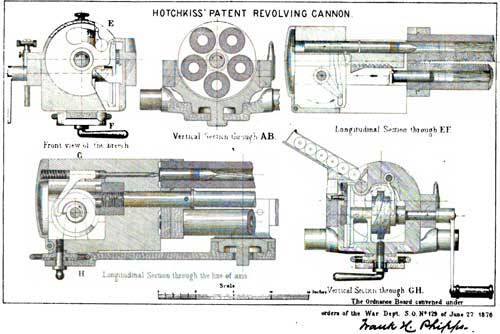
The mechanism differed from the Gatling Gun in that there were multiple barrels but only one striker, bolt and extractor. A center cam wheel is turned by the hand crank, which both rotates the barrels and holds them in place during different phases. Each rotation of the crank loads one shell, fires one shell and extracts one shell. The cam gear is cleverly shaped to turn another gear in the left side of the breech block which is pinned to 2 toothed shafts. The upper toothed shaft strips off a shell from the magazine and loads it in the chamber, while the bottom toothed shaft extracts a shell and dumps it out the bottom. The firing pin strikes the shell when the barrel is at the bottom of it's rotation.

The ammunition for the gun is a self contained cartridge, made up of brass wrapped into a cylinder with a solid center primed head, as in early British rifle bullets. An explosive shell and a canister shell were available, Canister consisted of steel shot, not unlike a giant shotgun shell, and was murderous against groups of the enemy. The shells weighed around a pound, were 5 inches long, and the tin or zinc magazine held 10. To unload the gun after firing consisted of removing the firing pin, rotating the barrels backwards with the handcrank and prying out the shells with a screwdriver, or pushing them out with a ramrod. Standing downstream from the gun had to give the gunner a moment of pause, as with unloading the Gatlings.
Some Hotchkiss guns were mounted on British ships, although they really preferred the Nordenfelt gun. Some guns were used in the Boer War, and at least one was present at the seige of Mafeking.
Friday, 8 May 2015
Mr Gatling's Patented Revolving Battery Gun and other fun
In recent months I've visited more than a few places in which historical artefacts are stored, so I have taken the opportunity to take pictographic records all sorts of inventions. I shall present them here for your edification but let me start with a bit of trivia: Edgar Rice Burroughs, the creator of John Carter of Mars and Tarzan, started life as a Gatling gun instructor while serving as a soldier in the 7th US Cavalry Regiment.
In the foreground we have a Colt Bulldog Model 1877 Gatling Gun, and in the background is the US Navy variant of the Colt Gatling Gun (1884), both are .45-70 calibre. Note the robust pedestal mounting and different barrel and magazine arrangements on the Naval variant.

Detail of the rear of the US Navy model

Naval variant in profile
 Rear view of the Model 1877:
 Manufacturer's stamp detail

Authentic packing crate for the Model 1887 - clearly it took a little time to bring into action off the march

“It occurred to me that if I could invent a machine — a gun — which could, by rapidity of fire, enable one man to do as much battle duty as a hundred, that it would, to a great extent, supersede the necessity of large armies.”
Foreground: not a Gatling gun but a 2 barrelled Gardner Gun, .45 calibre, used from 1874
Background: Colt Gatling Gun Navy Model 1900, .30-40 calibre, mounted on a modified M1895 Naval Landing Party carriage

Gatling Battery Gun Model 1866, .50-70 calibre, on an original carriage mount:

This is a Model 1883 Gatling, used in the movie Gunga Din

This one is one with the barrel casing removed but is unmarked for design or patent date. It was used in the movies War Wagon and The Outlaw Josey Wales


Hope you find this of interest, I certainly did! More period weaponry pics to come
In the foreground we have a Colt Bulldog Model 1877 Gatling Gun, and in the background is the US Navy variant of the Colt Gatling Gun (1884), both are .45-70 calibre. Note the robust pedestal mounting and different barrel and magazine arrangements on the Naval variant.
Detail of the rear of the US Navy model
Naval variant in profile
Authentic packing crate for the Model 1887 - clearly it took a little time to bring into action off the march
“It occurred to me that if I could invent a machine — a gun — which could, by rapidity of fire, enable one man to do as much battle duty as a hundred, that it would, to a great extent, supersede the necessity of large armies.”
- — Richard Gatling, inventor of “the first reliable machinegun,” 1877 (as quoted in The Economist, June 14)
Foreground: not a Gatling gun but a 2 barrelled Gardner Gun, .45 calibre, used from 1874
Background: Colt Gatling Gun Navy Model 1900, .30-40 calibre, mounted on a modified M1895 Naval Landing Party carriage
Gatling Battery Gun Model 1866, .50-70 calibre, on an original carriage mount:
This one is one with the barrel casing removed but is unmarked for design or patent date. It was used in the movies War Wagon and The Outlaw Josey Wales
Hope you find this of interest, I certainly did! More period weaponry pics to come
"Whatever happens we have got,
the Gatling gun and they have not."
the Gatling gun and they have not."
| - Hillaire Belloc |
Thursday, 30 April 2015
Zeppelin attack routes
I was perusing some of the many fantastic tomes at the library this week and found a great German account of WW1 Zeppelin raids on Britain which included this chart of 'standard routes'. Should a set of such plans fall into British agents' hands, an aeronef ambush could be set to pounce on the would be attacks. All the makings of a neat scenario!

Just some for the great books available - frustratingly, I don't have time to absorb them all!

Just some for the great books available - frustratingly, I don't have time to absorb them all!
Sunday, 26 April 2015
Percival Lowell's Globe of Mars
Percival Lowell was an American businessman and astronomer who founded an observatory in Arizona in the late 19th century. He was convinced of the existence of the Martian canals and studied the Red Planet extensively to chart their positions.
I was thrilled this week to find Percival Lowell's globe of Mars at the Smithsonian Air and Space Museum in Washington DC. A great pity they dont sell reproductions in the gift shop!


In an interesting post script, Lowell was also one of those who predicted the stance of a planet past Neptune and his observatory went on to prove the existence of Pluto after his death:

I was thrilled this week to find Percival Lowell's globe of Mars at the Smithsonian Air and Space Museum in Washington DC. A great pity they dont sell reproductions in the gift shop!
In an interesting post script, Lowell was also one of those who predicted the stance of a planet past Neptune and his observatory went on to prove the existence of Pluto after his death:
Friday, 24 April 2015
The Centenary of ANZAC


Sunday, 12 April 2015
Basing for Land Ironclads
I saw this very impressive array of 2mm Napoleonic armies over at the excellent "Lead doesn't Bleed" blog today and it got me thinking about options to base LI units, and infantry in particular. When I started my own infantry units I went with positioning the figure blocks in different formations for easy recognition, but I think this is a much better and more effective way to go. I'd be interested in other options that might be out there too.
http://leadnobleed.blogspot.com/2015/04/the-teeny-tiny-grande-armee.html

http://leadnobleed.blogspot.com/2015/04/the-teeny-tiny-grande-armee.html
Tuesday, 7 April 2015
Review: CSS Appomattox
CSS Appomattox
by Chris Stoesen

Amidst the slaughter of the American Civil War, recognition of the South by both France and Great Britain sees a negotiated settlement and the formal succession of the Confederacy. An uneasy Cold War ensues with each side seeking European Allies to bolster their economies and access world trade markets. The Union finds itself a friend in Germany, a growing power seeking overseas possessions and resources to fuel its industries. The Confederacy finds its own ally in Spain, and when Germany tries to seize Spanish holdings in the Caribbean, the Confederacy finds itself toeing a diplomatic tightrope of supporting its ally while not triggering another general war with the North.
Enter Captain Thomas Devareaux of the Confederate Navy and Captain of the dirigible CSS Appomattox. Let loose upon the expeditionary fleet of the German Navy operating in and around the Eastern seaboard, he leads his crew on raids and strikes to harass the enemy and solidify the South's alliance with Spain. Along the way there is international and domestic intrigue, glimpses of a shadow war with the North and a cast of characters with a divers range of backgrounds.
I really quite liked Chris's alternative history world and the way in which he describes a team of men trying to harness new technologies to do their duty in tough situations. Yes it is a self published with a few hiccups and no it is not a Bernard Cornwell novel. But it is a fun and easy read which I really enjoyed - I am looking forward to the next instalment in the adventures of Thomas Devareaux.
CSS Appomattox is available electronically here for less than a price of a beer. If alt history and riding zeppelins appeals to you (and if you are reading this Blog then that is probably likely!) then do yourself a favour and give it a go. You'll be thinking of wargaming the scenarios before you realise it!
by Chris Stoesen
Amidst the slaughter of the American Civil War, recognition of the South by both France and Great Britain sees a negotiated settlement and the formal succession of the Confederacy. An uneasy Cold War ensues with each side seeking European Allies to bolster their economies and access world trade markets. The Union finds itself a friend in Germany, a growing power seeking overseas possessions and resources to fuel its industries. The Confederacy finds its own ally in Spain, and when Germany tries to seize Spanish holdings in the Caribbean, the Confederacy finds itself toeing a diplomatic tightrope of supporting its ally while not triggering another general war with the North.
Enter Captain Thomas Devareaux of the Confederate Navy and Captain of the dirigible CSS Appomattox. Let loose upon the expeditionary fleet of the German Navy operating in and around the Eastern seaboard, he leads his crew on raids and strikes to harass the enemy and solidify the South's alliance with Spain. Along the way there is international and domestic intrigue, glimpses of a shadow war with the North and a cast of characters with a divers range of backgrounds.
I really quite liked Chris's alternative history world and the way in which he describes a team of men trying to harness new technologies to do their duty in tough situations. Yes it is a self published with a few hiccups and no it is not a Bernard Cornwell novel. But it is a fun and easy read which I really enjoyed - I am looking forward to the next instalment in the adventures of Thomas Devareaux.
CSS Appomattox is available electronically here for less than a price of a beer. If alt history and riding zeppelins appeals to you (and if you are reading this Blog then that is probably likely!) then do yourself a favour and give it a go. You'll be thinking of wargaming the scenarios before you realise it!
Friday, 3 April 2015
Austro-Hungarian Salzburg Class Carrier


I based it on a Ferdinand Max class Battleship (see here) but left out the main gundeck to give me the room to place a runway down once I'd offset the smokestacks.


I cut a couple of the sponsons from the Ferd Max and added them to rear superstructure to provide some guns. I felt this wasn't enough for a ship of this size so I cut down some spare masts to make the tiny turrets seen on the main deck and the upper rear of the Nef. With the spare rod from these masts I also added the twin guns on the prow as well as the fuel drums on the flight deck.
Finally, I added the main masts and a pair of Lohner-Taube's to complete the look and got it painted!

Great conversion Jack and thanks for sharing the modelling tips with us all!
Hope to see more of your fleets soon :-)
Thursday, 19 March 2015
French Aquanefs


Sunday, 15 March 2015
The Eterna Files
What Ho! chaps, how you toodling? One has been busier than a Pathan ambushing a column of Guides of late can't say too much, Mum's the word etc, by let's say some of the Boche will be eating their bratwurst through a tube for a while, pip pip!
Anyhow, a fine gentleman (for a colonial type) of my acquaintance, Thom Truelove Esq, has been reading a jolly interesting sounding penny dreadful by a female wordsmith called Leanna Renee Hieber.
Personally I'm not sure this is quite the thing a young lady should be doing in civilised company, but these colonial types have strange ideas not quite being British and what. Anyhow chaps, this is what Mr Truelove had to say about the young lady's efforts:

"I have recently spent time in a new universe. This gaslamp fantasy – crafted by pioneer of that genre, Leanna Renee Hieber, could easily have become a horror novel à la Koontz had there been a few more left turns than right. This finely blended tale of grim determination has true suspense. The atmosphere calls for vigilance from the characters. They behave as believable Victorian heroes, diligently trying to save Humanity while taking important steps toward understanding it.
Nearly all of Ms. Hieber's boldly selected and fine-drawn characters believe in the magic and mysticism that surrounds them and their decisions. This makes the occult described in The Eterna Files much more understandable and almost inviting.
The lives of these characters, particularly Clara Templeton, do not begin with the first opening of the book. They have all been living lives long before I started reading about them. Ms. Hieber makes it very easy to visualize the world(s) surrounding these spellbinding lives.
On a map of novels, I would place Ms. Hieber's stories – starting with The Eterna Files – about four blocks west of the intersection of Lovecraft and Poe. I am glad to have stopped there for coffee."
Anyhow, a fine gentleman (for a colonial type) of my acquaintance, Thom Truelove Esq, has been reading a jolly interesting sounding penny dreadful by a female wordsmith called Leanna Renee Hieber.
Personally I'm not sure this is quite the thing a young lady should be doing in civilised company, but these colonial types have strange ideas not quite being British and what. Anyhow chaps, this is what Mr Truelove had to say about the young lady's efforts:
"I have recently spent time in a new universe. This gaslamp fantasy – crafted by pioneer of that genre, Leanna Renee Hieber, could easily have become a horror novel à la Koontz had there been a few more left turns than right. This finely blended tale of grim determination has true suspense. The atmosphere calls for vigilance from the characters. They behave as believable Victorian heroes, diligently trying to save Humanity while taking important steps toward understanding it.
Nearly all of Ms. Hieber's boldly selected and fine-drawn characters believe in the magic and mysticism that surrounds them and their decisions. This makes the occult described in The Eterna Files much more understandable and almost inviting.
The lives of these characters, particularly Clara Templeton, do not begin with the first opening of the book. They have all been living lives long before I started reading about them. Ms. Hieber makes it very easy to visualize the world(s) surrounding these spellbinding lives.
On a map of novels, I would place Ms. Hieber's stories – starting with The Eterna Files – about four blocks west of the intersection of Lovecraft and Poe. I am glad to have stopped there for coffee."
Subscribe to:
Posts (Atom)
An exploration of debauchery, vice and other reasons to be a man!
