Showing posts with label Fortifications. Show all posts

Friday, 2 May 2025

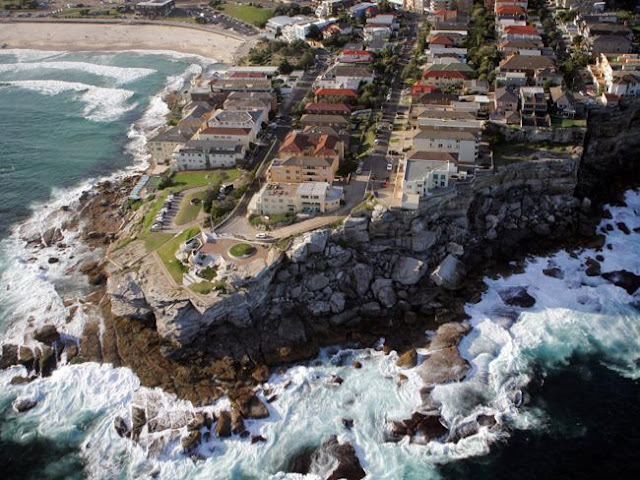
Ben Buckler Disappearing Gun Emplacement, Sydney

Earlier fortifications focused on inner harbour defences, but technology had rapidly progressed in the intervening years to require Sydney's approaches and entrance itself to become the focus.

In 1871 a string of works were undertaken in Sydney at outer and inner Middle Head, Georges Head, South Head, Steele Point and Bradleys Head. However, improvements in armaments led to continual redundancy of the fortifications by the 1880's. 

The batteries, including Ben Buckler, were aimed to maximise the new gun technologies of the era, and as a deterrent to hostile attack by increasingly efficient naval vessels bombarding the city from outside the harbour. Coastal guns were used in a 'counter-bombardment' role - to repel armed ships approaching, passing or bombarding population centres like Sydney. They had to be equal to the power of ship-mounted guns, and were used in association with smaller guns aimed at attacking vessels entering port along with other harbour defence systems such as mines and torpedo boats. 

The "Bondi Battery" was located under the now public parkland,
commanding the southern approach to Sydney Harbour from seaward.


Constructed in 1893, the Ben Buckler Gun Emplacement (aka "Bondi Battery") is one of the last coastal fortifications built in the colonial era, prior to Australia's Federation in 1901. Fitted with a 9.2inch naval gun, it one the last part of Sydney's outer defence perimeter and the culmination of the iterative fortification of Sydney since the Crimean War. It was no easy task:

"A Sydney Mail report said that, owing to the steepness and bad condition of the tracks, 35 horses were needed to drag the 20-tonne gun barrel, and when the wheels of the trolley sank deep into the ground a crane had to be employed. The operation took four weeks."

"'When in position, the gun will be able to pay considerable attention to any man-of-war attempting to bombard the city off Bondi,' was the opinion of a correspondent to the Sydney Illustrated News "

The 9.2 inch breech-loading gun types were originally designed for the Royal Navy. An 1879 British Ordinance Committee had earlier identified the need for Britain and its colonies to be able to match arms developments such as those of the German Imperial Army and Navy (Krupp guns). 


The Ben Buckler ('Bondi') Battery - specifics 

The three single guns batteries each consisted of a gun pit that incorporated a Mark '6' 9.2" (234mm) British-made breech-loading Armstrong hydro-pneumatic or 'disappearing' gun. The disappearing guns were prevalent at the end of the nineteenth century throughout Britain, its colonies and the United States. They were chosen because of their range and power, and upon firing and recoil, the gun retracted into its concealed pit and was therefore a lesser target to attacking naval vessels. The domed metal shield that covered the gun pit was devised to deflect incoming shells striking the battery. 

During the late nineteenth century, ten (10) 9.2" breech-loading 'counter bombardment' guns of this type were established in Australia. These comprised three (3) at Sydney's eastern suburb batteries (one being at Bondi) plus a spare barrel; four (4) in Victoria at Fort Nepean and Queenscliff, and two (2) in South Australia (purchased in 1888). The Adelaide guns were never established into Fort Glenelg but were bought back by the British government in 1915. 

The Sydney guns were purchased with three (3) hydro-pnuematic mounts and had the following serial numbers: Shark Point: #7317; Signal Hill: #7318; Bondi: #7319, and the spare: #7320. Of these guns, only the Signal Hill, Vaucluse barrel survives on public display at the Royal Australian Artillery Museum at North Fort, North Head. 

The Armstrong Foundry gun at Ben Buckler was cast in 1891 and established within its concrete casemate in 1893. The casemate allegedly had ten-metre (10m) thick concrete walls. Transportation of the gun from the Victoria Barracks, Sydney, involved a team of thirty-six horses and took three (3) weeks. The gun weighed 22 tons and was installed on an EOC Hydro-pneumatic Mark '1' disappearing mount, operated by hydraulic power. The gun was fired through a slot in the iron 'top' shield and could fire a 172-kilogram armour piecing projectile to a range of 8200 metres (8.2 kilometres). 


A report in the Sydney Morning Herald of April 1908 reported the findings of a Board of Enquiry into the premature firing of the Ben Buckler gun - illustrative of the dangers associated with this technology. 


It was not until the 1920s that Australian coastal defence sites began to be re-equipped with modern breech-loading 9.2" naval guns. These comprised the seven two-gun 'Mark 10' 9.2" batteries completed by World War Two. The new Sydney batteries comprised North Fort at North Head, and the Banks Battery at La Perouse. These sites still exist (minus the guns). 


Current Status
The Ben Buckler gun site has survived today through a series of unique events. Obsolete by the outbreak of World War Two, the gun was held in reserve. With the Federal military disposal program after the war, the majority of coastal gun fortifications were dismantled.  

The Australian coastal defence guns were generally offered for sale to be cut up for scrap value. No buyer was obtained for the Ben Buckler gun so it was allegedly buried under direction of Waverley Council in the 1950's, complete with its hydraulic raising mechanism and concrete emplacement works. The work allegedly involved the dumping of five feet of sand into and over the emplacement which was then incorporated into public grasslands.  

The gun's existence was forgotten until disturbance by excavation trench works associated with the Bondi sewerage treatment works in 1984. The exposed top of the concrete casemate was uncovered by mechanical diggers, photographed and surveyed by the (then) Waterboard Authority. The existence of the fortification led to its inclusion in the Waverley Heritage Study commissioned by council in 1990. At that time, the approximate location of the site was added to a modern plan of the Hugh Bamford Reserve. The gun is believed to have been retained within the below-ground level emplacement, although its existence has not been confirmed. The gun site remains/survives as a 'buried archaeological feature'.

From: http://www.environment.nsw.gov.au/heritageapp/ViewHeritageItemDetails.aspx?ID=5056455


Wednesday, 2 April 2025

Fort Denison, Sydney


Situated in the central approaches to the harbour, this natural island could not be more ideally situated to defend Sydney Cove.  Originally named Pinchgut Island (allegedly because that is where convicts were held on starvation ration for short periods), the rosy outcrop began its transformation in 1841 when Governor ordered the island to be fortified. Construction began in 1841, but progress was slow and often hampered by funding issues.

Artist's rendering of the original rocky island feature

This work was undertaken with convict labour without Imperial authorisation, which caused further angst.  


The Crimean War of 1854 and the threat to the colony posed by the strong Russian Pacific Fleet reinvigorated the project, and the new Governor of NSW Sir William Denison added his enthusiasm.  The Martello tower with its distinctive circular fortification was completed in 1857. 

Fort Denison pre-1885 loop-hole flank defences and seawall work


The only Martello tower to constructed in Australia and the last one built in the British Empire, it was originally equipped with two 10 inch guns (in the tower) and 12 x 8inch guns.

32 pounder guns installed as the tower was being built around them, so everything is authentic. They are dated to the reign of George III so they were old when they were installed. These are identical to the guns on the lower gun deck of HMS Victory.


Commencing in 1906, one of the Fort's gun was fired (without shot!) at 1.00 pm each day as the Sydney Observatory time ball was seen to drop. This was the signal which navigators used to synchronise their chronometers. This practice continues to today and if you go out to the island, they let someone from the crowd fire the gun - my Father in law did it on the day we visited because it was his birthday.


It has the distinction of having come under attack from U.S. friendly fire in 1942 when the tower was damaged by the heavy cruiser USS Chicago, as she opened fire on Japanese submarines at night during the Battle of Sydney.


Another interesting anecdote (from Wikipedia): In October 1900, as the Boer war raged in Africa, the White Star Line ship SS Medic sailed into Sydney Harbour and dropped anchor in Neutral Bay. One night, the fourth officer, Charles Lightoller and two shipmates rowed to Fort Denison and climbed the tower with a plan to fool locals into believing a Boer raiding party was attacking Sydney. They hoisted a makeshift Boer flag on the lightning conductor and fired a harmless wad of cotton waste from one of the 8-inch cannons.[5][6] The blast shattered a few of the fort's windows but caused no other damage. 

Charles Lightoller was never apprehended but confessed to his company's superiors and related the whole story in an autobiography. He was transferred to the Atlantic route and went on to be the second officer of the RMS Titanic and the most senior officer to survive the sinking of the ship. He was a key witness at both the British and American inquiries into the disaster.
West view from the South Bastion


Thursday, 21 March 2019

Beehive Casemate, Middle Head, Sydney

Beehive Casemate is a Colonial era fortification at Obelisk Bay, a small inslet within Sydney Harbour.  Construction was part of the wider defensive network and took place from 1871-1874.  The underground Casemate was one of the first to be locally designed and built after the withdrawal of British troops in 1870 as part of the Cardwell Reforms (under these reforms the  Australian and NZ colonies became responsible for their own land defence and small British army garrisons were replaced with locally raised units)

Three 3.7m by 2.1m high gunports in the cliff face

The fortification is built into the natural cliff face and contains three domed chambers that were used as gun emplacements, each chamber having a gunport with fields of fire to fire towards Sydney heads. They were intended to fire on enemy ships as they navigated the passages around Sow & Pigs Reef, within the entrance to Sydney Harbour. The underground chambers are of brick and mortar and were built into the excavated cavities in the sandstone bedrock.


Excellent fields of fire towards the entrance to Sydney Harbour

The Beehive Casemate was reinforced by another fortification above and adjacent to it, which would have added plunging fire to the direct waterline fire from the three Beehive guns.


Friday, 6 April 2018

Fort Warrnambool, Victoria


‘1884 Field Artillery Gun overlooking the sea on Cannon hill, Warrnambool’,
Libraries Australia ID 49408382 


Warrnambool Fort, also known as Warrnambool Garrison and Flagstaff Hill, was a new site built as part of a wider state upgrade in Victoria's coastal defences in the late 19th century.  The original coastal defence battery in Warrnambool was an earthen emplacement for Smooth Bore gun on Cannon Hill, about one Kilometre west of the new battery at Flagstaff Hill.


The original battery on Cannon Hill, from the Warnambool and District Historical Society. It shows a (probable) 32pdr smoothbore muzzle loading gun in the 1860s.  Compare with the photo above.


In 1877, Royal Engineer Officers, Major General Sir William Jervois and Lieutenant Colonel Peter Scratchley, published their report with the basis for coastal defence for the next thirty years in New Zealand and Australia. On Friday 4th February 1887, it was reported in the Warrnambool Standard , that tenders were let by the Public Works Department for the construction of a two gun battery at Warrnambool.


Two 80-pdr RML guns were part of a consignment of twenty-six guns sent to Australia in December 1866. These two guns were mounted in the new fortification in 1887, and the original guns from Cannon Hill were re-sited to the new battery location at the same time.  In front of each gun is a semi circular concrete wall with a mound of earth separating each emplacement from in front and to the sides, protecting the neighbouring gun crews from any potential explosions. Built into the fort in between each gun emplacement is infantry parapet allowing them to defend the Fort from ground attack with small arms fire. By November of that year, the 80 pounders were being used for live fire training.

"A target was moored out to sea at a range of about 960 yards. Major Helpman fired the first shot which proved to be a well-directed one as the shell struck the target shattering it into fragments. The concussion from the firing of the guns caused the whole of the ruby glass in the lower lighthouse to be broken."


The original wooden carriages (which can be seen on site) were replaced by iron garrison carriages in 1888. In 1898 a further upgrade saw an Armstrong 5-inch Breach loading gun on a hydro-pneumatic (disappearing) mounting - effective round approx 5000 yards - was installed between the two existing 80-pdr RML gun emplacements. 


In 1910 the Fort was decommissioned, the original 80pdrs relocated a displays to Cannon Hill (see first pic in this post), and the 5-inch gun was sent to the Suez Canal(!)  Two mobile 4.7-inch naval guns where then used to arm the local artillery battery but were employed mostly at Lake Gilear firing range until the battery was dissolved upon outbreak of WW1.


The 80pdrs were returned to Flagstaff Hill in 1973 and the site, badly overgrown by now, was fully reconditioned as a heritage project. On the 100th anniversary of the Fort the 80pdr guns underwent a full overhaul and renovation of Australia Army apprentices. Fort Warrambool was one of three defensive works built in the area in the 1880s. The other batteries were Portland Battery and Port Fairy BatteryA brief summary of the Warrnambool, Port Fairy and Portland Batteries and volunteer units serving them, prepared by David McGinness, can be downloaded here.


Local volunteers conduct a (blank) firing at Fort Warranmbool, 2013.

The Battery's 1887 fit of 2 x 80 pounder guns as seen today at the Flagstaff Hill Fort:


Mounting for the 5 inch BL gun, between the 80 pdrs


https://www.naa.gov.au/blog/colonial-victorias-unsung-defender

Saturday, 16 January 2016

Colonial Defences of Sydney

I have recently moved back to Sydney after around 10 years of living far and wide elsewhere.  I have given myself a 'bucket list' plan to visit the colonial era defences and fortifications.   Of course, I have a hidden alt-history and VSF agenda in the background as well :-)
9 inch gun, South Head Battery, 1872


I'll present my findings here of course and as a prelude thought I would provide some overview of what was constructed in the early colonial days, during the 'Russian Scares' and post Federation.  I had decided that for the time being, I am going to stick with defences constructed in the colonial period (pre 1901) only.


The colony of New South Wales was established in 1788 in Port Jackson (better known now as Sydney Harbour).  A remote spot on the far side of the world from the British Isles, it was a long way from the Royal Navy's bases and help.  Over the next century layers of defences were built and upgraded to included new technologies including rifled guns, breach loaders, mines, torpedoes and anti-submarine booms.


Some of the fortifications around Sydney's inner and outer harbour.
This summary explains it well - from: http://www.visitsydneyaustralia.com.au/harbour-forts.html

The arrival of a French expedition to Botany Bay almost simultaneous to the arrival of the first fleet in January 1788 was a timely reminder that the colony of New South Wales, being the most isolated outpost of the British Empire, was always going to be vulnerable to any military action which might be taken against it. In a world where the countries of Europe were jostling for superiority and control of world trade, Britain had no friends as such, least of all the French with whom the relation was at best unfriendly. Even as the colony was settling in at Sydney Cove, Gov. Phillip was formulating a plan which included fortifications around the entrance to Sydney Cove and the establishment of a system of lookouts near the entrance to Port Jackson (Sydney Harbour). His actions were hardly surprising since he was a military man and the settlement on Sydney Cove was little more than a military outpost which employed convicts to do the dirty work. None of Phillip's original fortifications remain - the oldest fort is at Bradleys Head, which was completed in 1801. This battery was commissioned by Governor King during the Napoleonic Wars in 1800. This remarkable structure was hewn by convicts from the local sandstone and is a reminder of how fearful the fledgling colony was of invasion particularly from France.

On 29th November 1839, the unheralded arrival of a squadron of US Navy ships caused a furor. They entered the harbour under cover of darkness and no one knew of their arrival until morning, when the population rose to see them at anchor in the harbour. Fear of the repercussions had the new arrivals been unfriendly was enough to push the military authorities into re-assessing Sydney's defence strategies immediately. Their review resulted in Governor Gipps commencing work on what would become Fort Denison without waiting for British Government approval. In 1848 Lieutenant-Colonel James Gordon developed a definitive plan for the defence of Sydney town which involved 30 heavy guns located at Inner South Head and Middle Head, 9 heavy guns at Sow and Pigs Reef, 2 heavy guns at Pinchgut, work at Bradley's Head and changes to the Dawes Point Battery. The plan was only instigated in part.

The 1850s were heady days for Australia, the goldrushes of inland New South Wales and Victoria bringing unbelievable wealth to both individuals and the country itself. This influx of wealth, coupled with the knowledge that Australia's coastal towns were still vulnerable to attack by sea, led the authorities to fear that raids by foreign ships to plunder the colony's gold reserves were a distinct possibility. Rumours began to circulate that such an attack by American pirates was imminent, and with the outbreak of the American Civil War, there were additional fears that the North may declare war on England and her colonies for aiding the Southern States.

In 1853 a Government Committee on the Defence of Port Jackson recommended harbour defenses be upgraded immediately in view of the threat of an European war with Russia which escalated into the Crimean War (1854-56). Governor FitzRoy appointed Col. Barney to improve harbour defenses. He based his plans on Gordon's recommendations of 1848 which included the arming of the outer harbour utilising fortifications at North, Middle and South Heads. The project was to be short lived. Governor Denison, who arrived in the middle of the building program, abandoned it, shifting the emphasis back on the inner harbour by reinforcing existing works as well as an upgrade of Fort Denison.

In the early 1870s, it was noted that a seemingly never ending stream of Russian naval vessels on long distance "training expeditions" were visiting Australian ports. They seemed to be taking more than a passing interest in Australia, and whilst there was no evidence that an invasion was in the wind, the visits were enough to make the local authorities re-think their defence strategies again. As a result of what became known as the Russian scare, more strategic harbourside land was set aside for military use and a series of fortifications built on them.

These defence upgrades reflect the scares that largely controlled the colonial reaction to events involving England. When a crisis or war scare occurred in England, the colony also felt threatened, and in a knee-jerk reaction, a lot of work was done - more often than not poorly - upgrading the city's defences until the threat of war dissipated or the Government ran out of money - or both. Either way, the job was more or less left unfinished until the next scare.

The Cardwell territorial reforms of 1870 within the British Army resulted in the withdrawal of British garrison troops from Australia. The British Colonial Office insisted that wealthier colonies such as New South Wales and Victoria should pay more of their own defence costs and thus begin to take full responsibility for their own defence. The negotiations and stances taken by both parties in the second half of the 19th century were somewhat convoluted, but nevertheless resulted in Britain giving the Australian states a helping hand in getting themselves started. A fallout from this was the construction of numerous new defence fortifications. In 1871 the first fortifications designed to defend the outer harbour were constructed. These were at Outer and Inner Middle Head, Georges Head, South Head, Steel Point and Bradleys Head. They remained operational but totally ineffective - fortunately they were never required to be put to the test to prove this - until well after World War I.

A pair of military defence advisers were sent out from England in 1877 to co-ordinate the defensive efforts of the colonies. They were Lieutenant Colonel Peter Scratchley and Lieutenant General Sir William Francis Drummond Jervois, both being Royal Engineers with expertise in defence fortifications. Both men advised the Queensland and Tasmanian Government on defence matters. Jervois, who had built military fortiftications in Canada, India, South Afrrica and the Malay peninsula, took responsibility for the creation of defence solutions for Port Phillip. Lt. Scratchley was appointed the Commissioner for Defences in New South Wales. After completion of his duties, Jervois stayed in Australia to become the Governor of South Australia from 2nd October, 1877 to 9th January, 1883, followed by a term as Governor of New Zealand.

During his term of office, Scratchley recommended a series of additional fortifications for Sydney, all of which were outdated even before they were finished. These included additional batteries which built in the 1890s in the Eastern Suburbs to prevent shelling of the residential areas to the east of Sydney and a self-contained fort designed by Scratchley for Bare Island to defend Botany Bay, it being supported by two disappearing guns at Henry Head.


Other useful resources with overviews here:
http://www.environment.nsw.gov.au/nswcultureheritage/SydneyDefenceHeritage.htm

http://dictionaryofsydney.org/entry/defending_colonial_sydney

More here for both Sydney and Melbourne Defences

Thursday, 7 January 2016

RML 9 inch Armstrong Fortress Guns, Fort Gellibrand, Melbourne


These 9 inch (228mm) Rifled Muzzle Loading guns are 12 ton Armstrong Fortress guns (300 pounder guns - actual weight of shot was 256lb). With a 9 man crew, rate of fire was approx one round every 3 minutes with either solid palliser shot or exploding shell ammunition, cast in water cooled moulds to harden the tip to enhance armour penetration. Effective range approx 5000 metres


This pair are situated in Williamstown (near my parents' house), an inner suburb of Melbourne, and cover the final approaches to the port. These guns (Nos 1679 and 1683) purchased by Sir George Vernon in 1866 to upgrade the existing 32 pounder smoothbore guns at Fort Gellibrand, constructed in 1855 during the Crimean War "Invasion Scare", to cover the southern approaches to the harbour.  


The Point Gellibrand shore batteries were first developed as part of an immediate defensive system for the city and port of Melbourne. The strategy for the defence of the port of Melbourne at this time was based on a number of shore batteries inside Port Phillip Bay. 


From the Military History and Heritage of Victoria website here: http://www.mhhv.org.au/?p=2351
"1869 Sir William Armstrong rifled muzzle-loading fortress gun"
- Military History & Heritage Victoria

This pic appears to be the same location as the one above it - quite unchanged really for well over a century earlier (other than a fence!) 

The first permanent battery was built by penal labour on Gellibrand’s Point in 1855. Convicts from the hulks moored offshore were employed on these works and accommodated in an old military barracks at the Fort. The buried central magazine at the Fort dates from this period. Further gun emplacements were added by private contracts, along the foreshore in the 1860’s."

The importance of the Fort batteries declined from the 1890s with the advent of new technologies allowing enemy ships to stand further out and shell Melbourne at range. Accordingly, they were replaced by new outer harbour defences at Queenscliff and Point Nepean, though they were still used for gunnery practice. Local residents, through the Williamstown Town Council, complained to the Acting Minister for Defence that the concussion from the guns damaged windows, walls and foundations of buildings. 
When the cannons were relegated to garden ornaments

Now deemed not just obsolescent but also a public nuance, the Armstrong Cannons were moved from Fort Gellibrand to the Williamstown Gardens in 1906 as static displays, where they stayed until 1970 when the development of the Esplanade saw them taken to their current position.

"Williamstown cannons being fired in 1988" (assumed for the Australian Bicentenary celebrators).
This was the last time the guns were fired


In addition to coastal fortifications, this type of gun was also typically fitted to smaller British ironclads and as the secondary broadside armament on larger battleships. The primary ammunition was solid Palliser shot, primarily employed for Armour Piercing work. Initial design was 1865 and 3 successive upgrades were implemented.

Two additional Armstrong guns, also originally emplaced at Fort Gellibrand, are displayed in another nearby Melbourne suburb where they were relocated in 1910.


https://historicalragbag.com/2024/07/

https://www.gleneira.vic.gov.au/our-city/history-and-heritage/our-monuments-and-sites/cannons-in-hopetoun-gardens

An exploration of debauchery, vice and other reasons to be a man!

An exploration of debauchery, vice and other reasons to be a man!