Sunday, 6 October 2024

A Zulu Fort...for Mars?

Imagine this...with a liftwood observation post floating above it!
 

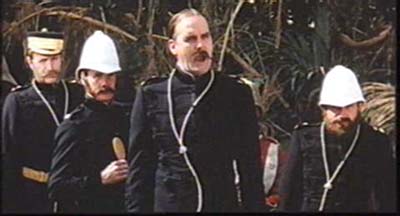
Just posting a quick article I came across in an old, old Magazine for making a Zulu War encampment by Mr Ian Weekley himself. Naturally, this sparked the idea of one for Mars for my Legion troops to defend against hordes of savage Hill Martians!

click for larger version

click for larger version

In fact this article comes from the hallowed pages of Miniature Wargames Issue 26 from July 1985, well back in last century (and almost 40 years ago in fact!)

-----------------------

Which reminded me of the lovely Martian Fort from the Slaute "Couldships of Mars" project of...well, a long time ago anyway

Pics courtesy of: http://www.werelords.com/cloudships/fort.htm


WIP pics showing construction detail:


Monday, 9 September 2024

Russians on Mars

Having decided that my French army is sufficiently big, I was scoping another Space 1889 force. My mate Gav already has some British with designs on Prussians, so what to do... Russians!

The Tsar on Mars - what might that look like? 


The Central Asian campaign look is probably most period correct (and matches the arid Mars terrain)

Vasily Vereshchagin, ‘Russian troops storming the city’


Siberian Coassack


Copplestone Castings - Back of Beyond Range - White Russians, might be sueful for some elements


Sep 2024 Edit: so yeah, of course this happened. I picked up 38 second hand Empress Russians to start the force.


Saturday, 31 August 2024

Space 1889: Grey Lady Down - Rescuing Airship Leland!

Back to Mars today, hosted by club mate Gav and with fellow Space 1889 aficionado Charles. Highly unusually for us, we kept the game size way down at 24 points, and played a modified scenario from TMWWBK rulebook. 


Using our modified rules tweaks listed here (but forgetting to use the Bolt Action dice drawing technique) I played a French force comprising:

- French Garde Grenadiers (12 man Regular Infantry) with Elite and Fierce (8 points)

- French Foreign Legionnaires (12 man Regular Infantry), with Fierce (7 points)

- 2 Skirmisher Squads (6 man/half strength Regular Infantry) (3 points each)

- Aerial vehicle crew (6 man/half strength Regular Infantry) (3 points)

The Leyand was cleverly constructed using card by Andrew P - all the fittings are magnetised

The aerial transport ship Leland had emergency landed on the Xanthe plain while transporting French supplies to Idaeus Fons. The local manager of the owning company, Dubauve and Gallais, had great influence with the local magistrate and was able to solicit military assistance for its recovery. Locally stationed legionaries had linked up with the crew, and now waited for a rescue column to arrive- led by the newly arrived Garde Grenadiers on their first foray out of the city! 

Against them, 4 mixed Martian companies (*8 units of Cutters and Shooters) advanced, seeking to forcibly claim the weapons and technology of the Earthmen.

The superior French rifles kept a number of Martian units pinned down and whittling them away slowly.  I managed to get my relief column into range and the volleys crashed out with regularity.


The Martians got some luck when their musketry took down a couple of the Airship's crew, pinning the unit. It failed to rally and the sailors fell back, abandoning the ship and their advantageous firing position. The race for the ship was on!


...and won by the Garde, who surged forward and began to pour the fire on. The Martians lost momentum and their casualties began to tell, falling backwards with a couple of units dispersing under fire.

The sound of rifle fire died away as the Martians melted back into the hinterland to lick their wounds


I thought I would be overwhelmed quickly, but lacking good leadership the Martians failed many of their activation rolls. In contrast, I didn't fail a single one all game and the Garde never rolled less than 11 !  That made it a rather one sided affair, though the Legionairres almost failed a pin check after taking a single casualty at a critical time and that would have really turned the game around.

My Armée d'Mars in all its Glory! (minus the Cavalry WIP on my desk)

Thanks to Gav and Charles for another fun game and the chance to get our figs out onto the table! Naturally we dreamed big plans for our next armies (my French army is now getting waaaay too big....said nobody ever!)


Saturday, 3 August 2024

French Land Cruiser unveiled!

Our planned game this week, to debut the French Grenadier Garde I painted earlier this year, unfortunately had to be cancelled when my mate got sick. Instead I invested time into a long stalled project... a French "Land Cruiser"!

Having trialled the design, the first four production vehicles were deployed to the German border to bolster the defences. Another pair were subsequently deployed to North Africa for expeditionary campaigning, and field tests were conducted in arid conditions.  With those lessons implemented, model Number 7 aka "Sept Chanceux" (Lucky Seven) was assigned to Franciase Corps expéditionnaire du Mars.


This was one of those models that stays in the cupboard for years awaiting the perfect time, and then rushed through the painting process in under 24 hrs to be ready for a game.  After all, a model finished to "good enough" standard is far better than "Parade Ready" too late (or so I have found out, years too late...!)

Fitted with a large calibre, short barrelled naval cannon

This model is a pre-release one that my friend allowed me to have while he implemented some improvements. The body is resin with the legs, weapon and mast in metal.  The model came with 6 different weapon options, so they are temporarily mounted depending on the field commander's needs! To add a bit more of the "Battleship on land" feel and add some colour, I made minor modifications to the mast to rig it, and then made some naval signal flags (still no wireless radio in 1889 you know!) 

Overall I am very happy with how it came out - thanks Drew for allowing me to have this model ahead of time (no release date currently)

Painting notes: Black Undercoat

Heavy Drybrush with GW Skavenblight Dinge

Drybrush with Model Colour (vallejo) Light Green Grey 70.971

Pinwash with GW Nuln Oil and Agrax Earthshade for rust spots

Wednesday, 31 July 2024

Armoured ram USS Katahdin

 Armoured ram USS Katahdin - commissioned in 1897 and expended as a target ship in 1909.


A design reminiscent of HMS POLYPHEMUS I suggest, but without the primary torpedo armament


USS Katahdin—Last of the Rams

The value of ramming, wherein one vessel deliberately runs into another, was always a sadly overrated naval tactic. Serious and objective study of naval engagements throughout the years reveals for the most part that such tactics were ineffectual, particularly against a moving target and in the face of firepower of any magnitude. This was true even in the days of Greece and Rome. Nevertheless, the idea was continually revived. With the advent of steam, entirely new tactical schemes were possible, but even then the idea of the ram continued to be espoused.

It was now held that a vessel independent of the wind would, if provided with an iron beak or even reinforced bows, be an excellent weapon in itself. Going a step further, it was argued by some that there was an important place for a vessel designed solely for ramming. This particular idea was tried with but indifferent success in several foreign navies but persisted rather strongly in this country, particularly in high places. During the Civil War a spate of rams was built by both the Union and Confederate navies in their contest to win the war afloat. Some deliberate thinkers tried to point out the fallacy of the idea. Unfortunately they were in the minority. A review of the records shows that even in the confined waters of rivers and bays, where many Civil War ship actions were fought, the ram was of dubious value.

Nevertheless the idea continued to persist in one form or another in this country. While some designers clung to the idea of the ram as a vessel designed solely for ramming purposes, others conceived of the ram as a sort of adjunct weapon, reinforcing the bows or attaching an iron beak to the bows. In the latter instances warship performance was hampered. Among other things, ships had to be built shorter and wider with ramming tactics in mind, and the bows themselves were modified, to the extent that sailing qualities were impaired.

At long last, with the building of the USS Katahdin, which proved a costly failure, the idea was finally abandoned in this country.

Built at a cost of some $930,000 at the Bath Iron Works, Bath, Maine, the vessel was named for a mountain in that state. Launched in 1893 and completed two years later, the Katahdin displaced 2,155 tons. She was 250 feet long, 43½ feet wide, and had a draft of fifteen feet. Her curved deck and her sides were covered with armor varying between two and six inches in thickness. The vessel rode extremely low in the water, in the manner of most rams. Offensive weapons were her speed and her ram. For defense against torpedo attack she was armed with four 6- pounder guns.

Designated a “harbor defense ram,” Katahdin went into commission on February 2, 1896. During her trials she failed to reach her contract speed of seventeen knots, sixteen-odd knots being the best she could do. This resulted in a reduction in the contract price paid the builders.

The Kalahdin made a short experimental cruise with the North Atlantic Squadron, then with the outbreak of the Spanish-Ameri- can War was refitted and attached to Commodore Schley’s Flying Squadron. Her war service was restricted to some rather limited patrol duty off the New England coast. Following the conclusion of hostilities she was laid up and for the next ten years was in ordinary. In 1909 she was turned over to the Bureau of Ordnance for experimental purposes, a rather expensive monument to a diehard theory.


-----

More here:

https://www.usni.org/magazines/naval-history-magazine/1994/april/unusual-strange-ship-katahdin

Tuesday, 30 July 2024

Torpedo Ram HMS Polyphemus

The 2,640 ton Torpedo Ram HMS Polyphemus was built in 1891/92 she had shallow-draft, fast, low-profile vessel, and was designed to penetrate enemy harbours at speed and sink anchored ships. She had a top speed of 17 knots, which was very fast for the time, to ram and sink or badly damage ships at anchor and make a quick escape.

Designed by Nathaniel Barnaby primarily as a protected torpedo boat, the ram was provided very much as secondary armament.


Even with a shallow draft of 20ft and 6inches Polyphemus was capable of making a passage in any weather from Plymouth to Gibraltar, or from Gibraltar to Malta at 10 knots without assistance. With a ships complement of 80, she was armed with 5 × 14-inch torpedo tubes and 6 × 1-inch Nordenfelt guns. One torpedo tube ran down the center of the ram. To help with manoeuvring in tight places she had bow rudders also on the ram. She was also the first Royal Navy vessel to be fitted with 80-volt electric lighting. This was adopted by the Royal Navy in 1882 following a fatal electrocution aboard HMS Inflexible, which had an 800-volt circuit.

Polyphemus launched a simulated attack on 30th of June 1885 evading around ten torpedoes fired by 6 torpedo boats during her two-mile run-in and easily smashed through the booms and a 5-inch steel hawser holding them in place.

It has been suggested that H. G. Wells’ fictional HMS Thunder Child from his novel The War of the Worlds may have been based on this ship, in part because he described Thunder Child as an ironclad torpedo ram.
When Martian invaders attack an evacuee packed ship, the ship goes to their rescue. During the intervention, the Thunder Child sacrifices herself to enable the refugee ship to escape but succeeds in destroying two alien tripods.


Polyphemus spent most of her career in the Mediterranean and was sold on July 7th 1903 and broken up.


Despite being a successful ship, no further vessels of this design were ordered by the Royal Navy, possibly because the development of much more sophisticated ships with traversing gun turrets, rendered the design of this ship obsolete. And so, Polyphemus was the only ship of this type which the Royal Navy possessed.


The wonderful names that the British came up for their ships, shows their affinity to the classical period. Polyphemus appears in The Odyssey of Greek mythology as a Cyclops, the son of the Greek Poseidon (equivalent to the Roman Neptune), the trident bearing sea god.

Thursday, 16 May 2024

USA on Mars

What if....Lt Colonel George Custer went to Mars with the 5th Cavalry....


A wonderful idea by Roderick Campbell here: 

     Custer was actually one of the few survivors of the Little Big Horn. This combined with his political leanings and glory hounding caused some consternation with the War Department. Custer was quietly shipped off to Mars at the head of a troop of 5th Cavalry where he would be out of the way. On a routine patrol he finds himself once again surrounded by angry native forces. 


US Infantry, Philippines, 1899


From GDW's "The Soldier's Companion"


Roderick's excellent 15mm conversions

And some 28mm USMC Infantry on patrol (on Venus in this case)


An exploration of debauchery, vice and other reasons to be a man!

An exploration of debauchery, vice and other reasons to be a man!